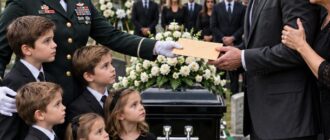
A silent three-year-old stepped into a courtroom holding onto the fur of a police dog—and then leaned in to whisper a single sentence that left the entire room frozen, because the judge suddenly realized the child had just revealed something only the true witness could possibly know.
THE CHILD WHO STOPPED SPEAKING AFTER EVERYTHING FELL APART
For three weeks, Nora Lane had not spoken a single word.
Not to the detectives who carefully repeated their questions in softly lit interview rooms designed to feel safe. Not to the doctors who examined her for signs of trauma and were met only with silence.
Not even to her foster mother, Claire Benson, who sat by her bedside each night listening to the quiet sounds of a child who no longer turned fear into language.
Nora was just three years old.

And three weeks earlier, her world had collapsed in a way she was far too young to understand or explain.
Her mother had been found unconscious in the kitchen of their apartment.
The scene suggested violence: shattered glass scattered near the counter, a chair tipped over against the wall, and a table edge cracked as though something—or someone—had struck it with tremendous force.
Emergency responders managed to save her life, but not to erase what had led her there.
Within hours, her boyfriend, Daniel Rusk, was arrested.
And just like that, the case became “clear” to everyone—except the child who had been inside that room.
Because Nora never spoke.
Not once. Not even her own name.
Claire tried everything she could think of. Gentle lullabies at bedtime. A soft stuffed rabbit Nora always clung to. Stories about brave animals surviving storms and darkness.
But the child only listened in silence, her gaze distant, fingers wrapped tightly around her toy as if it were the only stable thing left in her world.
When the trial finally began, the prosecution understood the reality: without Nora’s testimony, the case rested entirely on physical evidence and inference. Strong—but not complete.
And the defense understood it too.
That morning, the courthouse felt heavier than usual. Cameras lined the back walls. Reporters whispered in tight groups. The jury avoided looking at anyone for too long.
Daniel Rusk sat at the defense table with a calmness that unsettled the room—like a man convinced the system would never truly reach him.
Then the doors opened.
And everything changed.
THE DOG WHO BROUGHT A CHILD BACK FROM SILENCE
Atlas entered first.
A large German Shepherd wearing a dark navy service vest, trained not to intimidate, not to control—but to comfort. His purpose was simple in theory, and profoundly difficult in practice: to help frightened children remain grounded enough to testify.
He did not bark. He did not hesitate. He simply walked to the witness area and settled beside the small chair prepared for Nora.
Then she appeared.
Smaller than expected. Fragile-looking in a pale yellow dress and scuffed white shoes, clutching a worn stuffed rabbit tightly against her chest like armor against a world that felt too large.
Claire held her hand, but Nora barely responded. Her eyes stayed lowered, fixed on the floor as if even looking up might make everything more dangerous.
The judge’s expression softened slightly.
“Take your time,” he said gently.
Nora did not react.
Then Atlas shifted—just a small movement.
And Nora looked up.
For the first time since entering the courtroom, her attention landed on something that didn’t feel threatening.
The dog.
She stared at him for a long moment, as though deciding whether he belonged to the world that had hurt her or to something safer she had once known.
Then she let go of Claire’s hand.
Claire whispered her name again, but Nora was already moving.
Slowly. Carefully.
She walked toward Atlas.
No one stopped her.
No one dared.
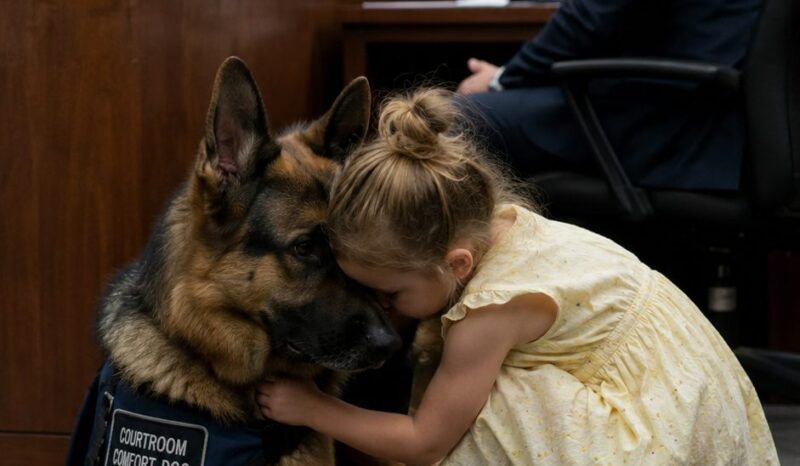
Nora knelt beside the dog and pressed her face into the thick fur of his neck. Her small fingers clutched his vest strap tightly, as if anchoring herself to something real for the first time in weeks.
The courtroom held its breath.
The prosecutor froze.
Even the defense attorney stopped turning pages.
Then Nora leaned in and whispered into Atlas’s ear.
No one heard the words.
No one except the dog.
Atlas did not react dramatically. No barking. No sudden movement. Only stillness—as if he was listening with absolute focus.
Then Nora pulled back slightly.
Her hand remained tangled in his fur.
But her eyes lifted.
She looked across the courtroom—past the jury, past the judge, past every adult who had failed to reach her.
And her gaze stopped at the defense table.
She spoke.
Barely above a whisper, but unmistakable.
“He hurt Mommy.”
The defense attorney shot to his feet immediately.
“Objection! This child is being led—this is highly prejudicial—”
The judge struck the gavel hard.
“The jury will disregard the statement.”
But it was already too late.
The words had entered the room.
And everyone had heard them.
Nora had not spoken for weeks.
Not to doctors.
Not to police.
Not to anyone.
Except the dog.
THE DRAWING THAT CONFIRMED THE CHILD SAW EVERYTHING
The prosecutor called for a short recess.
When the court reconvened, the atmosphere had shifted. Nora was still fragile—but steadier now, as if something inside her had finally found a point of balance. Atlas remained beside her chair like a quiet guardian.
The prosecutor approached carefully, lowering himself so he was at her eye level.
“Nora,” he said gently, “did you tell Atlas something important?”
She did not respond.
Instead, she reached into the pocket of her dress.
Slowly. Deliberately.
And pulled out a folded sheet of paper.
Her hands trembled as she held it forward.
The prosecutor took it and carefully unfolded it.
He went still.
It was a crayon drawing.
A small child hiding beneath a table.
A woman collapsed on the kitchen floor.
A dark figure standing nearby.
The furniture drawn at odd angles—matching the chaos documented in the crime scene photographs.
But that wasn’t what made his breath catch.
It was a detail in the corner.
A small, nearly overlooked mark.
A broken glass bottle with a very specific label imprint.
A brand identifier.
A bottle that had never been made public.
Never included in official reports.
Never shown to witnesses.
Only the investigative team—and the person who had been there—could have known it existed.
The prosecutor slowly lifted his gaze.
Across the courtroom.
To Daniel Rusk.
And for the first time during the entire trial, the certainty on his face cracked.
The judge leaned forward.
“Counsel,” he said firmly, “approach the bench.”
The defense attorney rose quickly, unease breaking through his composure.
“Your Honor, children draw random shapes all the time—this is not evidence—”
But the prosecutor was already shaking his head.
“No,” he said quietly. “They don’t draw details of evidence they were never told about.”
A heavy silence fell over the room—so dense it felt almost physical.
Atlas shifted slightly beside Nora.
And Nora, still gripping his fur, leaned in and whispered again—this time only for him to hear:
“The bad man is there.”
The courtroom did not explode into noise.
It didn’t need to.
Because everything had already changed.
In that moment, the case was no longer uncertain.
Only incomplete.
And for the first time since the trial began—
the truth had finally found a voice.