A widowed waiter shared a quiet dance with a CEO’s wounded daughter—and the melody brought him to tears.
The grand ballroom of the Imperial Hotel glowed beneath chandeliers that seemed to capture sunlight within their crystal.
Music from the orchestra flowed like a gentle tide, mingling with the soft clink of glassware and the effortless laughter of the elite.
It was the anniversary gala of Grupo Salinas del Valle, one of Mexico’s most influential corporations,

and every detail had been designed to impress—cascading white flowers, ivory carpets, shimmering gowns, and impeccably tailored suits.
Yet, in a quiet corner, seated alone on a velvet chair, was a young woman who seemed completely detached from it all.
Her name was Camila Salinas. At twenty-four, she wore a midnight-blue gown that radiated understated elegance, paired with delicate, minimal jewelry. But no one noticed her style.
No one admired her grace. Their attention was drawn instead to the scar.
A pale, uneven mark stretched across the left side of her face—from her temple down to her jaw.
It was the lasting trace of a car accident three years earlier, an event that had taken far more than her appearance.
It had stripped away her confidence, her ease, and her ability to exist without being defined by tragedy.
From the head table, her father, Alejandro Salinas—the company’s president and the evening’s host—watched her intently.
His face remained composed, but his eyes revealed his concern. He had encouraged her to attend, insisting it was time for her to return, to reclaim her place, to stop hiding.
But asking someone to be brave is easy. Living through judgment is not.
Near the bar, three young men, born into privilege rather than achievement, observed her with open cruelty.
“Poor Alejandro,” one muttered, lazily swirling his drink. “He built half the country, and still couldn’t fix his daughter’s face.”
A quiet, mocking laugh followed.
“Who would even dance with her?” another added. “I wouldn’t even look twice.”
“She should’ve stayed home,” the third concluded.
They didn’t need to speak loudly. Every word reached her.
Camila lowered her gaze, her fingers tightening in her lap until her knuckles turned white.
She didn’t cry—she had learned not to, at least not in public. But a familiar heaviness pressed against her chest, the quiet, painful awareness that even in a room full of people, she remained unseen.
Across the room, Mateo Cruz noticed.
Thirty-six years old, a widower, and the father of a nine-year-old girl, Mateo worked as a waiter at the hotel. He often took double shifts just to provide for his daughter, Valeria.
His uniform was simple but spotless, his posture steady, yet his eyes carried the quiet fatigue of a man who endured for the sake of love.
At home, Valeria waited each evening, eager to hear his stories as if he were a hero returning from an adventure.
Tucked inside his jacket was a worn blue handkerchief embroidered with tiny yellow flowers—a small keepsake from a past that had taught him both pain and compassion.
That night, he had been assigned to the VIP section—more pressure, higher expectations, but also the promise of better tips, money he needed for his daughter’s upcoming school trip.
As he refilled glasses near Camila’s table, he overheard the whispers. Then he saw her—the way her shoulders curved inward, as if she were trying to disappear.
He recognized it instantly.
He had carried that same weight after losing his wife.
The music shifted into a slow, emotional ballad. Couples began to gather on the dance floor. No one approached Camila.
At the head table, Alejandro watched, helpless.
Mateo set his tray aside.
Sometimes, overthinking leads to inaction. But Mateo was not a man who stood by when someone was hurting.
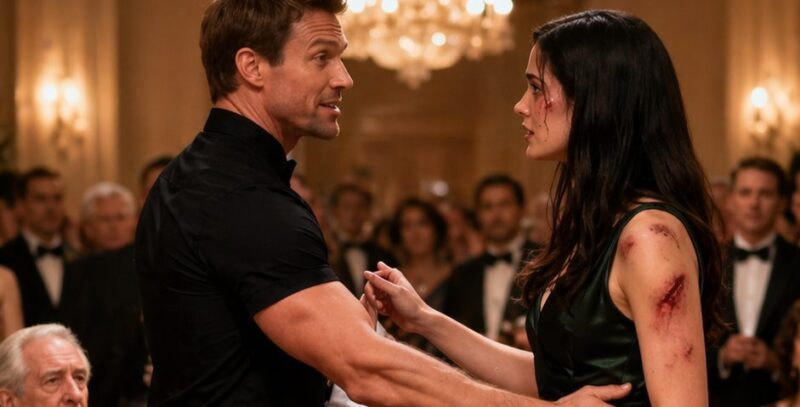
He heard his daughter’s voice in his mind: “Dad, you always help people who are sad. That’s why you’re my hero.”
He straightened his bow tie, took a steady breath, and walked toward Camila.
At first, no one noticed. Then conversations began to fade.
A ripple of curiosity spread as the waiter crossed the room toward the host’s daughter. By the time he reached her, half the ballroom was watching.
He stopped before her, gave a slight bow, and spoke clearly:
“Miss, may I have this dance?”
A deep silence settled over the room, so complete that even the orchestra seemed to soften its sound.
Camila slowly lifted her eyes, uncertain.
“Are you… speaking to me?”
Mateo smiled—not with pity, but with genuine warmth.
“Yes. And if you’d prefer not to, I understand. I only wanted you to know it would be an honor.”
Tears filled her eyes—different this time. She looked at his outstretched hand: steady, respectful, unwavering.
“You’re… a waiter,” she said quietly.
“Yes,” Mateo replied gently. “And you’re the bravest person in this room.”
At the head table, Alejandro rose to his feet without realizing it, overcome with emotion.
With trembling fingers, Camila placed her hand in Mateo’s.
And then, something remarkable happened.
No one laughed.
No one sneered.
Instead, the entire room seemed to pause, holding its breath.
Mateo gently led her onto the dance floor, his hand resting lightly against her back. At first, Camila moved stiffly, painfully aware of every pair of eyes on her, her steps hesitant and unsure.
“Don’t look at them,” he whispered softly. “Look at me.”
She did.
And in his gaze, she found no trace of pity. No discomfort. Only quiet dignity and genuine respect.
They began to move—slowly, carefully, one step at a time. Mateo never rushed her, never tried to impress the crowd. He simply followed her pace, steady and patient.
Halfway through the song, something shifted.
Camila smiled.
It was small, uncertain, almost delicate—but it was real.
When Alejandro saw it, he covered his face, overwhelmed as tears slipped through his fingers.
The music softened, as if honoring the moment. A few guests began to applaud—then more joined in—until the entire hall filled with warm, sincere clapping.
And then, from the edge of the room, a small voice called out:
“Dad!”
A little girl in a pink dress ran toward them, slightly out of breath, holding up a drawing.
It was Valeria.
She lifted the paper proudly—a crayon sketch of a man in a bow tie and a woman in a blue dress, both smiling brightly. Above them, in uneven letters, were the words:
“My dad dancing with a princess.”
A gentle wave of laughter spread through the room—not mocking, but filled with warmth.
Camila looked at the drawing, then at the girl.
“You’re very beautiful,” Valeria said simply. “Don’t let anyone tell you otherwise.”
That was the moment Camila broke.
Still holding Mateo’s hand, she sank to her knees and cried—not from pain, but from release.
“Thank you,” she whispered. “This is the most beautiful gift I’ve ever received.”
Valeria wrapped her arms around her without hesitation.
The entire room rose to its feet, applause swelling into something heartfelt and overwhelming.
Alejandro stepped forward, his voice unsteady.
“Thank you,” he said to Mateo. “You gave my daughter her smile back.”
Mateo shook his head gently.
“No, sir,” he replied. “Her smile was never gone. She just needed a reason to show it again.”
At that moment, as Mateo bent down to lift Valeria into his arms, something slipped from inside his jacket.
A blue handkerchief, embroidered with small yellow flowers.
Alejandro instinctively stepped forward and picked it up. The moment he saw the initials stitched into the corner—M.S.—his face lost all color.
His hands trembled.
“It… it can’t be…”
Mateo looked at him, confused.
“Do you recognize it?”
Alejandro slowly raised his eyes.
“This handkerchief belonged to my brother—Miguel Salinas.”
The air in the room stilled once more.
Miguel—the eldest of the Salinas brothers. The man whose portrait hung in Alejandro’s private office.
A decorated soldier who had died fifteen years earlier in the Middle East after rescuing men from a burning vehicle.
For years, Alejandro had lived with one haunting question: had his brother died alone?
Mateo closed his eyes briefly, as if something long buried had resurfaced.
“Miguel Salinas,” he repeated quietly. “He was my commanding officer.”
Silence fell again.
“He pulled me out of a burning car,” Mateo continued. “I tried to go back for him, but I couldn’t. Before he died, he gave me that handkerchief.
He asked me to return it to his family… and told me not to leave his younger brother alone. I didn’t know how to find you. I only had his name.”
Alejandro staggered slightly, gripping the handkerchief tighter.
“You… were with him?”
Mateo nodded.
“I held his hand until the end.”
Alejandro covered his face, and this time his sobs were raw and unrestrained. Fifteen years of buried grief broke free in a room that, moments earlier, had been filled with shallow judgment.
The murmurs around them changed—no longer cruel, but filled with awe.
The same guests who had seen Mateo as nothing more than a waiter now understood: he was a soldier, a widower, a father… and the last man to stand beside a hero.
The young men who had mocked Camila lowered their heads.
The women who had whispered cruelly suddenly found themselves preoccupied with anything but the scene before them.
Alejandro slowly straightened. When he turned, his voice was no longer emotional—it was firm, unyielding.
“I heard what you said about my daughter,” he declared, pointing toward the group of young men near the bar.
“You called her broken. You mocked her pain. You said no one would dance with her.”
Their faces went pale.
“You are no longer welcome at any event I host. And tomorrow, you will receive formal notice: no company under my name will ever be associated with yours again. Security—escort them out.”
Shock rippled through the room as the young men attempted to protest, but security was already moving. Within moments, they were gone.
Alejandro then turned his attention to the group of women.
“And you,” he continued, his tone quieter but far sharper, “spoke about my daughter as if she were flawed.
Let me make this absolutely clear—she is not a disgrace. She is the strongest person I know. And the man who showed her the most respect tonight was not a businessman, a politician, or an heir.”
His gaze shifted toward Mateo.
“He was a worker. A father. A man of integrity.”
No one dared to reply.
Camila inhaled slowly. Still holding Mateo’s hand, she turned to face the room—and for the first time in years, she didn’t shrink away.
“For a long time, I allowed this scar to define me,” she said. “I let fear speak for me. I let cruel voices convince me I was less than I am. But tonight, I remembered something I had forgotten…”
Her voice grew steadier.
“I am still here. I am still myself. And I am still worthy of love, respect… and being seen.”
She looked at Mateo.
“You didn’t see a scar. You saw me. Thank you.”
Valeria gently tugged at her hand.
“Can we be friends?” she asked with simple sincerity.
Through her tears, Camila laughed softly.
“I’d love that.”
From that moment on, the atmosphere of the evening changed completely.
Some guests approached her with sincere apologies. Others simply introduced themselves for the first time—as though only now realizing she was a person, not a shadow in the corner.
Camila welcomed the conversations, the smiles, even the photographs—not because she sought approval, but because she was no longer hiding.
Later, when the ballroom had nearly emptied, only four people remained seated at a quiet table: Alejandro, Camila, Mateo…
and Valeria, asleep with her head resting gently on Camila’s lap, as if she had always belonged there.
The blue handkerchief lay unfolded between them.
Alejandro stared at it for a long moment.
“For fifteen years, I’ve carried anger,” he said softly. “At the war. At fate. At everything. But what haunted me most… was not knowing if my brother died alone.”
Mateo shook his head gently.
“He didn’t.”
Alejandro swallowed hard.
“That gives me more peace than I can ever repay.”
Camila ran her fingers through Valeria’s hair, her voice softer now.
“And you gave me something I thought I had lost forever,” she said. “You reminded me what it feels like to be truly seen.”
Mateo offered a modest smile.
“I didn’t give you anything, miss. I just recognized what was already there.”
Alejandro leaned forward slightly.
“I’d like to offer you a position in my company. Something that reflects your experience—and your character. Not out of charity, but out of respect.”
Mateo glanced at his sleeping daughter, then at Camila, and finally back at Alejandro.
“Thank you, sir. Truly. But I don’t need a title to know who I am. The only thing I would accept… is help making sure my daughter can go on her school trip without me worrying about the cost.”
Alejandro smiled—this time with genuine warmth.
“That’s already taken care of. And beyond that, I want to establish a foundation in my brother’s memory—for the children of veterans, for those rebuilding their lives. I’d like both of you to be part of it.”
Camila blinked in surprise.
“Both of us?”
“Yes,” Alejandro replied. “You—because tonight, you found yourself again. And him—because he reminded all of us what true courage looks like.”
Mateo didn’t answer immediately. His eyes rested on the handkerchief.
“My daughter believes I’m a hero,” he said quietly. “Tonight… I just tried to live up to that.”
Camila gently squeezed his hand.
“You did.”
When it was time to leave, Mateo carried Valeria in his arms. Camila leaned down and kissed the little girl’s forehead.
Alejandro held the handkerchief close to his chest, as though, after all these years, he had finally found a piece of his brother again.
At the doorway, Mateo turned back one last time.
“Our scars don’t diminish us,” he said calmly. “They prove we’re still here.”
Camila met his eyes—her smile steady, bright, and free.
And that night, beneath the fading lights of the grand hall, what had begun as a display of wealth and appearances became something far more meaningful:
A genuine moment.
A daughter rediscovered her voice.
A brother was no longer lost.
A child reminded everyone how to see with the heart.
And a man in a waiter’s uniform showed that dignity is never defined by status—but by the courage to reach out when others turn away.