At a Millionaire’s Birthday Gala, a Poor Little Girl Asked to Play the Piano — What Happened Next Left an Entire Ballroom Speechless and Changed Lives Forever
The night a poor young girl asked for permission to play the piano at a millionaire’s extravagant birthday celebration,
no one in that luxurious ballroom could have imagined that a single melody would expose the emptiness hidden beneath years of wealth, status, and carefully maintained perfection.
The grand ballroom of the Palacio Estrella Hotel sparkled beneath enormous crystal chandeliers, while polished marble floors reflected a level of luxury so overwhelming it almost felt unreal.
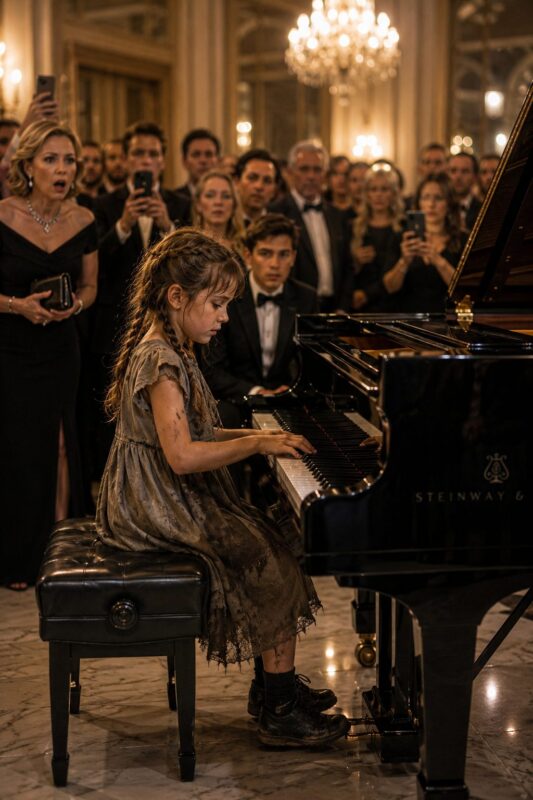
Every detail had been orchestrated to impress — from the imported wines to the elegant orchestra — all surrounding the centerpiece of the evening: a magnificent black Steinway grand piano positioned on stage like a royal treasure.
The event honored Julián Ignacio Luján Rivas, the sole heir to one of the country’s most powerful dynasties.
His mother, Isabel, floated gracefully through the crowd, proudly reminding guests that her son had studied music since childhood, speaking less like a mother and more like someone presenting a masterpiece she had personally crafted.
When Julián finally sat at the piano, the ballroom instantly fell silent. Phones lifted into the air as guests prepared to capture what they expected would be a flawless performance. And technically, it was.
Every note was precise. Every movement controlled.
But something was missing.
The music sounded perfect, yet it lacked life. It impressed the audience without truly touching them. When he finished, the applause that followed felt polite rather than heartfelt — admiration out of obligation rather than emotion.
Then, quietly, a side door opened.
A small girl stepped inside.
She immediately stood out against the sea of diamonds and tailored suits.
Her dress was plain, her shoes worn and faded, and her presence shattered the illusion of perfection the ballroom had been desperately trying to maintain.
Ignoring the whispers spreading through the crowd, she walked calmly toward the stage and asked in a steady voice:
“May I play?”
Laughter spread quickly through the room — sharp, mocking, dismissive.
Isabel instantly signaled security to remove the child. But before anyone could act, Julián raised his hand and stopped them. He watched the girl with a curiosity no one else understood.
Without asking another question, he placed a cushion on the piano bench and helped her sit down, as though he already sensed that whatever was about to happen mattered more than the expectations of everyone in that room.
In the distance, the girl’s mother, Clara, rushed into the ballroom with panic written across her face — but she arrived too late.
The child had already touched the keys.
The first notes were not polished or professionally trained, yet they carried something no elite education could ever manufacture.
Truth.
The melody unfolded slowly, overflowing with emotion far beyond the girl’s years.
Almost instantly, the atmosphere in the ballroom transformed. Conversations faded.
Laughter disappeared. Even guests who had attended only to display their wealth found themselves unable to look away.
The music did not perform for the audience.
It revealed something to them.
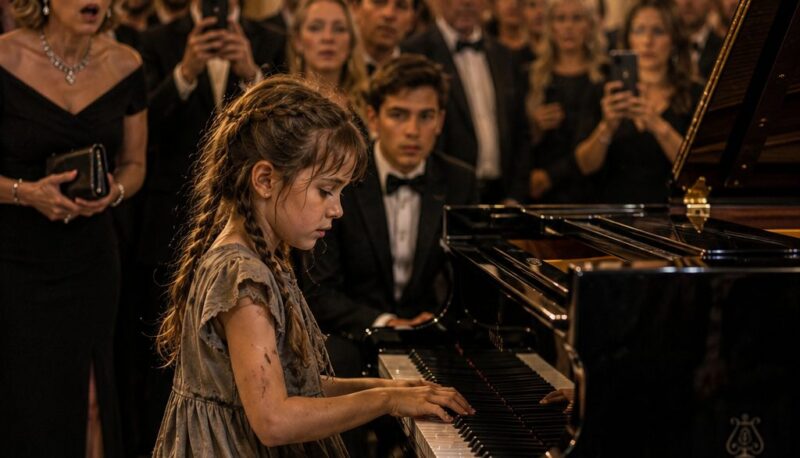
It carried sorrow, memory, hope, and humanity — emotions that the room, despite all its luxury, had long forgotten how to recognize.
Clara stood frozen, tears streaming down her face as she heard a side of her daughter she had never fully understood.
And beside the piano, Julián felt something inside him awaken for the first time in years.
When the final note faded away, silence remained.
But this silence was different.
It was full.
And when the applause finally erupted, it came naturally and uncontrollably, as though the audience had been forced to acknowledge something too powerful to deny.
The moment, however, did not last long.
Isabel’s cold voice sliced through the ballroom, demanding that the girl be removed immediately and that order be restored.
Clara, overwhelmed with shame and fear, tried to take her daughter away, but Julián followed them, no longer willing to remain trapped inside a world that had just exposed its own emptiness.
In the quiet hotel lobby, he handed the little girl a piece of unfinished sheet music he had abandoned years earlier and asked her to complete it — not out of pity, but because he recognized in her something he himself had lost long ago.
Soon, a recording of the performance spread across the world. Millions of people connected with the raw authenticity in the girl’s playing.
While Clara endured criticism and humiliation, Isabel used every ounce of her influence to bury the story, desperate to protect her family’s flawless image from something so unpredictable and uncontrollable.
But Julián chose a different path.
Away from the spotlight, he created a quiet place where the girl could continue playing freely — without pressure, judgment, or expectations.
For a brief moment, that fragile peace survived. But power rarely tolerates what it cannot control. Slowly, opportunities disappeared.
Bureaucracy became a weapon. People questioned the girl’s legitimacy, reducing her existence to paperwork and status rather than talent and humanity.
Because in the end, the world wasn’t threatened by her music.
It was threatened by the truth her music revealed:
That genuine beauty, emotion, and brilliance can emerge from places wealth and privilege often fail to see.
Refusing to fade into silence, Julián and Clara decided to step into the public eye. Together, they organized a concert inside an abandoned old theater, opening the doors to anyone willing to listen.
And when Amelia sat down to play once more, the reaction was impossible to ignore. Her music broke through social barriers, forcing even the harshest skeptics to pay attention.
But admiration alone could not dismantle the system protecting those in power. Recognition without truth changes nothing.
At the final gala — where wealth, influence, and carefully crafted appearances gathered once again beneath glittering chandeliers — Amelia stepped onto the stage before touching a single key.
She did not speak about status, fame, or identity. She spoke only about memory.
Then she began to play.
The melody was simple, almost fragile — a haunting lullaby that carried something ancient and deeply familiar.
As the music echoed through the ballroom, it awakened recognition in someone who had unknowingly been waiting years to hear it again.
A journalist suddenly rose from his seat, visibly shaken. He recognized the song immediately. It was the same lullaby once sung inside an orphanage connected to the mysterious disappearance of several children many years earlier.
The room erupted in whispers.
What had started as a performance suddenly became something far larger. Amelia’s presence was no longer simply extraordinary talent — it was a thread tied to a hidden truth buried beneath decades of wealth, influence, and silence.
Clara then revealed the secret she had carried for years: Amelia had been left at her doorstep as a small child. What had once been a quiet act of compassion instantly became part of a public reckoning that could no longer be contained.
The scandal that followed shattered the illusion of untouchable power. Investigations exposed a network of corruption linked directly to the very family that had spent years trying to control the narrative.
The empire that once appeared invincible began to crack apart — not through violence or revenge, but because the truth had finally found a voice loud enough to be heard.
A system built on appearances and silence could not survive once reality stepped into the light.
In the years that followed, Amelia’s life changed forever — though not in the way the public expected.
She never became obsessed with fame, nor did she seek revenge against those who had wronged her. Instead, she stayed close to the people who truly loved her, building a family rooted not only in blood, but in loyalty, kindness, and choice.
Julián abandoned the privileged world that had shaped him, dedicating his life instead to creating opportunities for forgotten children and unheard voices.
And Clara remained exactly what she had always been from the very beginning — the quiet foundation that made everything else possible.
Years later, when Amelia was asked how she had managed to bring down something so powerful, she never spoke about bravery or strength.
She spoke about truth.
She spoke about music.
And she spoke about the people who refused to look away.
Because in the end, nothing changed because of money or influence.
Everything changed because something genuine entered a world built entirely on appearances — and once it was seen, it could no longer be ignored.