BEFORE HIS EXECUTION, HIS 8-YEAR-OLD DAUGHTER WHISPERED SOMETHING THAT LEFT GUARDS FROZEN — AND WITHIN 24 HOURS, AN ENTIRE STATE WAS FORCED TO HALT EVERYTHING
Just hours before he was scheduled to be executed by lethal injection, a death row inmate made one final request: to see his young daughter, whom he had not held in three years.
What she whispered to him in that moment would unravel a five-year-old conviction, expose corruption at the highest levels of the justice system, and reveal a truth no one had been prepared to confront.

At exactly 6:00 a.m., officers opened the cell of Daniel Foster, who had spent the last five years on death row at the Huntsville Unit in Texas.
For five years, Daniel had proclaimed his innocence against unyielding concrete walls that never responded. Now, with only hours left before his execution, he had one final plea.
“I want to see my daughter,” he said, his voice rough with exhaustion. “Just once. Please… let me see Emily before it’s over.”
One guard glanced at him with pity. Another turned away.
But the request eventually reached Warden Robert Mitchell, a 60-year-old veteran who had overseen more executions than he cared to recall. Something about Daniel’s case had always left him uneasy.
The evidence had appeared airtight—fingerprints on the weapon, blood on his clothing, and a neighbor who claimed to have seen him leaving the house that night.
And yet, Daniel’s eyes had never looked like those of a killer.
After a long silence, Mitchell gave the order.
“Bring the child.”
Three hours later, a white state vehicle entered the prison grounds. A social worker stepped out, holding the hand of an eight-year-old girl with pale blonde hair and steady blue eyes.
Emily Foster walked through the prison corridor without tears or hesitation. Even the inmates fell silent as she passed.
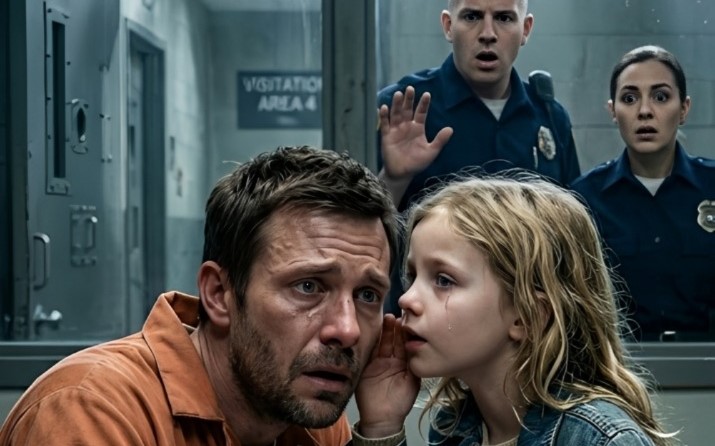
When she entered the visitation room, Daniel sat shackled to the table, noticeably thinner than she remembered, dressed in a faded orange jumpsuit.
“My little girl…” he whispered, tears welling in his eyes.
Emily stepped forward slowly. She did not run. She did not cry.
She embraced him.
For a full minute, neither of them spoke.
Then she leaned in close to his ear and whispered something no one else could hear.
What followed stunned every guard in the room.
Daniel’s face went pale. His body began to shake uncontrollably. He looked at his daughter with a mixture of shock and sudden, burning hope.
“Are you certain?” he asked, his voice breaking.
She nodded.
Daniel shot to his feet so abruptly that his chair crashed backward.
“I’m innocent!” he shouted. “I can prove it now!”
Guards rushed forward, believing he was resisting. But he wasn’t fighting them—he was crying, overwhelmed by a grief that had transformed into something entirely different.
Warden Mitchell watched from the security monitor, unmoving.
Something had shifted.
Within an hour, he made a decision that placed his entire career at risk: he contacted the Texas Attorney General’s office and requested a 72-hour stay of execution.
“What new evidence?” the voice on the line demanded.
Mitchell stared at the paused image of Emily’s face.
“A child who witnessed something,” he said quietly. “And I believe we convicted the wrong man.”
Two hundred miles away in suburban Dallas, retired defense attorney Margaret Hayes, 68, nearly dropped her coffee when she saw the report.
Early in her career, she had once failed to save an innocent man—an experience that had haunted her ever since.
The moment she saw Daniel Foster on television, she recognized the same look she had seen before.
Within hours, she was buried in the five-year-old case file surrounding the murder of Daniel’s wife.
What she uncovered deeply unsettled her.
The prosecutor who had secured Daniel’s conviction—now Judge Alan Brooks—had ongoing financial ties to Daniel’s younger brother, Michael Foster, who had inherited most of their parents’ estate shortly after Daniel’s arrest.
Even more troubling, Daniel’s wife, Laura Foster, had been quietly investigating financial discrepancies and legal documents in the weeks leading up to her death.
Margaret began connecting details others had ignored—or avoided.
Meanwhile, Emily had stopped speaking after the prison visit entirely. At the state-run children’s home where she had lived for six months under the guardianship of her uncle Michael, she communicated only through drawings.
One drawing stood out above the rest.
A house. A woman lying on the floor. A man in a blue shirt standing over her. And a small figure hiding in the hallway.
Daniel had never owned a blue shirt.
Michael wore them constantly.
With less than 30 hours remaining on the execution countdown, Margaret received a call from a man who had vanished five years earlier: Ethan Reyes, the family’s former landscaper.
“I saw what happened that night,” he said. “And there’s something far bigger you don’t know.”
What he revealed would shake the entire state.
Laura Foster had not died that night.
Ethan had discovered her still alive, barely surviving, and helped her escape before Michael could complete what he had started. A body taken from a nearby hospital—misidentified through falsified dental records—had been used to stage her death convincingly.
Laura had spent five years in hiding.
Waiting.
And during that time, she had kept evidence.
Audio recordings of Michael threatening her. Conversations in which Judge Alan Brooks discussed how to “manage” Daniel’s conviction and control the child’s future.
By the time Margaret reached a secure location outside San Antonio, she came face to face with a woman the world had long since mourned.
Laura Foster was alive.
And she was prepared to testify.
Back in Huntsville, Daniel finally slept without fear for the first time in years.
Because he now understood what his daughter had whispered to him:
“Mom is alive. I saw her.”
Within 24 hours, armed with the recordings, financial documentation, psychological evaluations tied to Emily’s trauma drawings, and sworn statements from both Laura and Ethan, Margaret submitted an emergency petition to the Texas Supreme Court.
The execution was suspended indefinitely.
Michael Foster was arrested on charges of attempted murder, fraud, and conspiracy.
Judge Alan Brooks resigned within days and was later formally indicted on corruption charges.
Five years of deception collapsed in less than a week.
And at the center of it all stood an eight-year-old girl who finally found the courage to whisper the truth.
Justice does not always arrive loudly.
Sometimes…
it arrives in a whisper.