THE PRICE OF CONTROL: A STORY OF LOSS, TRUTH, AND REDEMPTION
For twenty years, Roberto Mendoza had mistaken control for strength.
At thirty-nine, he stood at the top of a vast real estate empire—respected by financial institutions and admired by glossy magazines.
His mere presence commanded silence. He preferred it that way, convinced that authority meant power, never realizing it was simply a shield.
One ordinary morning, a minor disruption unsettled his routine. María Elena Rodríguez, a quiet and diligent cleaning worker, had missed work once again—her third absence that month.
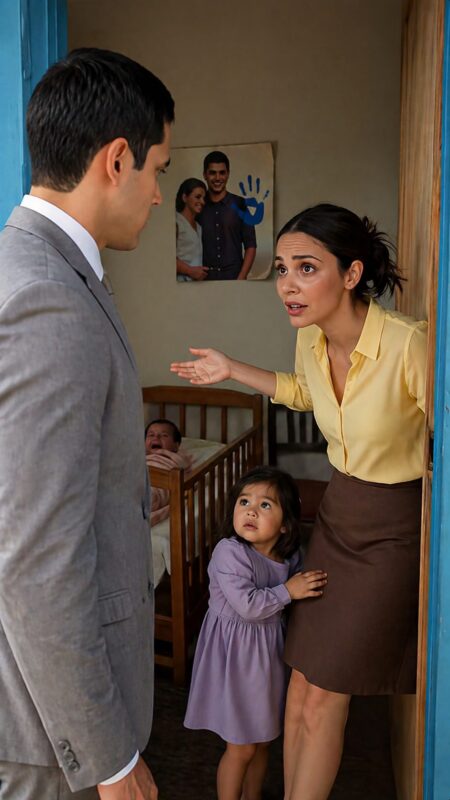
Her explanation hadn’t changed: a family emergency. Annoyed and skeptical, Roberto requested her address and decided to confront her himself.
As he drove into the impoverished district of San Miguel, a strange discomfort crept over him.
The streets were cracked, the homes fragile, and for the first time, his wealth felt irrelevant. When he knocked on the faded blue door, he expected excuses.
What he found instead was exhaustion.
María Elena looked nothing like the composed woman he saw at the office. Inside, the house told a painful story: a crying infant, a small girl, barely any furniture, and clear signs of ongoing hardship.
Roberto was ready to fire her—until the little girl asked a question that stopped him cold:
“Are you the man in the photo?”
He froze.
On the wall hung an old photograph—one he hadn’t seen in fifteen years. It showed him as a young man beside his younger brother, Gabriel. The memory struck like a blow.
Without waiting for permission, Roberto stepped further inside. In a small bedroom, he noticed more details: medication, children’s drawings, and a framed picture of Gabriel with three children.
Beneath it, a child’s drawing titled My Family included an unexpected name: “Uncle Roberto.”
The truth shattered him.
This wasn’t just his employee’s home—it was his brother’s family.
Gabriel had died years ago.
María Elena confirmed it quietly. Gabriel had been her husband. Roberto struggled to process the revelation.
He hadn’t seen his brother in over seven years, ever since their relationship had collapsed over a construction dispute.
Gabriel had uncovered serious safety violations and tried to stop the project. Roberto, focused on profit and reputation, publicly humiliated him. Gabriel walked away—and Roberto never tried to fix what was broken.
Afterward, Gabriel built a modest life. He married María Elena and became a father to three children.
But tragedy struck when he died in a structural accident linked to one of Roberto’s construction sites—saving others in the process.
The report had crossed Roberto’s desk like any other document. He had signed it without reading.
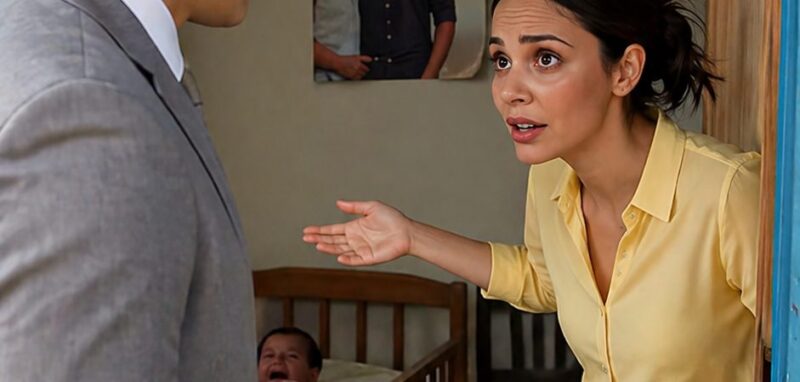
María Elena had tried to reach him after the funeral. She sent letters, pleaded for help, and even shared medical concerns about their son, Tomás. But Roberto’s assistant, Patricia, had blocked every attempt.
Standing there now, Roberto felt the full weight of his indifference.
Everything changed when Tomás suddenly struggled to breathe. Without thinking, Roberto rushed him to a private hospital. For the first time, his influence opened doors he felt unworthy to walk through.
Doctors confirmed that Tomás needed heart surgery—a hereditary condition. The same one María Elena had written about, begging only for information.
This time, Roberto stayed.
Lucía, the eldest child, looked at him and asked a simple but piercing question:
“Why didn’t you come before?”
He had no answer—only the painful truth that he had arrived too late.
That night, he confronted Patricia. She admitted hiding calls and returning letters to protect the company’s image. Roberto fired her immediately. But that wasn’t enough.
He launched a full investigation into his company, uncovering negligence, corruption, and the toxic culture he himself had created.
Publicly, he took responsibility. He funded compensation for victims, restructured operations, and enforced strict safety reforms.
Still, María Elena did not forgive him easily. When he offered money and solutions, she stopped him.
She didn’t want to be saved—she wanted respect.
Roberto understood. He created a secure trust for the children, transferred ownership of a home to her, and ensured long-term support without control or conditions.
He also reformed his hiring practices, bringing workers on directly with full benefits.
Tomás’s surgery was a success. During those difficult weeks, Roberto stayed close—not to erase the past, but to face it.
Months later, he visited Gabriel’s grave and, for the first time, asked for forgiveness.
Life didn’t suddenly become perfect. Instead, Roberto began learning what he had ignored for so long: compassion, patience, and presence.
He became involved in everyday moments, listened more, and started seeing people—not as obstacles, but as human lives.
A year later, the neighborhood had transformed. In place of neglect stood a community center named after Gabriel, offering healthcare, legal support, and assistance to families in need.
At its opening, Roberto stood quietly among the crowd—not as a powerful businessman, but as someone still learning how to be better.
Inside María Elena’s new home, two photographs hung side by side: the old one of Roberto and Gabriel, and a new one—showing Roberto with the family.
Not replacing the past, but honoring it.
That day, as they shared a simple meal, Tomás handed Roberto a drawing: a house, a crane, and five people holding hands. Above it, a single word was written:
Family.
In that moment, Roberto finally understood—his greatest failure had never been in business.
It was in forgetting people.
And though he couldn’t rewrite the past, he could choose, at last, to truly see.