His Father Called the Old Beggar “Worthless” — But the Mark on His Wrist Changed Everything
The scream sliced through the morning air like a blade.
“Stay away from that filthy beggar!”

People on the sidewalk turned their heads. A few paused. Most simply quickened their pace—the way city dwellers do when discomfort intrudes on their carefully controlled routines.
But no one reacted the way the boy did.
Marcus Hale was not a man who tolerated defiance. Not in the boardroom. Not at home.
And certainly not on the corner of West 4th and Brennan, where he had made the rare—and now disastrous—decision to walk his eight-year-old son, Eli, to school instead of sending him by car.
It was meant to be a good morning.
It lasted barely four minutes.
Eli had noticed the old man the moment they turned the corner.
He sat slumped against the wall of a closed laundromat, half swallowed by shadow, half exposed to the pale November light.
His coat resembled faded newspaper. His shoes—if they could still be called that—were torn open at the front, revealing feet that were cracked, gray from the cold, and left bare as if even his clothing had abandoned him.
Most people walked around him.
One woman even crossed the street to avoid him.
But Eli stopped.
He felt something children understand instinctively before the world teaches them to ignore it—a silent, powerful pull toward another person’s suffering. Like a compass needle drawn to true north.
“Dad,” he said softly, “that man’s feet are bleeding.”
Marcus didn’t even glance up from his phone. “Keep walking, Eli.”
“Dad—”
“I said keep walking.”
But Eli had already begun moving toward the old man. He reached into his backpack and pulled out his small water bottle—
the one with the blue cap. His mother had packed it for him every day, even now, from her hospital bed, out of habit and love.
That’s when Marcus looked up.
That’s when he grabbed his son’s arm.
“Stay away from that filthy beggar!”
The words were harsh—too harsh. Even Marcus, for a brief second, heard how they sounded out loud.
But he didn’t take them back.
He never did.
Eli’s eyes widened—not in fear, but in something sharper. A kind of realization. The moment a child recognizes that a parent is wrong—truly wrong—and understands it completely.
He pulled his arm free.
Marcus was caught off guard. His son was small, only eight, and had never once physically resisted him. But Eli twisted away and ran—not away from the situation, but straight toward it.
“Eli!” Marcus’s voice cracked across the street.
People were watching now.
A woman with a stroller had stopped. Two teenagers leaned against a wall, phones half-raised. A delivery worker slowed his cart.
Eli dropped to his knees on the cold pavement in front of the old man.
Carefully, he unscrewed the blue cap from his bottle and began pouring water over the man’s cracked, bleeding feet. With his small hands, he tried to clean them as gently as he could.
The old man looked down at him as though he were seeing a miracle.
Marcus stormed forward.
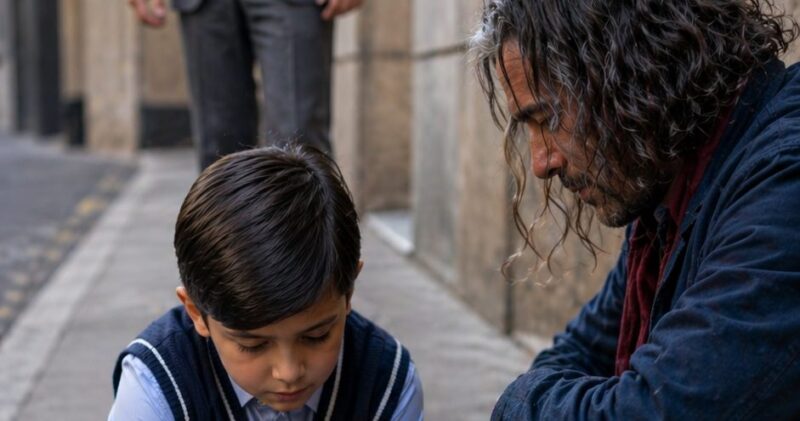
His jaw tightened, his face shifting into the cold, controlled expression he wore in the boardroom—the one that ended careers and silenced rooms.
He grabbed Eli by the shoulder and pulled him to his feet.
“That’s enough.”
“Dad, he’s hurt—”
“He means nothing to us!”
Eli looked up at him. Tears streamed down his face, but his eyes burned with something stronger than fear. In that moment, he looked so much like his mother it almost hurt to see.
Marcus opened his mouth to speak again.
But then the old man moved.
It was slow—painfully slow. Every inch of motion seemed to cost him, as though it had to fight through years of cold nights, hunger, and being ignored by countless strangers.
The old man lifted his head.
His face was worn like aged leather, lined with stories untold. His eyes—pale, gray-blue like a winter sky—were filled with tears he had yet to shed.
And on his wrist, where his sleeve had slipped back, there was a mark.
A birthmark.
Dark reddish-brown, uneven at the edges, shaped like a crescent moon.
Small. Distinctive. Impossible to miss.
Exactly like the one on Marcus Hale’s left wrist.
The one he had carried his entire life.
The one doctors had once told him was hereditary.
Hereditary.
The old man’s gaze locked onto Marcus.
Not Eli.
Marcus.
His eyes traced Marcus’s face slowly, almost hungrily—like someone rereading something they had once memorized, making sure every detail was still there.
His voice, when it finally came, was barely more than a whisper—thin and fragile, like worn paper. Yet every word was clear.
“Son… is that really you?”
The world stopped.
Not in a poetic or dramatic sense—it truly paused.
The delivery cart halted mid-roll, the woman with the stroller froze in place, even the wind seemed to hold its breath between the buildings, as if it too needed a moment.
Marcus couldn’t speak.
His mouth hung open. The polished, controlled expression he wore in boardrooms vanished instantly, as though it had never existed.
What remained was something raw, younger… and afraid. Something that had never shown itself in meetings, courtrooms, or charity events.
He looked like a child.
His gaze dropped to the old man’s wrist. To the mark. Then back to those pale gray-blue eyes—God, they were his eyes. How had he never noticed? How had he never—
His knees nearly gave way.
Eli looked from his father to the old man, then back again. His small face flickered with confusion, wonder, and the beginning of something he didn’t yet have a name for.
“Dad?” he asked softly. “Do you… know him?”
Marcus couldn’t answer.
Because, for the first time in thirty-six years, he was confronting the truth he had spent a lifetime avoiding—every silence at the dinner table, every locked door, every vague answer that wasn’t really an answer at all.
Your grandfather moved away.
Your grandfather was complicated.
We don’t talk about your grandfather.
We don’t talk about your grandfather.
Water from Eli’s bottle still trickled along the curb, forming a thin, glistening stream as it slipped toward the drain.
The old man’s eyes never left Marcus. They were patient—patient in the way only someone who has waited a lifetime can be. Patient like hope that has survived far more than it ever should have.
A tear slid down the old man’s cheek.
He didn’t wipe it away.
“I searched for you,” he whispered. “For so many years.”
Marcus’s throat tightened. His entire body was rigid, every defense he had ever built standing tall—and collapsing, piece by piece, in real time, on a public sidewalk on an ordinary Tuesday morning, with his eight-year-old son watching.
And Eli—gentle, perceptive Eli, who had knelt on cold concrete to wash a stranger’s feet while his father shouted—reached out and took the old man’s marked wrist in both hands.
Carefully. The same way he had held the water bottle.
He looked up at his father, his eyes intense and unwavering.
“Dad,” he said quietly, “I think you should sit down.”
Marcus Hale—wealthy, composed, untouchable—slowly lowered himself onto the curb.
And the three of them remained there, bathed in the pale November light, as the city flowed around them like a river bending around three unmoving stones.
Some things, once opened, can never be sealed again.
And sometimes, it takes an eight-year-old child to remind a grown man where he left his heart.