I found my daughter asleep in a grocery store parking lot, with my grandson curled up in the back seat.
When she woke and whispered that her husband and his mother had thrown her out of the house I had bought, I immediately realized something far more serious was going on.
At first glance, it looked like an ordinary evening. But as I got closer to the car, I noticed the blanket, the scattered toys, and the way my grandson slept—like a child already accustomed to discomfort.
When I knocked, my daughter, Callista, woke in fear before recognizing me. She barely lowered the window and spoke softly, as though she had already accepted what had been done to her.
I told her to open the door. After a brief hesitation, she did. I checked on my grandson, Toby, then told her firmly that they were coming home with me.
She resisted at first, worried about causing trouble, but I made it clear she was not the problem.
That night, after we returned to my home, I could see how deeply shaken she was. Fear lingered in every movement, every glance.
The next morning, I asked her to tell me everything. Slowly, the truth began to unfold.
When she married Austin, I had given them a house, keeping the deed in my name as a safeguard. At first, everything appeared stable. But over time, her independence was quietly stripped away.
Austin insisted she stay home, controlled their finances, and questioned every expense. His mother, Frances, became a constant presence, increasingly critical and invasive.
Little by little, these behaviors built into something controlling and suffocating. Callista began apologizing for everything—even for her own emotions.
Eventually, Austin controlled all access to money and accounts. She had to ask permission for basic necessities. Frances moved in permanently, and the house stopped feeling like hers.
Then, after an argument, they told her to leave and not return unless she apologized.
When Callista asked whether the house was still legally mine, I confirmed that it was. That changed everything. I reviewed her messages and found clear signs of manipulation and coercive control.

I contacted my friend Miranda, an attorney, who immediately advised taking legal action.
At the property records office, we discovered that someone had attempted to transfer ownership of the house using a forged signature.
The transfer had been rejected, but the attempt revealed their intentions. Now we had grounds for a formal case.
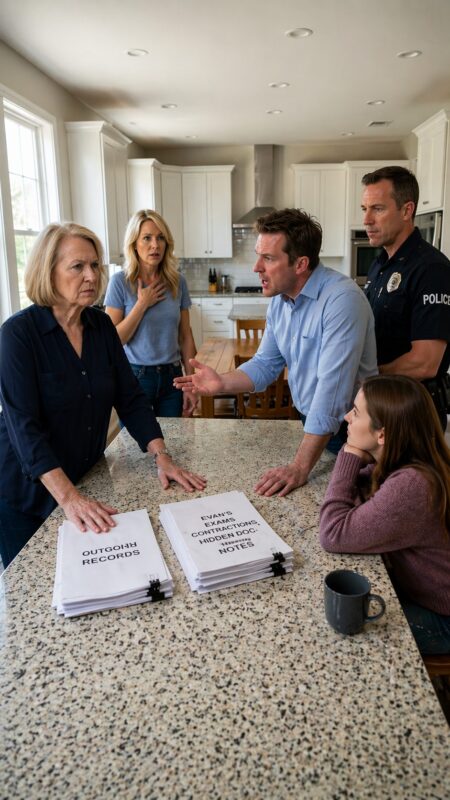
That same day, we returned to the house accompanied by a police officer. The locks had been changed, but we entered through a side door. Inside, the atmosphere felt cold and чуж, as if the home no longer belonged to the people living in it.
Toby’s room had been cleared out, and Callista’s belongings had been replaced with Frances’s. We found hidden correspondence—job offers, financial statements, official notices—that Callista had never seen.
Someone had been controlling her life without her knowledge.
In the home office, we uncovered forged documents and practice samples of my signature.
There was also a notebook labeled “CUSTODY,” in which Frances had documented Callista’s behavior, seemingly building a case against her.
Surveillance devices were discovered throughout the house.
We called Austin and instructed him to return immediately. When he arrived, he tried to maintain his innocence, but the evidence was undeniable.
When he reached for the notebook, the officer intervened and placed him under arrest. Investigators soon arrived and documented everything, including fraud and illegal surveillance.
Frances was ordered to vacate the property, and we began securing the home.
Over the following months, we focused on rebuilding—financially, legally, and emotionally. Charges were filed, and the full truth emerged.
Gradually, Callista began to recover. We restored the house, repainted Toby’s room, and rebuilt a sense of safety. I reminded her that she had not been weak—only worn down by people she trusted.
In the end, I placed the home into a protected legal trust to guarantee her security.
As she held the new keys in her hands, I saw fear finally give way to relief. What they had tried to take from her ultimately revealed something undeniable: the home—and her life—had never truly belonged to them.