I Married an Elderly Millionaire Everyone Thought I Was Using — On His Deathbed, He Told Me, “You Won’t Receive My Fortune, But I’m Giving You Exactly What You’ve Been Searching For”
When I married Arthur, I knew exactly what people thought.
I was thirty-two years old.
He was eighty-four.
To most observers, those numbers alone explained everything.
His children—Deborah, Alfred, and Norman—never bothered hiding their distrust. Family dinners felt like interrogations.
Deborah constantly implied I was after Arthur’s money, while Alfred watched me as if I might steal the silverware. Norman rarely spoke to me at all.
Only Arthur stood by my side.
Whenever arguments started, he calmly reminded them that I was his wife and deserved to be treated with dignity.

What none of them understood was that money had never been the reason I married him.
Of course, his wealth offered security. Anyone would be lying if they claimed otherwise. But what attracted me to Arthur was something far less tangible.
For most of my life, I had never truly belonged anywhere.
After my mother passed away, I spent years moving between relatives, guest rooms, and temporary arrangements. Later, failed relationships left me feeling just as unwanted. Everywhere I lived felt borrowed.
Temporary.
Fragile.
I constantly feared the moment someone would tell me it was time to leave.
Arthur was the first person who ever made me feel safe.
One evening, while we sat together in the kitchen drinking tea, he asked me a simple question.
“What do you want more than anything?”
I surprised myself by answering honestly.
“I want a place where nobody can tell me to pack my bags and go.”
Arthur stared at me for several seconds.
Then he quietly said, “That may be the loneliest thing I’ve ever heard.”
Our marriage wasn’t built on passion or grand gestures.
It was built on peace.
We watched old movies together.
Worked on crossword puzzles.
Shared quiet dinners.
Talked late into the evening.
For the first time in my life, I felt seen.
About six months before he died, Arthur took me somewhere I had never visited before.
A small cottage beside a lake.
It wasn’t luxurious. The blue shutters were faded and peeling. The wooden porch showed signs of age, and the paint needed attention.
Yet the moment I stepped outside and looked across the water, a strange feeling settled over me.
Peace.
Real peace.
Arthur smiled when he saw my reaction.
“This place belonged to Sophia,” he said.
Sophia had been his first wife.
“The cottage was her favorite place in the world.”
At the time, I had no idea how important that little house would become.
As Arthur’s health worsened, his children became increasingly interested in discussing his possessions rather than his well-being.
Hospital visits turned into conversations about paintings, investments, bank accounts, and inheritance plans.
Several times they even attempted to keep me away from him.
One afternoon, Deborah physically blocked the hospital room doorway.
“Family only,” she said coldly.
I met her stare.
“I am family. I’m his wife.”
“Only legally,” she replied.
Before I could answer, Arthur’s weak voice drifted from inside the room.
“Let her in.”
Even in his final days, he never stopped protecting me.
A few days later, he asked everyone to leave his hospital room.
Everyone except me.
Once we were alone, he reached beneath his blanket and pulled out an old cardboard box.
My name was written across the lid.
“Open it after my funeral,” he told me.
Then he made me promise.
Two days later, he was gone.
The funeral was exactly as painful as I expected.
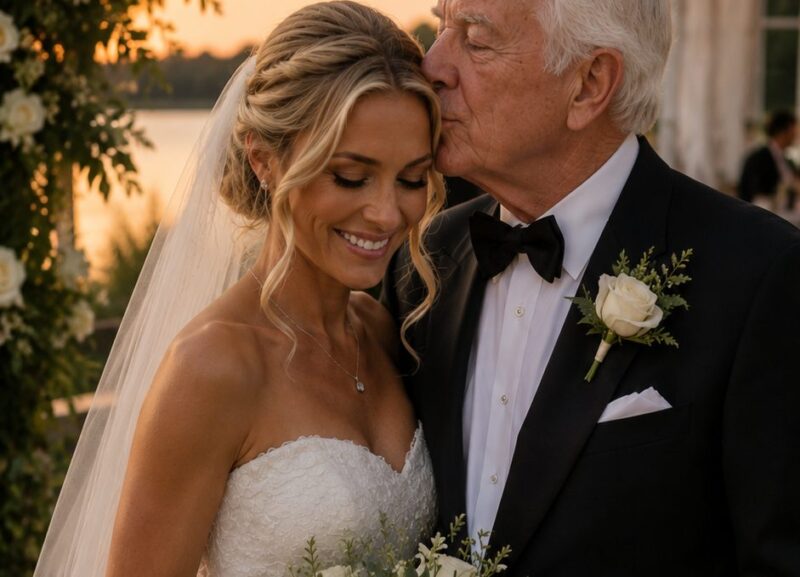
Deborah made several cruel remarks within earshot of guests.
Alfred barely acknowledged my existence.
After the service, the family gathered with Arthur’s attorney to hear the reading of the will.
As expected, Arthur left the vast majority of his estate to his children.
The mansion.
The investment portfolio.
The businesses.
The artwork.
The financial accounts.
Everything.
Then came the statement everyone had been waiting for.
“The primary estate leaves no monetary inheritance to Camille.”
Deborah smiled immediately.
“You spent two years for nothing,” she said.
I felt every eye in the room turn toward me.
Humiliated, I prepared to leave.
Then the attorney cleared his throat.
“There is one final matter.”
The room fell silent.
He explained that a separate property existed outside the estate.
The lakeside cottage.
Originally, it had belonged entirely to Sophia.
Deborah looked relieved.
Naturally, she assumed the property would remain with Arthur’s children.
She was wrong.
The attorney unfolded an old letter written by Sophia and began reading.
“If Arthur ever finds another woman who brings peace back into his life, give her the cottage.
Not as a reward.
Not as charity.
But as shelter.
A home belongs to the person who understands why having one matters.”
The room became perfectly silent.
Arthur had legally transferred the cottage into my name before his death.
The children were furious.
Deborah accused me of manipulation.
Alfred threatened court action.
For the first time, I stood my ground.
“I loved him,” I said. “I cared for him. I listened when nobody else did. And I never tried to replace your mother.”
No one had a response.
That evening, alone at the cottage, I finally opened the cardboard box Arthur had given me.
Inside was a photograph.
I recognized it immediately.
Arthur had secretly taken it during our visit to the cottage.
I was standing on the porch, staring at the lake.
On the back of the photograph, he had written:
«This was the first place where I saw you stop looking like you were ready to leave.»
Tears filled my eyes.
Beneath the photograph lay a brass key, a copy of the property deed, and two sealed letters.
The first letter was from Sophia.
She explained that if another woman ever brought happiness back into Arthur’s life, she wanted that woman to inherit the cottage—not money, not jewelry, not luxury.
A home.
A place where she would never have to wonder whether she belonged.
My hands trembled as I reached for the second envelope.
Arthur’s letter.
The final words he would ever leave for me.
Arthur’s letter was short, but every word carried weight.
He wrote that his children had always understood the value of money, while I understood the cost of loneliness.
He reminded me of the evening we sat together in the kitchen, sharing tea, when I confessed how exhausting it was to live in places that never truly felt like mine.
I had told him how much I hated waking up in homes where my name wasn’t on the mailbox, where I always felt like a temporary guest waiting for someone to ask me to leave.
Then came the final lines:
«You gave me something I thought I had lost forever—peace. My children will inherit my wealth because it belongs to them. But the cottage belongs to you because you stayed when everyone else eventually left. Welcome home, my darling.»
By the time I finished reading, tears blurred the ink.
For several minutes, I simply sat there, holding the letter against my chest.
Three months later, I returned to the lakeside cottage with the brass key Arthur had left in the box.
For the first time, I wasn’t a visitor.
I wasn’t a guest.
I wasn’t borrowing someone else’s space.
The cottage was mine.
As the key turned in the lock, a strange feeling settled over me—one I had spent most of my life searching for.
Belonging.
The little house looked exactly as I remembered it. The blue shutters still showed signs of age, the wooden porch creaked beneath my footsteps, and the lake stretched peacefully beyond the windows.
Yet everything felt different.
For the first time, I knew I didn’t have to leave.
I spent the following weeks slowly making the cottage my own while preserving the memories that already lived there.
Sophia’s favorite books remained on the shelves. Her photographs stayed in their frames. Arthur’s reading chair remained beside the fireplace.
The house wasn’t a replacement for the past.
It was a continuation of it.
One quiet afternoon, there was a knock at the door.
When I opened it, Deborah stood outside holding a small box.
Inside were several of Arthur’s books, along with a few personal items she thought belonged at the cottage.
I invited her in.
As she walked through the rooms, her eyes wandered across the familiar photographs displayed throughout the house.
Then she stopped.
On a table near the fireplace sat a framed photograph of Arthur and Sophia taken many years earlier.
Deborah stared at it for a long moment.
«You kept Mom’s picture,» she finally said.
I nodded.
«Of course.»
She looked surprised.
For years, she had assumed I wanted to erase her mother’s memory.
Instead, I had carefully preserved it.
«She belongs here,» I said softly. «This was her home long before it was mine.»
Deborah lowered her gaze.
For the first time since I’d known her, the hostility seemed to fade from her face.
«You really weren’t trying to replace her, were you?» she asked quietly.
I shook my head.
«No.»
After a pause, I added, «I was only trying not to disappear myself.»
The words hung between us.
And for the first time, I think she truly understood.
Not everything was forgiven that day.
Not every wound healed.
But something changed.
A bridge appeared where there had once been a wall.
That evening, after Deborah left, I carried a cup of chamomile tea onto the porch and settled into one of the old wooden chairs.
The lake shimmered beneath the fading light of sunset.
A gentle breeze moved across the water.
The world felt still.
I thought about Arthur.
About Sophia.
About the years I had spent searching for somewhere to belong.
Arthur hadn’t left me his fortune.
He hadn’t given me mansions, investments, or bank accounts.
Instead, he gave me something infinitely more valuable.
A place where I would never again have to ask permission to stay.
A place where my name belonged on the door.
A place that was finally, unquestionably, home.