“LET ME DANCE WITH YOUR DAUGHTER… AND I’LL HELP HER WALK AGAIN,” SAID THE HOMELESS BOY
A gentle June rain drifted over Chapultepec Park, covering the city in a gray mist that seemed to reflect the sorrow inside Carlos Mendoza.
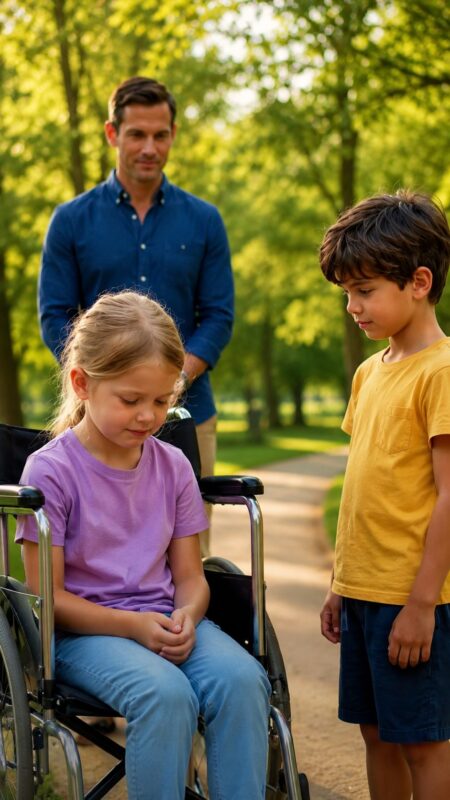
Holding an umbrella with tired determination, he stood beside the wheelchair carrying his daughter, Valeria, whose distant eyes stared blankly ahead.
Two years earlier, their lives had shattered. Ever since the accident that claimed his wife’s life, Valeria had been unable to walk.
Worse than the paralysis was the silence that surrounded her—a silence no doctor, therapy, or fortune had managed to break.
Carlos felt the cold seep through his coat, but the deepest chill came from the hopelessness buried inside him.
Then a voice interrupted the rain.
“Sir… let me dance with your daughter, and I’ll help her walk again.”
The voice belonged to a child, yet it carried an unsettling confidence.
Carlos turned and saw a boy no older than twelve. He was barefoot, his clothes worn and stained, dark hair hanging messily over sharp eyes. He looked like countless abandoned children wandering the streets of Mexico City.
But something about him felt different—something fearless and impossible to ignore.
Carlos’s first instinct was outrage.
How could this child mock his suffering? He had spent fortunes searching for answers, consulted renowned specialists, and traveled endlessly for treatments.
And now a homeless boy was offering miracles through dance?
He was seconds away from calling security and throwing the child out—
Until he felt a gentle tug on his sleeve.
Valeria.
For the first time in months, she wasn’t lost in emptiness. She was staring directly at the boy. And in her eyes, usually hollow and lifeless, a faint spark had returned.
“Let him stay,” she whispered softly, her voice stronger than Carlos had heard in a long time. “His name is Mateo.”
That single moment shattered something inside him.
The boy somehow knew their habits. He knew Valeria loved feeding pigeons in the park. He knew her favorite colors.
He had quietly observed them for weeks—not with bad intentions, but with a kind of attention Carlos himself had forgotten in his grief.
Mateo never asked for money.
He never asked for food.
He only asked for one chance—to prove that music could heal wounds medicine could not reach.
Caught between doubt and desperate hope, Carlos finally agreed.
Mateo was invited to the Mendoza mansion on Avenida Reforma under strict supervision.
As the boy disappeared into the rain, leaving wet footprints behind him, Carlos felt an uneasy shiver crawl down his spine.
He had no idea that this strange encounter was about to unleash a storm of emotions, expose buried secrets, and challenge everything he believed about healing, family, and love.
Monday arrived wrapped in tension.
Josefina, the loyal housekeeper who had cared for Valeria like her own child, strongly opposed allowing a “street kid” into the house.
But when Mateo stepped inside—his damp hair neatly combed, his bare feet clean despite the storm—the mansion itself seemed to fall silent.
He carried no medical equipment.
No miracle drugs.
Only an old portable radio powered by batteries… and absolute faith.
The sessions began unlike anything Carlos expected.
There were no painful therapies. No forced attempts to stand.
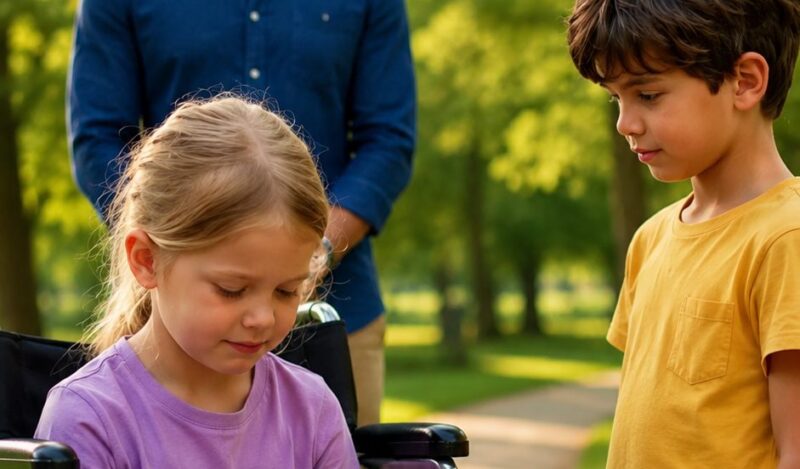
Mateo simply sat with Valeria, played soft music, and talked to her.
They spoke about rhythm. About melodies hidden in nature. About the sound of wind moving through trees.
And then Mateo danced.
Not professionally. Not gracefully in the traditional sense.
His movements were raw, emotional, and free.
Sitting on the floor, he moved his arms and torso in ways that mirrored Valeria’s physical limitations, transforming weakness into expression.
“The dance isn’t in your legs, Valeria,” Mateo said with a bright smile. “It’s here.” He touched his heart. “And here.” Then he gently tapped his temple.
Weeks slowly passed.
The changes were small—but impossible to deny.
Valeria, who had barely spoken in months, started talking again. Laughing again. Waiting eagerly for Mateo’s visits.
Determined to learn the truth about the mysterious boy, Carlos hired an investigator.
What he discovered shook him deeply.
Mateo was an orphan. His mother had abandoned him years ago. He had once cared for a younger sister named Sofía, who also lost the ability to walk after severe emotional trauma.
And somehow… Mateo had helped her walk again using the same strange method of music, patience, and emotional connection—before authorities separated the siblings.
Carlos realized something heartbreaking:
This wounded child was healing Valeria with fragments of his own pain.
But healing never comes without resistance.
Carlos’s mother, Doña Mercedes—a proud woman obsessed with status and appearances—arrived furious, demanding the “madness” end immediately and threatening to involve the authorities.
Even Dr. Gutiérrez, the family physician, warned Carlos not to cling to false hope.
Then everything changed.
One afternoon, while practicing a breathing exercise, Valeria focused entirely on Mateo’s voice and the soft melody playing nearby.
Suddenly—
Her toe moved.
Only slightly. Barely enough to notice.
But for them, it felt like the earth itself had shifted.
“I felt it, Dad! I moved it!” Valeria cried, tears streaming down her face.
That tiny movement shattered years of despair.
It proved the connection between her body and mind had never completely disappeared.
It had simply been sleeping…
Waiting for the right melody to awaken it.