My family forced me to sleep in an ice-cold garage while I was seven months pregnant, only a few months after my Marine husband’s funeral. But less than twelve hours later, black military SUVs pulled into the driveway, armed soldiers addressed me by name, and the same people who had humiliated me suddenly realized they had just destroyed their own future.
At 5:12 a.m. on Thanksgiving morning, my phone vibrated across the kitchen counter.
It was my younger sister, Chloe.
No greeting.
No warmth.
No hesitation.
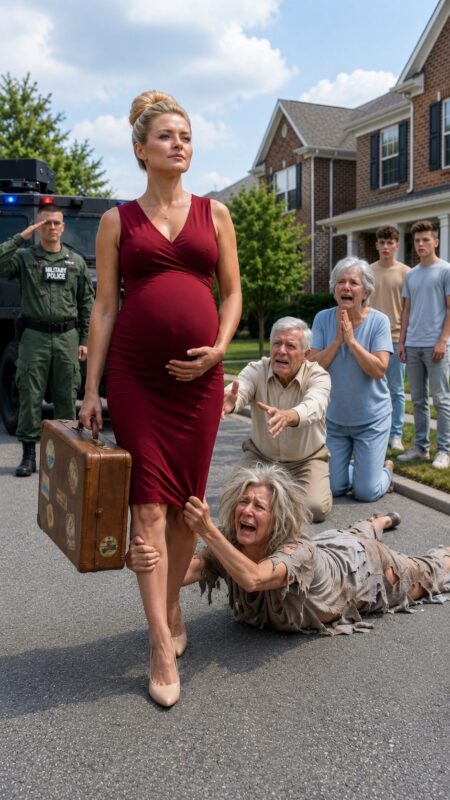
“Mom and Dad need the upstairs bedrooms,” she said flatly. “Move your things into the garage tonight. Ryan needs a private office while he’s staying here.”
I stood silently by the sink, holding a cup of cold coffee, wrapped in my late husband Daniel’s old Navy sweatshirt. Frost coated the windows.
The kitchen smelled of stale grease and artificial cinnamon candles, as if someone was trying—and failing—to make the house feel warm.
“The garage?” I asked quietly. “It’s freezing outside.”
My mother stirred sweetener into her coffee without even looking at me.
My father lowered his newspaper, irritation already sharp in his expression.
“You heard your sister,” he snapped. “Stop acting like the world owes you something.”
I almost laughed.
Because Daniel Carter, my husband, had paid for nearly everything in that house.
Daniel bought it after his second deployment overseas.
Daniel paid for my father’s surgeries.
Daniel covered Chloe’s law school tuition.
Daniel helped Ryan launch his consulting business.
And Daniel had been dead for nine months.
Apparently, that was enough time for everyone to forget.
Chloe walked into the kitchen in silk pajamas, holding her tiny designer dog like she was walking into a photoshoot.
“It’s temporary,” she said casually. “Ryan needs quiet for his meetings.”
Ryan smirked behind her.
“And honestly,” he added, “this whole grief atmosphere is exhausting.”
My mother sighed as if inconvenienced.
“Just don’t leave boxes everywhere,” she muttered. “Ryan parks the Mercedes in there.”
No one looked ashamed.
No one looked uncomfortable.
That was the worst part.
Cruelty in families rarely sounds cruel. It sounds reasonable, practical, justified.
I smiled once.
Small.
Empty.
“Fine,” I said softly.
They thought I was giving up.
In reality, I had simply stopped protecting them from the consequences of who they had become.
That night, I packed in silence.
Two coats.
Maternity clothes.
My laptop.
Daniel’s military tags.
Nothing else mattered anymore.
The garage smelled of gasoline, damp concrete, and dust. An old folding bed had been shoved against the wall beside stacks of plastic storage bins.
One thin blanket.
No heater.
No bathroom.
No dignity.
I lowered myself onto the bed and rested a hand over my stomach.
The baby kicked gently beneath my palm.
Then my encrypted phone vibrated beside me.
TRANSFER COMPLETE.
PROJECT ORION AUTHORIZED.
DEFENSE CONTRACT APPROVED.
TRANSPORT ETA: 0800.
WELCOME TO STRATIX DEFENSE SYSTEMS, MRS. CARTER.
I stared at the screen in silence.
For nearly a year, while my family treated me like a burden occupying space in their home, I had secretly completed the military defense software Daniel once dreamed of building himself.
A battlefield communication shield.
A system designed to prevent extraction failures during combat evacuations—the same kind of failure that had cost Daniel and his unit their lives overseas.
I built it from his research.
From his notes.

And from my grief.
Two days earlier, Stratix Defense Systems—one of the largest defense contractors in the United States—had purchased the entire platform.
And appointed me Chief Technology Officer before my thirty-third birthday.
My family knew none of it.
Because none of them had ever cared enough to ask what I was doing behind closed doors.
At 7:58 a.m., the garage floor began to tremble.
Heavy engines.
Multiple vehicles.
I slowly opened the garage door.
Three matte-black military SUVs rolled into the driveway.
Then Colonel Nathan Hayes stepped out in full dress uniform.
Behind him stood four members of Daniel’s former special operations unit.
Because Daniel should have been standing beside me that morning.
He should have witnessed his dream finally come to life.
The colonel’s voice softened.
“Daniel would be proud of you.”
Those words broke something inside me.
Not completely.
Not loudly.
But enough that tears immediately filled my eyes.
Behind us, my family stood frozen as the weight of reality settled over them.
The pregnant widow they had forced into a freezing garage had quietly built something extraordinary while living under their roof.
Ryan was the first to speak.
“Wait… she works for the government?”
Colonel Hayes didn’t even look at him.
“Mrs. Carter now oversees one of the most critical military defense systems developed in the last decade.”
Silence fell across the driveway.
Then the colonel opened another folder.
“Additionally,” he said calmly, “there is one final legal matter to address.”
He handed me a second document.
Property transfer of ownership.
Daniel had protected me in ways I never fully understood.
The house had never belonged to my parents.
It had belonged to us.
And after Daniel’s death, full ownership had passed to me.
My mother’s face went pale.
Chloe stared at me in shock, unable to process what she was seeing.
Ryan looked physically unwell.
My father slowly lowered the newspaper from his hands.
I looked at all of them quietly.
Then I spoke.
“You forced the rightful owner of this house to sleep in the garage.”
No one answered.
A cold wind swept across the driveway as truth finally settled over them.
Some people mistake silence for weakness—until consequences arrive in military uniforms and polished black boots.
Colonel Hayes gently took my suitcase and placed it inside the SUV.
I touched Daniel’s dog tags resting against my chest.
Then I turned away from the garage, the house, and the people who had abandoned me long before I ever left them behind.