My Father-in-Law Threw Me and My Six Children Into the Rain, Saying “Only Real Blood Belongs Here.” But the Moment I Mentioned the Name on the Property Deed, Everything Changed.
“Take your six children and leave. My son is gone, and you have no place in this family anymore.”
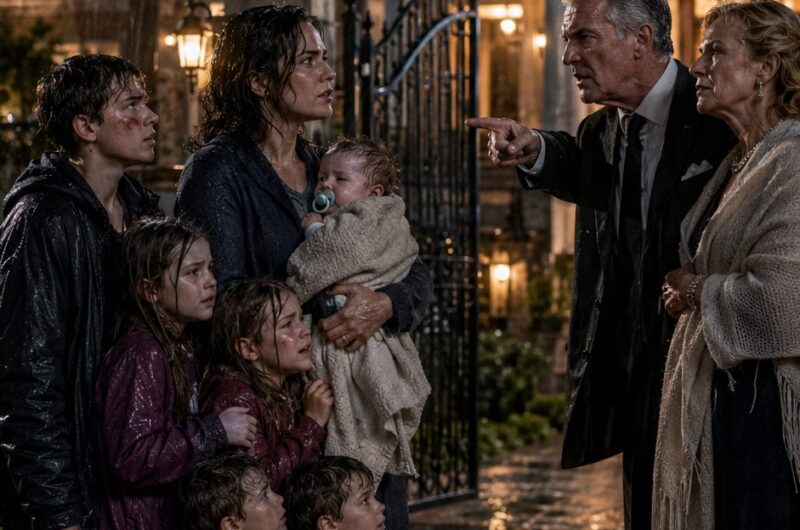
Patrick Callahan’s words hit me harder than the cold rain falling across Pine Valley that night.
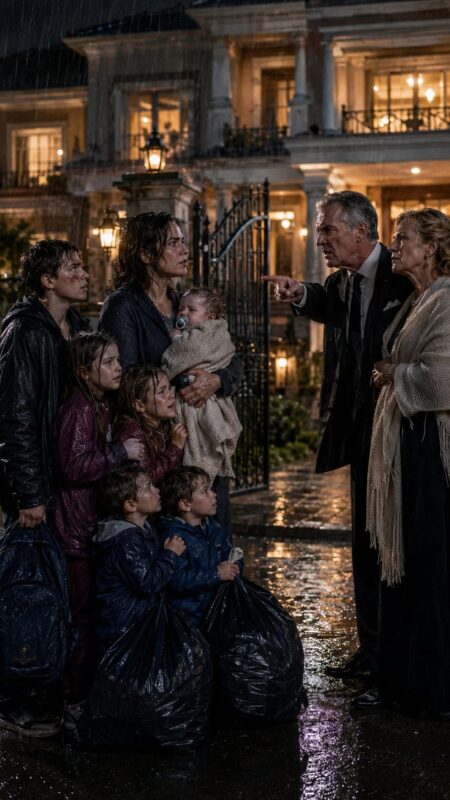
I stood outside the wrought-iron gates with my baby daughter, Sophie, pressed tightly against my chest.
Behind me, my five other children shivered in the storm, clutching school backpacks and two garbage bags stuffed with the belongings my mother-in-law had carelessly thrown together.
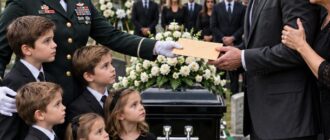
My husband, Andrew, had been buried only seven days earlier.
One week.
That was all the time his parents needed to replace sorrow with greed.
“Patrick, please,” I said, struggling to steady my voice. “Those are your grandchildren. This was Andrew’s home too.”
Margaret Callahan stepped beside her husband, wrapped in a luxurious cashmere shawl.
“It belonged to Andrew because we allowed it,” she replied coolly. “But don’t fool yourself, Cynthia. Marrying a Callahan never made you one.”
My oldest son, Benjamin, only thirteen, stepped forward. His eyes burned with anger.
“Dad said Mom was supposed to stay here,” he said. “I heard him myself.”
Patrick’s expression darkened.
A moment later, Benjamin staggered backward, clutching his cheek.
Something inside me froze.
“Do not ever touch my son again,” I said quietly.
Patrick laughed.
“And what exactly are you going to do? Sue us? You came into this family with nothing, Cynthia. And you’re still nothing.”
Grace and Abigail were crying openly. The twins, Samuel and David, clung to my skirt. Sophie’s fever made her body feel dangerously warm against my shoulder while the rain soaked us all.
Margaret kicked one of the bags toward us.
The seam split open, spilling clothes into the mud.
“We’ve already changed the locks,” she said. “And if you come back, we’ll tell the police you’re unstable. A penniless widow with six children? Nobody will take your side.”
I looked toward the mansion.
Curtains shifted behind the windows.
Relatives were watching.
Neighbors were watching.
Everyone saw what was happening.
Not a single person came outside.
For fourteen years, I had tolerated their insults for Andrew’s sake. I ignored their comments, swallowed their judgments, and endured being treated like an outsider.
But that night, my silence finally ended.
I took Benjamin’s hand and guided my children toward the road.
I had nowhere to go.
No plan.
No certainty about tomorrow.
Only six frightened children and a yellow folder hidden inside the diaper bag—a folder Andrew had entrusted to me before he died.
“If my parents ever try to force you out,” he had whispered, “take this folder to Rebecca Stone. Don’t open it until you’re sitting in her office. Promise me.”
Halfway down the driveway, I stopped and turned around.
“Before you start celebrating,” I called out, “you should probably verify who actually owns this house.”
Patrick’s expression changed immediately.
Margaret’s smile disappeared.
For the first time all night, nobody spoke.
Only the sound of rain filled the silence.
That night, we checked into a small roadside motel.
The carpet smelled musty.
The television didn’t work.
The bathroom light flickered every few seconds.
But my children were warm.
They were dry.
Most importantly, they were safe.
Benjamin sat by the window watching the parking lot as though he had aged years overnight. Grace and Abigail helped the twins settle into bed.
When everyone finally fell asleep, I pulled out the yellow folder.
Inside were legal documents, a USB drive, and a handwritten letter from Andrew.
His handwriting was unsteady.
Cynthia,
I’m sorry you’re facing this. My parents never accepted you, but they cannot take away what we built together.
The house is protected by a trust. You’re the trustee. The children are protected as well.
If they come after you, Rebecca has everything she needs.
My father has been moving company funds for years.
Don’t be afraid.
I covered my mouth as tears streamed down my face.
The next morning, while the children quietly ate stale bread from a nearby convenience store, my phone wouldn’t stop vibrating.
Margaret had posted a photo of the Callahan living room online.
The caption read:
«True family always finds its way home.»
Comments poured in.
People praised her.
They called her strong.
They offered sympathy.
A few hours later, a legal notice arrived.
Patrick and Margaret were formally accusing me of abandoning the property and attempting to steal assets from Andrew’s estate.
At noon, my phone rang.
Margaret.
“Cynthia,” she said sweetly, “let’s be practical. Sign over any claim to the house, and I’ll give you one hundred and fifty thousand dollars. You can start over somewhere else.”
“And if I don’t?”
Her voice instantly lost its warmth.
“Then we’ll prove you’re an unfit mother. You’re broke, alone, and raising six children by yourself. Think very carefully before making the wrong decision.”
My eyes burned, but my voice remained steady.
“I’ll see you in court, Margaret.”
Then I ended the call.
That afternoon, I met Rebecca Stone.
She was composed, intelligent, and impossible to intimidate.
After reviewing the documents, she nodded.
“Andrew met with me months ago,” she said. “He suspected something like this could happen.”
Then she inserted the USB drive.
Andrew appeared on the screen.
He looked thin and exhausted, but his eyes were focused and determined.
“If you’re watching this, Cynthia,” he said softly, “it means they tried to hurt you.”
He paused.
“My wife never took anything from me.”
“She helped build everything I had.”
“And if anyone deserves protection after I’m gone, it’s her.”
“She raised our children. She took care of me. The house belongs to her and the kids. Don’t let them intimidate you.”
That was the moment I broke down in tears.
Rebecca then revealed the rest of the evidence—bank statements, concealed accounts, forged agreements, and email records proving that Patrick had been diverting funds long before Andrew’s death.
“This is a strong case,” she said calmly. “And it will stand in court.”
Just then, my phone vibrated again.
A former housekeeper had sent me a video. It showed Patrick inside the garage, speaking to a real estate agent.
“Sell it this week,” he said firmly. “Before she realizes the property isn’t even in my name anymore.”
A cold, controlled rage settled inside me.
Then came one last message from Margaret: a photo of her wearing my mother’s ring—the same one Andrew had once kept safe for me.
“Some women are born to wear jewelry,” she wrote. “Others are born to clean it.”
I stared at the courthouse address in my hand.
It was time.
On the day of the hearing, I wore a simple blue dress and arrived with all six of my children. Benjamin’s cheek had mostly healed, but his eyes still carried the weight of that night.
Patrick entered the courtroom as if he already owned it. Margaret sat beside him, proudly displaying my ring so everyone could see it.
Their attorney tried to paint me as unstable, arguing that Andrew had not been of sound mind when he created the trust, and that I had contributed nothing to the Callahan family.
Benjamin shifted beside me, anger rising, but I kept hold of his hand.
Then Rebecca stood.
She didn’t raise her voice. She didn’t need to.
“Your Honor,” she said evenly, “we have notarized trust documents, full medical records, financial documentation, and a recorded statement from Andrew Callahan himself.”
She laid everything out with precision.
The property was not Patrick’s. It was held in a trust. I was the legal administrator. My children were the rightful beneficiaries. Patrick had no authority to remove us.
“This is false!” Patrick shouted.
Rebecca calmly pressed play.
Andrew’s face appeared on the courtroom screen.
“Cynthia gave up her career to raise our children and take care of me,” he said. “Anyone claiming she contributed nothing to this family is lying. She held everything together while my parents focused on money.”
Margaret turned pale.
Rebecca then presented the emails, financial records, and the garage recording. Finally, she showed evidence of what had happened to Benjamin outside the gate.
The judge turned to Patrick.
“Did you strike this child?”
Patrick hesitated.
“It… it was a misunderstanding,” he stammered.
Benjamin stood up.
“I was protecting my mother.”
The judge’s expression hardened.
He upheld the trust, froze Patrick’s financial assets, and issued a restraining order preventing both grandparents from approaching us.
Then Rebecca pointed toward Margaret’s hand.
“And the ring, Your Honor.”
Margaret instinctively covered it.
“It belongs to me,” she insisted.
The judge’s voice was firm.
“Remove it.”
With shaking hands, she took off my mother’s ring and placed it on the table.
I didn’t feel victorious.
I felt free.
A week later, my children and I returned to the house. Laughter echoed through the halls again as they ran from room to room, bringing life back into every corner.
Benjamin stood beside me at the gate.
“Dad knew, didn’t he?” he asked quietly.
I nodded.
“Yes,” I said. “He knew.”
Months later, Patrick was buried under lawsuits and financial collapse. The house was legally and completely ours.
One afternoon, Benjamin planted a small lemon tree near the entrance.
“So something good can grow where they made us feel unwanted,” he said.
I hugged him tightly.
And in that moment, I finally understood something deeply true:
Family isn’t a surname, a mansion, or money in a bank account.
Family is who stays beside you when the storm comes—when everyone else chooses to shut the door.