My son and his wife forced me and my three-month-old granddaughter into the basement, yelling, “Stay here, you noisy brat and useless old woman!” before boarding a flight to Hawaii. When they came back, the first thing that greeted them was the smell—and then the horror, as they asked, “How did this happen?”
My name is Margaret Johnson. I was sixty-two when my own son locked me underground with his infant daughter and left for a vacation.
It’s the truth—harsh and unembellished. People hear it and assume I must be exaggerating, that there had to be some misunderstanding or moment of panic that explains it.
There wasn’t. My son, David, and his wife, Karen, had arranged a trip they couldn’t afford unless someone took care of baby Emily for two full weeks.
They assumed that someone would be me, just as it had always been since my husband died: waking early to watch her, feeding her, rocking her to sleep, washing bottles,
folding her tiny clothes, and handing her back each evening while they came home tired and entitled. When I told them I couldn’t manage Emily alone for that long, something cold settled over their faces.
I should have recognized it sooner. For months, I had felt myself slipping from mother into unpaid servant. David barely lifted his eyes from his phone when he asked for help.
Karen had stopped saying please. If they were late, I stayed later. If Emily cried at night, they brought her straight to me.
I loved that child with everything in me—but love can be turned against you when selfish people know exactly how to use it.
The evening before everything happened, they came home from shopping with beach sandals, sunscreen, and bright, careless smiles. Hawaii was no longer an idea—it was booked.
David spoke as if my agreement had already been decided. Karen called me “the only person Emily trusts,” not out of gratitude, but as a tactic.
I refused again—not to Emily, never to her—but to being treated as though I had no limits, no grief, no body that could grow tired.
The next morning, they were too calm.
David asked me into the kitchen. Karen stood by the stairs, Emily’s diaper bag already packed. Before I could understand what was unfolding, David grabbed my arm—hard.
Karen took Emily’s carrier. I shouted, thinking it was just another argument that would stop once reason returned.
It didn’t.
They dragged us toward the basement door.
I remember everything—the moment Emily began to cry, the way my shoes slipped on the floor, the heavy drop of fear in my stomach as Karen opened the door.
David shoved me down the steps. Karen pushed the carrier after me. Then came the words I will hear for the rest of my life:
“Stay here, you noisy brat and useless old woman.”
The door slammed shut. The lock clicked. Their footsteps faded away.
At first, I screamed. I pounded on the door until my hands went numb. I called David’s name the way I used to when he was a little boy running too close to the street.
But above me, the house grew quiet—then silent—then final.
Emily’s cries filled the darkness.
And as I held her close, I understood something terrible.
My son hadn’t lost control.
He had abandoned us.
Once my eyes adjusted to the dim light, I forced myself to stop shaking and think—like a teacher, like a widow, like someone who needed to survive. Panic would waste what little we had.
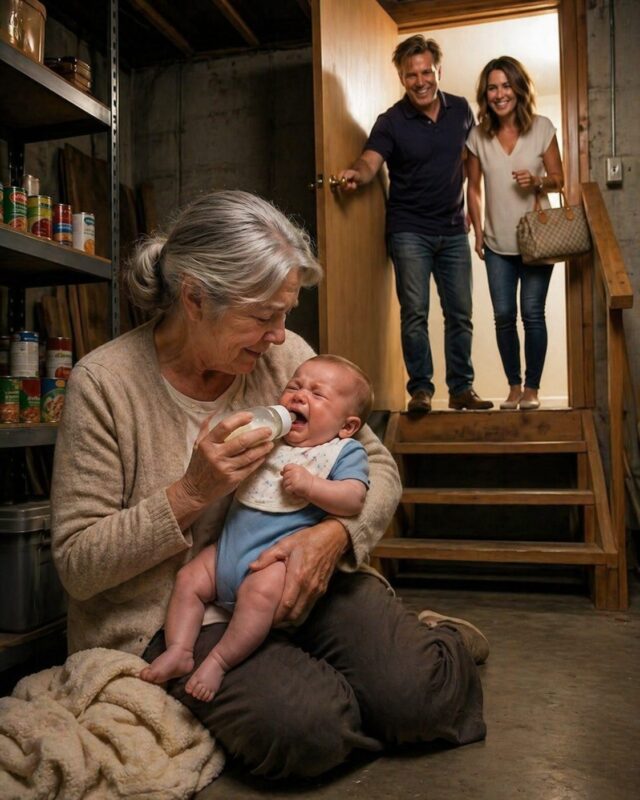
Emily needed food, warmth, and a voice that didn’t sound afraid, even if mine trembled. Near the wall, I found a plastic shopping bag. Inside were canned vegetables, soup, bottled water, baby formula, diapers, and wipes.
Enough to prove this wasn’t impulsive.
They had planned it.
That realization hurt more than the locked door.
My phone was still in my pocket, and for a brief moment, hope surged through me. But there was no signal. I walked the basement, holding it up as if it might catch something—anything.
Nothing. I switched on the flashlight and searched every corner. The air smelled of concrete, damp wood, dust, and old cardboard.
There was a small ground-level window, too narrow to climb through, an old radio, and beneath a workbench, a rusted toolbox.
That toolbox became my only hope.
Inside were pliers, screwdrivers, a hammer, nails, and spare batteries.
I started with the door. Balancing Emily in one arm, I tried to work on the hinges. The screws were old and stubborn, the angle awkward. I struck at the lock until my wrists ached, but the wood held.
Every failed attempt made the room feel smaller, tighter. When the noise upset Emily, I stopped, held her close, hummed softly, and waited for her breathing to steady before trying again.
Hours passed—maybe more. Time lost its meaning underground.
When my phone battery dropped below half, I turned it off and switched on the radio instead. With fresh batteries, voices crackled through the static—weather reports, sports updates, fragments of music.
Human voices.
I almost cried.
We were still part of the world… even if the world had no idea where we were.
I carefully rationed everything we had. The formula was for Emily first. Water was shared between us. I allowed myself small portions of canned food only when the dizziness became too strong to ignore.
I changed her on an old blanket, folding each diaper neatly, doing everything I could to keep our small space clean.
When she cried for too long, I sang the same lullabies I had once sung to David—and that hurt in a way I can hardly explain. More than once, I had to stop because the bitterness rose so sharply it felt like it might choke me.
By what I believe was the second day, I noticed a crate of vegetables I had brought home earlier that week. Some of them had already started to spoil. The smell was sour and sharp.
That’s when an idea formed. If I placed the rotting vegetables beneath the small basement window and let the odor drift outside, maybe someone would notice.
A neighbor. Someone passing by. Maybe even Sarah—the college girl from the farmers market who always asked about Emily.
So I turned decay into a signal.
I dragged the crate across the floor, opened the worst of the bags, and shoved them beneath the window. By evening, the stench was strong enough to sting my eyes.
Good, I thought. Let someone notice. Let someone ask questions.
Then I sat there with Emily in my arms, the radio whispering faintly in the darkness, and made a promise to myself: if my son intended for us to disappear quietly, I would make sure our survival made enough noise to destroy his lie.
We were rescued because one young woman paid attention.
Sarah worked at her family’s stall at the Saturday farmers market. I had promised to bring Emily again, and I was the kind of person who kept her word. When I didn’t show up, she noticed.
On her way home, she passed my house and caught the foul smell drifting from the basement window. The curtains were drawn. The driveway was empty. She knocked.
She called my name. No answer. Most people would have walked away.
Sarah didn’t.
She called the police.
At the time, I knew none of this. All I knew was that after another long stretch of silence, I heard movement upstairs. Car doors. Voices. Then—to my horror—David and Karen came back.
I heard the wheels of their suitcases and Karen asking about the smell. David said, “How did this happen?” in the tone of someone surprised by consequences, not cruelty.
Then I heard another voice.
A police officer.
The basement door opened, and a harsh beam of light cut through the darkness. I shielded Emily’s face as officers rushed down the stairs. One muttered under his breath.
Another called for paramedics. Behind them stood Sarah, pale and trembling, her hand covering her mouth as she saw that we were alive.
After that, everything broke into fragments—blankets, flashlights, fresh air, Emily reaching toward Sarah. David standing outside as handcuffs snapped around his wrists.
Karen crying that it had all been a misunderstanding. Neighbors gathering, staring as though something rotten had finally been brought into the light.
At the hospital, doctors said Emily and I were dehydrated but fortunate. She had avoided serious harm. I was left with bruises, exhaustion, and dangerously high blood pressure.
Once the detectives heard the full story, the case moved quickly. The evidence was undeniable: the locked basement, the supplies left behind, the travel records, Sarah’s call, even messages where Karen complained that I had “ruined” their trip.
The hardest moment came during David’s first interview. He asked to speak with me alone, and I agreed. He cried, and for a brief moment, I saw my little boy again.
Then he said, “Mom, if you tell them we planned to come back sooner, maybe this won’t destroy our lives.”
Not *Are you okay?*
Not *I’m sorry.*
Just: *help us escape the consequences.*
Something inside me shut down completely. I told him the truth was all I had left.
The court placed them on probation, ordered community service, and limited their parental rights. Later, family court granted me full custody of Emily.
The judge said my home and my care were the only stable future she had. I cried afterward—not out of triumph, but because of what it had cost.
Six months later, I began therapy. A year after that, I joined a support group. I saw David and Karen one last time under supervision. They apologized.
They looked smaller somehow, stripped of the arrogance that once made them feel untouchable. I didn’t forgive them that day. Maybe forgiveness isn’t a single moment. Maybe it’s a road you walk only if truth walks beside you.
What I do know is this: Emily sleeps safely in the next room. Sarah is now part of our lives. The farmers market still opens every Saturday. And I am no longer a lonely widow waiting to be used.
I am the woman who survived the basement, told the truth—and kept the child.