Captain Thomas Reed had just told 187 passengers they were going to die when I unbuckled my seat belt.
Southwest Flight 2891 had suffered complete hydraulic failure.
The Boeing was banking uncontrollably toward the Columbia River, but nobody knew that thirty-two
years earlier I had been Lieutenant Colonel Sarah Mitchell, an Air Force test pilot known as Phoenix.
I had once landed an aircraft without hydraulics using engine thrust alone.
My career ended after the experimental Wraith aircraft crashed in 1992, killing two people. Officials blamed me, stripped away my career, and destroyed my reputation.
Eventually, even my daughter Emily stopped speaking to me.
Now, after fifteen years of silence, Emily had invited me to her wedding in Seattle.
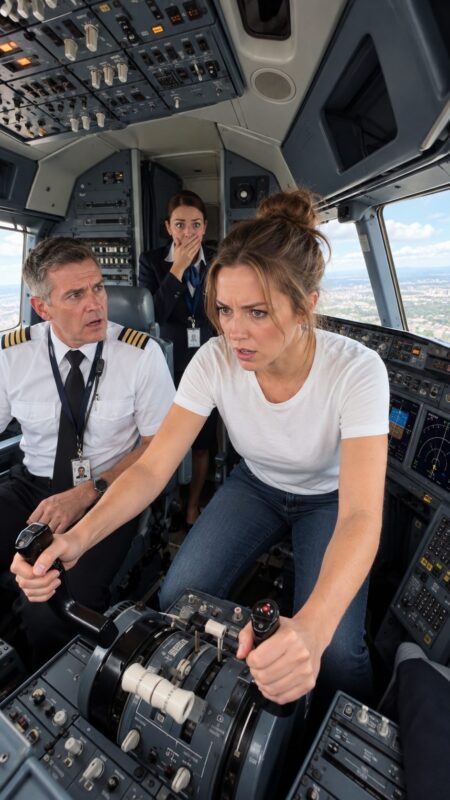
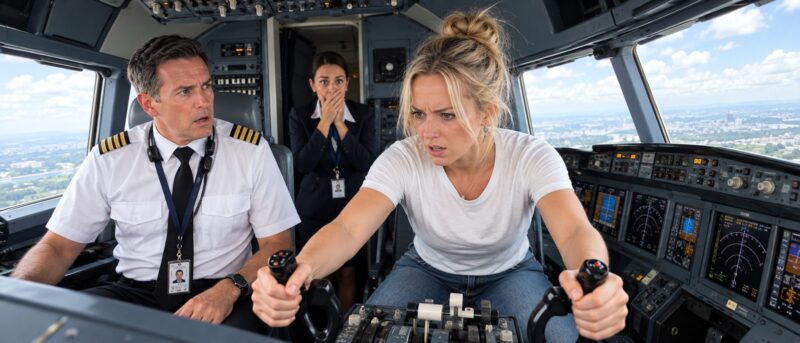
When Flight 2891 began falling, I entered the cockpit and told Reed and First Officer Jennifer Parker that we could steer using differential thrust. Then the left engine exploded.
While examining the systems, I discovered something impossible: WRAITH-92 software was installed aboard the Boeing, and my name appeared as its authorized test pilot.
This wasn’t an accident.
Someone had deliberately recreated the Wraith failure.
Worse, the aircraft was receiving remote commands.
Using the remaining engine, I helped Reed and Jennifer guide the crippled Boeing toward the Columbia River.
Seconds before impact, we manipulated the thrust to raise the nose.
The aircraft slammed into the water—but floated.
All 187 passengers survived.
Then the maintenance screen displayed:
TEST COMPLETE.
SURVIVABILITY CONFIRMED.
PHOENIX RESPONSE: SUCCESSFUL.
Someone had expected me to be aboard.
The mystery deepened when I discovered Alan Voss, my former Wraith program director, listed as passenger 22A.
He disappeared before evacuation, leaving behind an envelope addressed to me containing an old photograph and a message:
YOU WERE NEVER THE TEST SUBJECT.
YOU WERE THE CONTROL.
Then Emily called.
She had been kidnapped. Her captors told her that because I had survived Flight 2891, “Phase Two” would begin.
I headed toward Seattle and contacted Dr. Michael Hayes, the former Wraith chief engineer. He revealed that the program had secretly continued for decades.
Flight 2891 was merely the latest experiment.
Eventually I reached an abandoned naval air station, where Michael revealed the horrifying truth.
The organization behind Wraith had conducted dozens of secret flight-control experiments. Their goal wasn’t simply to create an autonomous aircraft.
They wanted a system capable of learning human instinct.
And they had been studying me and Emily.
As a child, Emily possessed an extraordinary ability to recognize aircraft problems from patterns and sounds.
She had watched me fly and remembered my reactions.
The program used those memories alongside my flying instincts to build an adaptive control system.
Flight 2891 had been designed to make that system learn from me.
Michael led me into a hidden underground facility where I finally found Emily, alive inside a sophisticated cockpit simulator.
Then Colonel Richard Hale—the man responsible for destroying my career—appeared on the screens. He had survived all these years and was still running the experiment.
He demanded that I teach their final aircraft, Aurora 1, an autonomous commercial-sized jet built from everything the program had learned from Emily and me.
When I refused, Hale threatened Emily.
But something else happened: my suppressed memories returned.
I remembered that decades earlier Hale’s organization had taken three-year-old Emily and studied her abilities.
I had threatened to expose them, and the Wraith disaster had been engineered afterward.
They hadn’t merely destroyed my reputation.
They had manipulated my memories and allowed guilt to keep me silent.
Michael finally revealed that an organization called the Directorate stood above Hale and had secretly controlled the project for decades.
Hale accelerated the countdown for Aurora’s launch.
I refused to cooperate.
Instead, a recovered memory led me to a hidden mechanical key inside the simulator. Turning it opened a secret tunnel beneath the facility.
“It goes to the aircraft,” I said.
Michael warned me that I couldn’t fly Aurora.
“I don’t need to.”
I looked at Emily.
“She can.”
We followed the tunnel toward the sound of an engine until we reached a massive steel door protected by a biometric scanner.
My hand failed.
Michael’s failed.
Then Emily stepped forward and placed her hand against the scanner.
The light turned green.