She Eats Beside Me
“Do not let that filthy child touch the king’s table.”
The Great Hall fell into stunned silence as a starving little girl reached toward a loaf of bread during the royal banquet.
“May I sit here and eat?” she asked quietly.
No one answered.
The child, no more than six years old, stood soaked from the rain. Her dress was torn, her shoes mismatched, and hunger had carved shadows beneath her eyes.
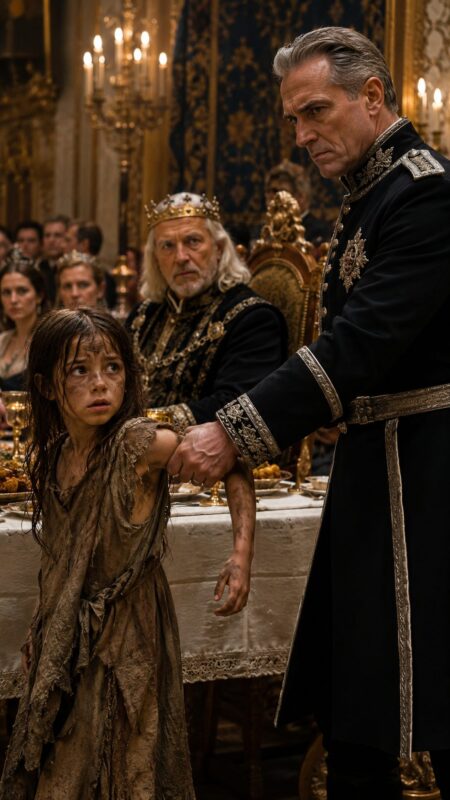
Before her stretched a feast worthy of kings and queens, yet she looked not at the food but at the elderly ruler seated nearby.
A wave of discomfort swept through the hall.
Lord Percival Rowan, the royal steward, marched forward and seized her wrist.
“You have no place here,” he said sharply, pulling her away from the table.
The nobles watched without protest. A few even chuckled.
Duchess Marcelline lifted a silk handkerchief to her nose.
“She smells like the gutters,” she said with disgust.
The little girl lowered her head, but she refused to cry.
From his seat, King Aldric of Valedorn observed everything in silence.
For eight long years, ever since the death of his beloved daughter, Princess Elara, he had lived like a man trapped in shadows.
Laughter had vanished from his life. Every celebration felt hollow. Every feast reminded him of the daughter he could never bring back.
Then the child looked up at him with frightened eyes.
“Am I in trouble?” she whispered.
The words struck him like a blade.
Years earlier, Elara had spoken those exact words after returning home covered in mud from rescuing an injured animal.
“Am I in trouble, Papa?”
He remembered laughing as he lifted her into his arms.
“You could never be in trouble with me.”
Now, hearing those same words from a hungry child shattered the walls he had built around his grief.
Slowly, King Aldric set down his silver goblet.
The sound echoed across the silent hall.
Then he stood.
“Release her.”
The room froze.
Percival immediately let go of the girl’s wrist.
Ignoring the shocked expressions around him, the king walked toward her and lowered himself to one knee. Gasps spread through the court. Kings did not kneel before beggars.
“What is your name?” he asked gently.
“Lina.”
“And when was the last time you ate?”
The girl hesitated.
“I don’t remember.”
The answer pierced his heart.
Tears gathered in the king’s eyes.
“No, child,” he said softly when she again asked if she was in trouble. “You are exactly where you belong.”
Taking her hand, he led her through the hall toward the head of the banquet table.
There stood a chair that had remained untouched for eight years.
Princess Elara’s chair.

King Aldric pulled it out.
“She eats beside me.”
The declaration left the entire hall speechless.
Lina sat down and reached for a piece of bread. At first she ate cautiously, afraid someone might take it away. But hunger soon overcame fear. Tears rolled down her cheeks as she ate.
The king rose and looked around the room.
“The honor of this hall was never threatened by a hungry child,” he said firmly. “It was threatened by every person who watched her suffer and chose to remain silent.”
No one dared speak.
Then Aldric noticed a red mark on Lina’s wrist where Percival had grabbed her.
“This,” he said coldly to the steward, “is the result of your service.”
As the king spoke with Lina, he learned that she had a younger brother named Tomas. The boy was ill and alone in an abandoned bell tower.
Without hesitation, Aldric issued orders.
Physicians. Food. Blankets. Transportation.
Everything was to be sent immediately.
“You’ll help him?” Lina asked in disbelief.
“With every resource I possess,” the king replied.
For the first time in many years, he embraced a child.
Lina burst into tears in his arms.
The moment awakened memories of Elara, who had devoted much of her life to helping the poor, the hungry, and the forgotten.
Then an even greater revelation emerged.
Lina explained that before her death, her mother, Nora, had instructed her to seek the king if she ever needed help.
Lady Mirelle, Elara’s former tutor, immediately recognized the name.
Nora had been among the families secretly supported by Princess Elara’s charitable efforts.
The discovery unsettled Percival.
When questioned further, Lina revealed that after Nora’s death, Percival had taken a document hidden beneath a loose floor stone—a document intended for the king.
Suspicion spread rapidly through the hall.
A search of Percival’s office uncovered concealed ledgers, missing records, and a letter written by Princess Elara shortly before her death.
In the letter, Elara pleaded with her father not to allow compassion to die alongside her.
“Do not build only statues,” she had written. “Build kitchens. Build shelters. Build doors that open for those with nowhere else to go.”
The letter also mentioned Nora by name and instructed the king to protect her family.
At last, Aldric understood the truth.
For years, Percival had buried Elara’s charitable work, diverted resources, and ignored the suffering of countless families throughout the kingdom.
“You stole her legacy,” the king said.
“You allowed children to starve.”
Percival was stripped of his title and removed under armed guard.
The scandal shook the kingdom.
Corrupt officials were exposed. Ministers resigned. Noble families came under investigation. Long-forgotten relief programs were restored.
The very next morning, the palace gates opened to the poor.
Bread, medicine, blankets, and shelter were distributed freely to anyone in need.
Soon afterward, the abandoned bell tower where Tomas had suffered alone was transformed into the kingdom’s first public refuge—a place where no hungry child would ever again be turned away.
Above the entrance, King Aldric ordered a simple inscription to be carved into the wooden archway:
No child should ever be punished for being hungry.
Lina and Tomas found refuge within the palace walls, where they were finally safe, warm, and cared for. As the months passed, their lives began to heal—and so did the kingdom around them.
But the greatest transformation was seen in King Aldric himself.
Because of one hungry little girl who had dared to ask for a place at his table, he rediscovered everything he thought he had lost.
Through Lina, he found his daughter’s legacy alive in the world. Through her courage, he remembered his duty. Through her suffering, he awakened the compassion that years of grief had buried deep within his heart.
For the first time since Elara’s death, the king no longer ruled from sorrow alone.
And by helping Lina and Tomas, he finally found the truest way to honor his beloved daughter—not through monuments of stone or statues of bronze, but through acts of mercy, kindness, and open doors for those in need.