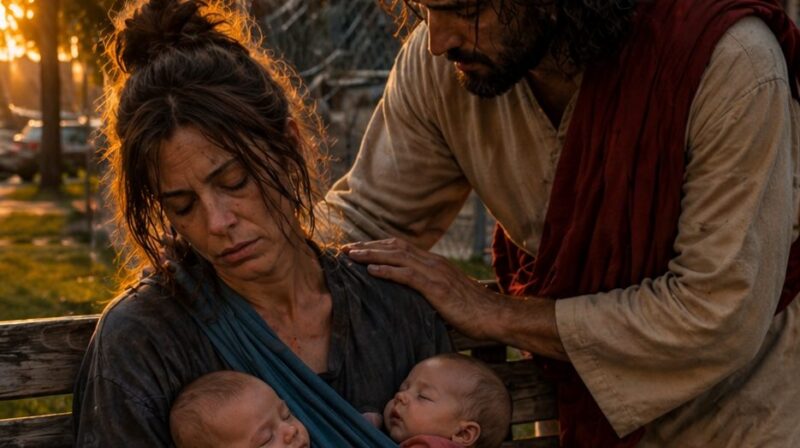
She hadn’t intended to fall asleep.
Not there—on that rough, splintered bench set between rows of quiet, identical houses.
The lawns were perfectly trimmed, cars neatly parked, windows firmly shut to people like her.
But exhaustion doesn’t wait for permission. It takes over when it must.
Her name was Lila, though no one had spoken it in days.
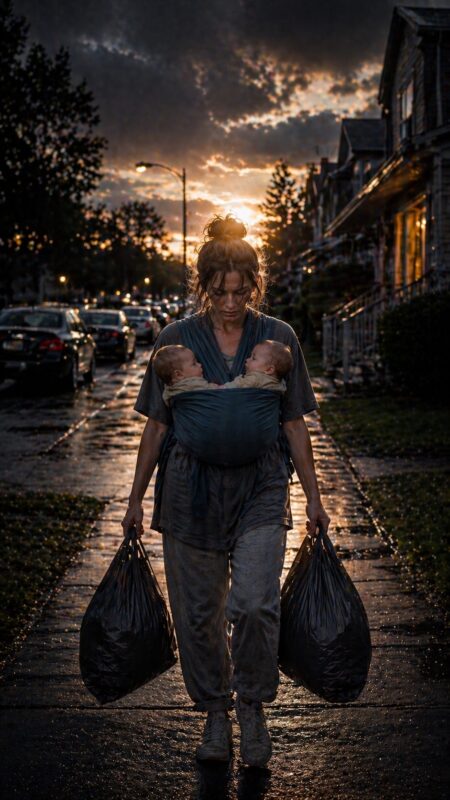
Barefoot, she moved along the sidewalk with uneven steps, her arms aching beneath the weight of two black bags.
Everything she owned was inside them—clothes, a few tins of food, and small remnants of a life she couldn’t let go of.
A life where she had a home.
A life where her name was spoken with care.
Now, she was just someone people chose not to see.
Two tiny babies lay against her chest, wrapped securely in a faded teal cloth.
They were quiet—sometimes too quiet—and that silence frightened her more than any cry.
Every few steps, she adjusted them, whispering softly, reminding them—and herself—that she was still there.
“I’ve got you,” she murmured, even when doubt crept in.
The sun sank lower, stretching long shadows across the pavement. By the time she reached the bench, her legs were trembling.
Just a minute, she told herself. Just one moment to sit.
She set the bags down and lowered herself carefully, trying not to wake the babies.
Nearby stood an empty stroller, one wheel bent out of shape. She had stopped using it—it slowed her too much—but she couldn’t bring herself to abandon it.
Her head leaned back.
Her eyes closed.
And for the first time in what felt like forever, everything fell still․
He had been watching her for some time.
From farther down the street, he stood quietly, unnoticed. He wore a simple robe, a deep red sash draped over his shoulder.
His hair fell loosely around his face, and a crown of thorns rested upon his head—not piercing, not cruel, but symbolic.
He did not hurry.
He never did.
But something in her walk—the burden she carried, the quiet strength in every step—drew him forward.
So he followed.
Not close enough to startle her.
Just close enough to be there when she stopped.
When she woke, the cold reached her first.
Then the stiffness in her neck.
Then the sudden rush of fear.
Her eyes snapped open, and she gasped, clutching the babies instinctively.
They were still there.
Still breathing.
Still warm.
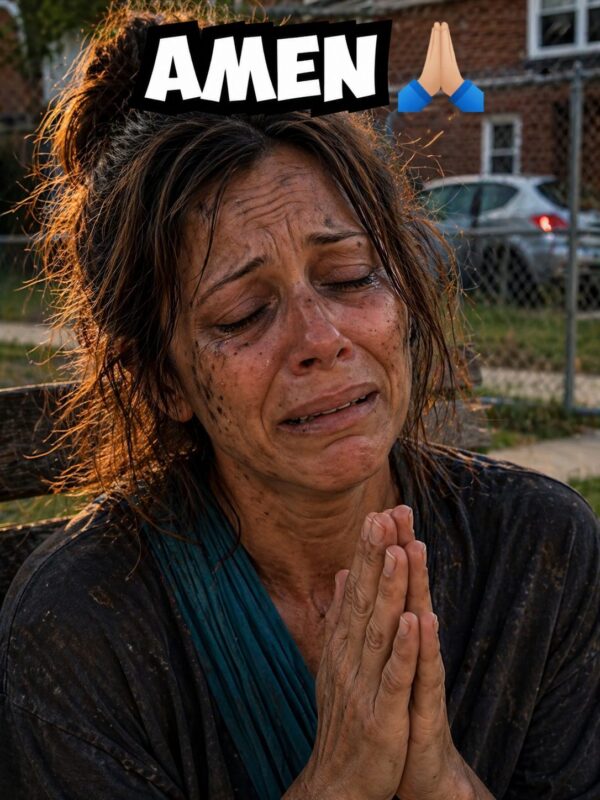
Tears filled her eyes before she even realized she was crying.
“I’m sorry,” she whispered, her voice trembling. “I’m so sorry…”
Her hands shook as she adjusted them, checking their tiny faces, pressing her forehead gently against theirs. She had nothing left to give—yet she kept giving.
That’s what mothers do.
That’s what love does.
At first, she didn’t notice him kneeling beside her.
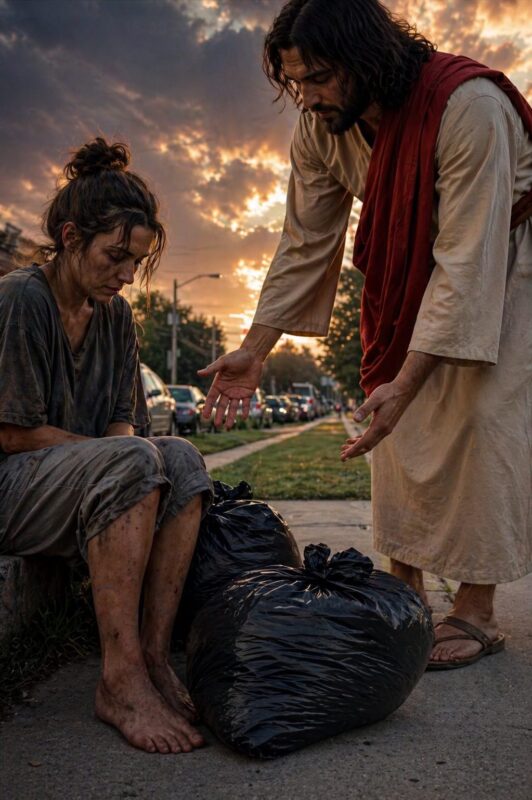
Only when a gentle warmth brushed her knee did she freeze.
It wasn’t sunlight.
It wasn’t the wind.
It was… something else.
A soft, golden glow.
Slowly, she looked down, her breath caught between fear and wonder.
His hand hovered near her—not touching, simply present. The light pulsed gently, spreading warmth through her weary body, easing the deep exhaustion she had carried for so long.
Her gaze followed the glow upward.
And then she saw him.
His eyes were not distant or untouchable, as she might have expected.
They were kind.
Almost weary.
As though he understood her… as though he had walked a long road himself.
“Why…?” she whispered faintly. “Why me?”
He didn’t answer with words.
He didn’t need to.
Instead, he reached for one of her heavy bags and lifted it effortlessly. Then the other.
She stared, unable to comprehend what she was seeing.
“You don’t have to carry everything by yourself,” he said softly.
The words settled deep within her, touching something she hadn’t realized was still there.
Her hands slowly came together, trembling, uncertain.
Tears flowed freely now, tracing clean paths through the dust on her face.
“I don’t belong here,” she said, her voice breaking completely.
He looked at her—not with judgment, not with pity, but with something deeper.
“You do,” he replied gently. “More than you know.”
The babies stirred softly against her, as if sensing the shift.
For the first time in days, Lila no longer felt invisible.
For the first time in weeks, she didn’t feel alone.
And for the first time in longer than she could remember… she believed that perhaps—just perhaps—this was not the end of her story.