Luz had learned early that the world noticed polished shoes before it ever noticed hungry children. At eight years old, she could read faces faster than words, because faces told her whether a door would open or slam shut.
She lived behind a row of utility buildings not far from the hospital district, where delivery trucks arrived before sunrise and the pavement held onto heat long after sunset. People knew her as quiet, fast, and almost invisible.

Santi was not invisible. Even when he played in dusty places where children weren’t supposed to be, he carried the unmistakable aura of wealth around him: expensive sneakers, a soft jacket, a precise haircut—the look of someone always expected somewhere important.
The two children had crossed paths more than once near the service gates of an apartment complex, where workers moved trash, laundry, and groceries through hidden corridors. Santi spoke to Luz as if she were a person, not an inconvenience.
That was why she noticed when his breathing changed. Children notice what adults dismiss. A slowed step. A grayish tint around the mouth. A hand clutching his own chest without understanding why it hurt.
No one in the service corridor reacted quickly enough. Someone assumed he was pretending. Someone thought his parents had already been called. Someone believed a child in designer clothes must already belong to help.
Luz didn’t think. She moved. One arm went behind his back, the other under his knees, and she lifted with everything her small body had. The first attempt almost brought them both down.
At 3:58 p.m., a delivery camera captured two figures leaving the back alley: a barefoot girl staggering under the weight of a boy dressed for a life she had only ever seen through glass.
The hospital was only a few blocks away, but fear stretched the distance. Luz fell near a curb, scraping both knees, then twisted her body so Santi landed on her instead of the concrete.
That became the pattern—fall, protect him, stand. Fall, protect him, stand. She kept whispering to him because silence felt dangerous, as if death preferred rooms where no one spoke.
“Don’t fall asleep, Santi,” she repeated over and over. “You can be angry at me later. Just don’t sleep now.” Her words were childish, desperate—and more faithful than any adult promise.
By 4:17 p.m., the hospital’s sliding doors opened. Security footage would later mark the exact second, but those inside would remember the sound first: bare feet striking tile—uneven, urgent, breaking the sterile calm.
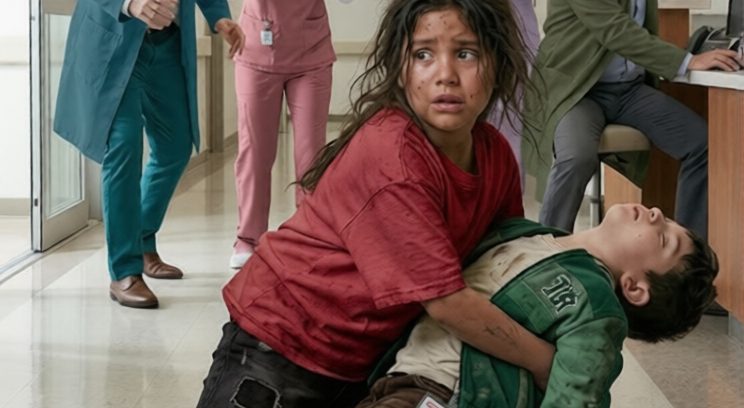
The Pediatric Emergency Department was polished into blinding brightness. White walls. Chrome rails. Fluorescent panels humming overhead. Everything reflected light—except Luz, who burst in covered in dust, blood, and panic.
She held Santi out in front of her like something too precious to drop. His head hung backward. His lips had turned a faint bluish color that made one nurse stop mid-sentence.
Near the nurses’ station, five medical staff members had been talking about shift changes and coffee. For a brief, terrible moment, training lost to disbelief. They saw poverty carrying privilege, and the image refused to compute.
A paper cup froze mid-air in a doctor’s hand. A pen hovered above an intake form. One nurse stared at Luz’s bare feet instead of the boy’s face, as if her eyes had chosen the wrong target.
The printer continued feeding paper. A monitor blinked green. Someone in the waiting area lowered a magazine but said nothing. The entire corridor balanced on the edge between recognition and action—no one moving.
Luz tried to speak, but only a broken sound came out. Her throat was raw from running. Her arms had gone numb. Her back felt as though burning wire had been threaded through it.
Then she found the last shred of her voice.
“He’s dying,” she screamed. “Someone help me. He’s dying.”
That broke whatever hesitation remained.
The nearest doctor rushed forward. A nurse called for a gurney. Another shouted for respiratory support. A clipboard marked PEDIATRIC EMERGENCY INTAKE slipped from the counter and clattered to the floor.
Luz barely registered any of it. The corridor stretched and blurred under tears and fluorescent glare. She felt Santi slipping away. Her grip tightened until the tendons stood out beneath the dirt on her hands.
There was no space left for fear of herself. Only the boy, the cold floor, rushing footsteps—and the terrifying certainty that her legs were about to fail.
When she finally collapsed, she twisted her body instinctively. Her back hit the ground first. Santi landed across her chest, still protected by the child who had carried him all the way there. The sound made several people flinch down the hallway.
A doctor dropped beside them and pressed two fingers to Santi’s neck.
“Pulse present,” he said—but his expression did not ease.
Oxygen came next. Then monitors. Then urgent instructions too fast for Luz to follow.
A nurse attempted to gently pry Luz’s hands away from Santi’s jacket, but she resisted without really understanding why.
“I didn’t drop him,” she kept repeating. “Tell him I didn’t drop him. Please, tell him.”
As they transferred Santi onto the gurney, a small laminated card slipped from his pocket. It listed a private doctor, an emergency contact, and a family office number—details that immediately changed the nurse’s expression.
The hospital did not suddenly become attentive because of money. At least, that is what those present would later tell themselves. But several of them would remember the exact moment their urgency intensified.
The call was placed to Santi’s father while the medical team worked. When he answered, his voice did not sound angry at first—only hollow, as if something had struck him deep in the chest and taken his breath with it.
He arrived at 4:31 p.m., just eleven minutes after the nurse reached him. His suit was expensive; his face was not. Panic had stripped away every trace of composure before he even stepped through the automatic doors.
By then, Luz was sitting in a chair, wrapped in a thin hospital blanket. Her knees had been cleaned but not yet bandaged. She kept asking if Santi was breathing. No one answered quickly enough.
Santi’s father looked at her blood-streaked legs, her dirt-covered feet, and the way she stared at the treatment room as if her entire world was inside it. His lips moved before any sound came out.
“She carried him?” he asked.
The nurse nodded. No one embellished the story. The security footage, the intake timestamp, the torn knees, and the boy’s bluish lips had already said enough.
For the first time that day, Luz noticed the way the adults were looking at her. Not with warmth—but with a new kind of attention. As if the balance of importance in the corridor had quietly shifted.
Santi stabilized before nightfall. The doctors later explained oxygen levels, dehydration, shock, and how a delay like that can turn survival into tragedy. Luz only understood one thing: he had lived.
When Santi opened his eyes the next morning, his first words were not for his father or the nurses. They were for Luz, who had fallen asleep in a chair outside his room.
“You didn’t drop me,” he whispered.
Luz cried then—quietly, ashamedly—because being brave had taken everything she had, and left her with no strength left to accept praise.
The hospital filed an official incident report. Security downloaded the 4:17 p.m. corridor footage. A social worker sat with Luz, asking gentle questions and writing down not only where she slept, but also who had failed to notice her before.
Days later, Santi’s father returned. No cameras. No speeches. No performative gratitude. He brought a child advocate, legal documents, and a plan already in motion.
He did not try to “rescue” Luz as a gesture of charity. Instead, he arranged medical care for her injuries, temporary safe housing, school enrollment, and legal protection to ensure no one could quietly send her back into danger.
The first document was not a press statement. It was a guardianship support petition reviewed by hospital social services. The second confirmed tuition coverage. The third secured counseling, clothing, and food.
Luz stared at the papers as if they might disappear. She had learned too early that help often came with hidden conditions. Santi’s father seemed to understand this, because he set the pen down far from her reach.
“You don’t owe me anything,” he said quietly. “My son is alive because of you. This isn’t payment. It’s what should have happened before you ever had to save him.”
That sentence changed more than her circumstances. It changed how everyone in the room reinterpreted the footage of that day. A barefoot girl carrying a millionaire’s son through panic, and everything afterward shifting in her life.
But the truth was harder than any headline. One child had done what an entire system of adults failed to do—notice, act, and refuse to let go.
Months later, Luz walked through the same hospital again, this time wearing shoes that fit. The floor was still cold and bright. The doors still sighed open. The corridor still carried the faint scent of disinfectant.
Santi walked beside her now—slower, but smiling—holding a handmade thank-you card for the emergency staff. This time, Luz didn’t carry him. She didn’t need to.
Near the nurses’ station, the same green monitor blinked. The same printer hummed. A nurse looked up and recognized the girl who had once shattered the hallway’s silence.
No child should ever become a stretcher because adults arrived too late. Luz had been that stretcher, that warning, that impossible moment of courage with bleeding knees and clenched hands.
Her life changed because she saved Santi. But everyone else’s understanding changed because, for one unbearable instant, the smallest person in the hospital was the only one strong enough to act.