The Little Girl Who Sold Her Doll for 90 Pesos to Save Her Mother—Unaware She Would Expose the Most Powerful Man on Reforma
The Doll That Uncovered the Truth
Six-year-old Mariana wandered through the upscale streets of Mexico City like someone the world had chosen not to notice.
Her faded yellow dress hung loosely from her small frame, one sandal was held together by a piece of yarn, and in her arms she carried a worn cloth doll she treasured more than anything she owned.
Outside an elegant café, billionaire entrepreneur Damián Arriaga stepped onto the sidewalk after concluding a business meeting.
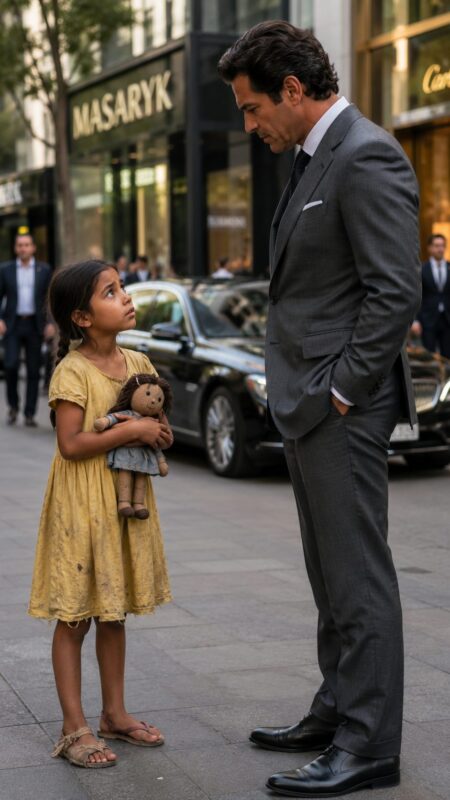
Damián was one of the city’s most influential figures. He owned luxury hotels, towering office buildings, and a celebrated charitable foundation for children. People respected him, feared his influence, and rarely challenged his authority.
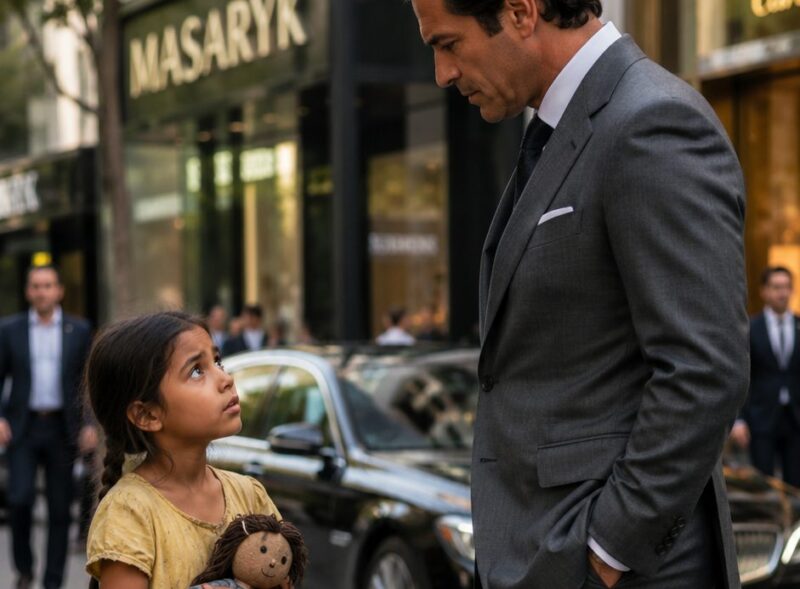
Mariana stopped directly in front of him.
“Sir, would you like to buy my doll?”
Without even glancing down, Damián replied that he had no cash. But when the little girl softly mentioned that her mother had not eaten for three days, he unexpectedly stopped walking.
What caught his attention was not desperation.
Mariana was not begging for money.
She was offering the only possession she truly loved.
The doll, Rosita, had been sewn by her mother when Mariana was still a baby. For just ninety pesos, Mariana hoped to purchase soup, tortillas, and medicine.
Searching his wallet, Damián discovered he had only a one-thousand-peso note.
He handed it to her.
“I can’t give you change,” Mariana said nervously.
“Keep it,” he answered.
Before surrendering Rosita, she looked him in the eyes and asked one simple question.
“Will you take care of her? She gets frightened when she’s left alone.”
Something about those words touched a place inside him he thought no longer existed.
Unable to explain why, he promised he would.
That evening, Rosita rested on a marble table inside Damián’s luxurious penthouse overlooking Reforma Avenue. Despite trying to focus on work, he found himself thinking about Mariana and the mother she was desperately trying to save.
Shortly before midnight, he heard a faint noise coming from the doll.
Intrigued, he inspected it carefully and discovered a hidden compartment concealed inside the fabric.
Within it were three objects: an old cellphone, a USB flash drive, and a photograph folded several times.
A message still glowed on the cracked screen:
“If this reaches Damián Arriaga, tell him Mariana is his daughter.”
The words struck him like a lightning bolt.
The photograph showed a young woman holding a newborn child. Written on the back was a note explaining that she had spent years trying to tell Mariana’s father the truth.
The woman was Lucía Herrera.
Seven years earlier, Lucía had worked as an auditor for Damián’s company. Brilliant, courageous, and honest, she had been the only woman he had ever imagined building a future with.
Their relationship had ended after Damián’s mother, Amalia Arriaga, presented evidence claiming Lucía was dishonest and interested only in his wealth. Later, when Lucía revealed she was pregnant, Damián dismissed her claim and refused to believe her.
Devastated, Lucía vanished from his life.
As Damián examined the files stored on the USB drive, a far darker reality emerged.
Lucía had uncovered extensive corruption inside his charitable foundation. Donations intended for sick children had been funneled through shell companies. Medical contracts had been manipulated to launder money. When Lucía refused to cooperate, she became a target.
She was framed, dismissed from her position, threatened, and forced into hiding.
Then came the most painful revelation of all.
The evidence proved that Amalia had orchestrated everything.
She had falsified communications, bribed individuals to lie, concealed Mariana’s existence, and convinced Damián that Lucía had deceived him.
The final piece of evidence was an audio recording in which Amalia calmly explained that Mariana must never be allowed near Damián because discovering the truth would make him “weak.”
Consumed by regret and guilt, Damián spent the entire night reviewing every document.
At dawn, carrying Rosita, the photograph, and the USB drive, he began searching for Mariana.
He eventually found her inside a rundown apartment building in the Guerrero district. Mariana sat on the floor eating soup while Lucía, weakened by illness, rested in a nearby bed.
When Lucía saw him, she did not smile.
She looked afraid.
“I know everything now,” Damián told her.
Lucía answered with bitterness.
“You ignored the truth because trusting your mother was easier than trusting me.”
For the first time in years, Damián had no defense.
He immediately arranged medical care for Lucía, secured every piece of evidence, and prepared to confront the people responsible.
At an emergency board meeting, he presented recordings, financial reports, contracts, and witness statements exposing years of fraud, theft, and manipulation.
When Lucía entered the room with Mariana standing beside her, no one could deny the truth any longer.
Authorities launched an investigation.
Amalia’s carefully built empire collapsed.
She was arrested and charged with corruption, fraud, money laundering, intimidation, and multiple financial crimes.
Yet for Lucía, legal justice alone was not enough.
When Damián offered her and Mariana a luxurious life in his penthouse, she declined.
“I don’t want a beautiful prison,” she said. “I want respect and dignity.”
For the first time, Damián understood what she meant.
Rather than attempting to purchase forgiveness, he committed himself to earning it. He offered support without control, remained present in Mariana’s life, and learned that fatherhood was measured by consistency, not money.
Over the following year, Lucía’s health improved, and Mariana gradually welcomed Damián into her heart.
Determined to honor everything he had learned, Damián established a community center dedicated to helping struggling mothers and vulnerable children—ensuring that no child would ever again have to sell a beloved doll simply to buy food for the person they loved most.
He called it Casa Rosita.
At the entrance, inside a protective glass case, stood the old handmade doll that had transformed all of their lives.
Mounted beneath it was a small plaque that read:
“The truth does not always arrive in polished reports or official records. Sometimes it is hidden inside what the powerful are quick to dismiss as worthless.”
On the day the center officially opened, Mariana stepped forward to address the gathered crowd.
Though still young, her voice carried confidence beyond her years.
“This place exists so that no little girl will ever have to sell her favorite doll because her mother is hungry,” she said.
The audience fell silent before breaking into heartfelt applause.
For many, it was simply a touching speech.
For Damián and Lucía, it was a reminder of the painful journey that had brought them there.
Several months later, Damián arrived at Lucía and Mariana’s modest home carrying a bouquet of flowers and a bag filled with freshly baked bread.
Gone were the expensive gifts, grand gestures, and promises money could buy.
This time, he came only as himself.
Mariana opened the door.
She studied him for a moment before speaking.
“I’m still not sure if I’m ready to call you Dad,” she admitted.
Damián smiled gently.
“You don’t have to make that decision today,” he replied. “Take all the time you need.”
A shy smile appeared on her face.
“Then… can I call you Damián-Dad for now? Just little by little?”
Emotion tightened his throat.
For a moment, he could not find the words.
Instead, he simply nodded.
That afternoon, while standing beside Lucía in their small kitchen, helping wash dishes and listening to Mariana laugh from the next room, Damián understood something his wealth, influence, and success had never been able to teach him.
A powerful empire can collapse because of a single forgotten doll.
But rebuilding a family requires something far greater than money.
It requires truth.
It requires justice.
And above all, it requires love.