The pool of the Andrade mansion shimmered under the afternoon sun like an impossible blue jewel.
Around it, guests laughed with cold drinks in hand, dressed in white suits, linen shirts, and dark sunglasses. It was an elegant gathering—one of those parties where no one spoke about problems, hunger, or fear.
Only travel, business, and influential names filled the conversation.
Near the edge of the pool sat Valeria Andrade in her wheelchair.
She was nine years old, wearing a white summer dress, carrying a quiet sadness that almost no one noticed. Since the accident that took away the use of her legs, everyone treated her as if she were made of glass.

She couldn’t run, couldn’t play, and wasn’t allowed too close to the water.
Her grandfather, Don Ernesto Andrade, always repeated the same warning:
“Take care of her. Don’t let anyone get too close.”
He loved her, yes—but his love felt more like a cage.
That afternoon, among the staff helping at the party, there was Mateo.
He was thirteen, wearing an old brown T-shirt and dark trousers, his small hands already worn from too much work. His mother cleaned the mansion, and he came along when she had no one to leave him with.
He didn’t belong there.
He could feel it in every glance.
Some guests looked at him like he was invisible; others like he was out of place entirely.
But Valeria noticed him.
“What’s your name?” she asked from her wheelchair.
“Mateo,” he answered, surprised.
“I’m Valeria.”
“I know,” he said nervously. “Everyone talks about you.”
She frowned. “As if I’m not even here.”
Mateo had no reply.
Valeria looked at the water.
“I used to love swimming.”
His eyes dropped to her motionless legs, then quickly away in embarrassment.
“Sorry,” he muttered.
“It’s okay,” she said softly. “Everyone stares. At least you don’t do it with pity.”
For the first time in weeks, she smiled.
And so did he.
But from a distance, Don Ernesto was watching.
His expression tightened.
He didn’t like the idea of a poor boy near his granddaughter. He didn’t like that someone without the Andrade name could make her smile so easily.
Before he could intervene, he was stopped by a guest speaking about business.
And then it happened.
One wheel of Valeria’s chair got stuck in a crack on the patio. She tried to move it herself—once, then again.
The chair tilted.
“Mateo!” she cried out.
He turned just in time to see her fall.
The wheelchair struck the edge.
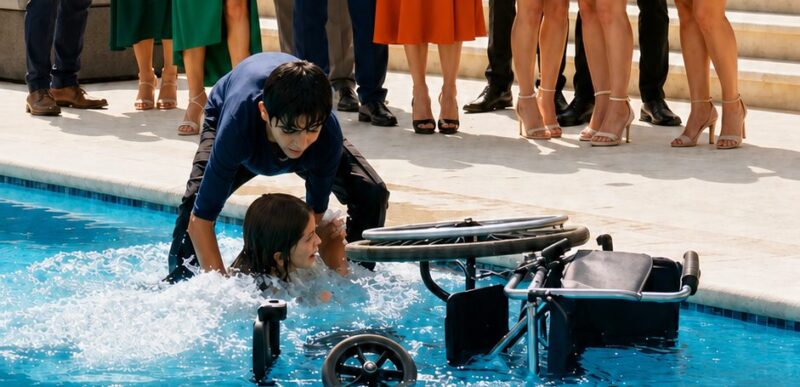
Valeria disappeared into the pool.
For a second, no one understood what had happened.
Then a scream cut through the air.
“The girl!”
Mateo didn’t think.
He ran.
He jumped into the pool fully clothed, breaking the perfect reflection of the water. He swam toward her as she flailed in panic, swallowing water, her white dress clinging to her body.
“I can’t!” she cried. “I can’t breathe!”
“Hold on to me!” Mateo shouted.
She grabbed him desperately, nearly pulling him under. He fought against the weight of wet clothes and panic, his lungs burning, arms shaking—but he didn’t let go.
A staff member finally reacted and helped pull them out.
Mateo collapsed onto the patio, soaked and gasping. Valeria coughed and cried, clinging tightly to him.
The wheelchair lay overturned near the pool.
Then Don Ernesto arrived.
He saw none of it.
Not the wheelchair.
Not the water dripping from Mateo’s hair.
Not the way Valeria was holding him in fear and relief.
He only saw a poor boy holding his granddaughter.
“Get away from her!” he roared.
Mateo looked up, confused.
“Sir, I—”
Don Ernesto grabbed his shoulder hard.
“What did you do to her?”
The guests fell silent.
Whispers began.
“He must have done something.”
“These kids…”
“He could’ve harmed her.”
Mateo’s face burned with shame. He tried to stand, but Valeria wouldn’t let go.
“I didn’t push her,” he said breathlessly. “I saved her.”
“Liar!” Don Ernesto snapped.
Valeria lifted her tear-streaked face.
“Grandpa…”
But he kept glaring at Mateo.
“You don’t belong here. You got close to her, and now you want to play the hero.”
Mateo lowered his gaze. Water dripped from his hair onto the marble floor.
“I didn’t want to be a hero,” he whispered. “I just didn’t want her to die.”
That sentence silenced part of the crowd.
Then Valeria shouted with all the strength she had left:
“Grandpa, stop!”
Don Ernesto froze.
She was trembling, but her voice was steady.
“He didn’t push me. I fell. The chair got stuck. No one came… except him.”
Slowly, Don Ernesto released Mateo’s shoulder.
For the first time, he looked around properly.
He saw the overturned wheelchair.
He saw the water trail from the pool to where they stood.
He saw Mateo’s scraped hands against the marble.
And finally… he began to understand the truth.
He saw Valeria clinging to the boy as if he were the only safe place in the world.
The color drained completely from the old millionaire’s face.
“Valeria…”
“You always say I’m being taken care of,” she cried. “But everyone was just watching from a distance. He was the only one who jumped in.”
A heavy silence fell over the crowd.
Don Ernesto scanned the guests. Many quickly lowered their eyes.
Then he looked at Mateo.
The boy stood there, pale and exhausted, his lips trembling, expecting another accusation.
Instead, Don Ernesto slowly knelt in front of him.
The gesture left everyone speechless.
“Forgive me,” he said in a broken voice. “I judged you without knowing the truth.”
At first, Mateo didn’t respond.
He didn’t know how to accept an apology from someone who only minutes earlier had treated him like nothing.
Valeria took Mateo’s hand.
“If he hadn’t been here, I wouldn’t be alive.”
Don Ernesto closed his eyes.
When he opened them again, they were filled with tears.
“Then this family owes you a debt we can never repay.”
Mateo shook his head slightly.
“I don’t want money.”
“Then what do you want?”
He looked at Valeria, then toward the pool.
“For people to stop looking at her like she’s broken.”
Valeria began to cry again—but this time she was smiling.
Don Ernesto lowered his head in shame.
The party no longer felt luxurious. It felt small. Small in the presence of a poor boy who had shown more courage than all the well-dressed adults combined.
Don Ernesto removed his jacket and gently placed it over Mateo’s wet shoulders.
“From this day forward,” he said aloud, “this boy enters through the front door.”
No one spoke.
There was no need.
Mateo helped Valeria settle into a dry chair while she kept holding his hand.
“Thank you for jumping in,” she whispered.
Mateo gave a faint smile.
“Thank you for telling the truth.”
And by the pool where everyone had first seen only an accusation, two children found something no amount of money could ever buy:
A friendship born in the exact moment someone chose not to look away.