The Millionaire Disguised Himself as a Poor Customer in His Own Watch Boutique… And an Employee Taught Him the Most Important Lesson of His Life
Mateo Herrera, the founder and CEO of one of Mexico’s most prestigious luxury watch companies, had grown weary of artificial smiles, flawless reports, and employees who treated him differently because of his wealth.
Determined to discover how his staff treated people they believed had no status or money, he decided to conduct a personal experiment.
Dressed in a faded gray T-shirt, worn jeans, and old sneakers, he walked into one of his flagship stores in the upscale Polanco district, looking like an ordinary man struggling to make ends meet.
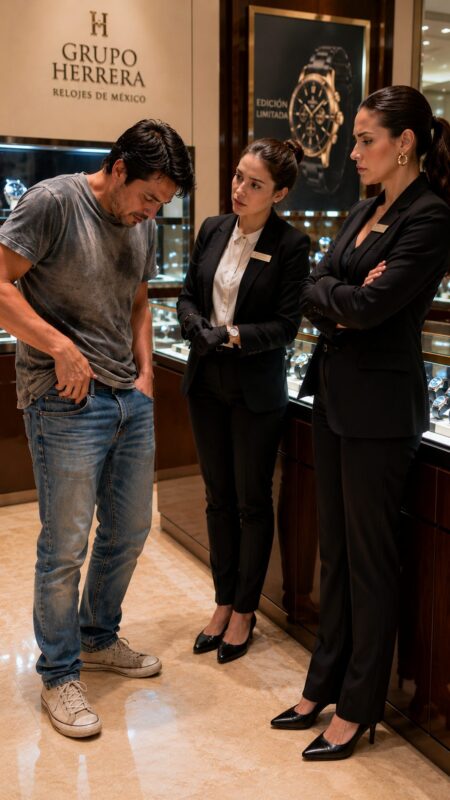
The reaction was immediate.
Fernanda, a sales associate known for her arrogance, looked him over with open contempt.
“If you’re here to ask about prices,” she said loudly, “you should know right away that everything in this store is extremely expensive.”
But another employee responded differently.
Lucía Ramírez, a twenty-seven-year-old sales consultant with a quiet confidence and genuine warmth, greeted him with a smile.
“Good afternoon, sir. Welcome. Is there a specific model you’d like to see today?”
When Mateo pointed to a limited-edition watch, Lucía carefully removed it from the display and spent nearly twenty minutes explaining its craftsmanship, history, and unique design.
Throughout the entire conversation, she treated him with patience and respect, never judging him by his appearance.
Impressed, Mateo decided to take his test a step further.
“I’ll buy it,” he said.
Then he pretended to search for his wallet.
Moments later, he frowned.
“I think I’ve lost it.”
Fernanda immediately burst out laughing.
“I knew it! He was never going to buy anything.”
Lucía quickly came to his defense.
“He’s still a customer,” she said firmly.
Fernanda responded with cruel remarks, mocking both Mateo and Lucía’s humble background.
Instead of shrinking away, Lucía stood her ground.
“Yes, I grew up with very little,” she replied calmly. “My mother sold tamales outside a subway station, and my father left debts instead of support. But I work hard, I study, and I treat people with dignity.
This uniform was given to me to help customers—not to humiliate them.”
Her words struck Mateo more deeply than he expected.
Without asking for anything in return, Lucía offered to help him search for the missing wallet.
Together they walked the surrounding streets, checking sidewalks, benches, and even storm drains. She genuinely believed she was helping a stranger in distress.
Feeling increasingly ashamed, Mateo eventually pretended to find the wallet inside his car.
That evening, he reviewed Lucía’s employee file.
He learned that she had lost her mother, grown up without her father, started university later than most students, and supported herself entirely through hard work.
Every achievement in her life had been earned without privilege, connections, or shortcuts.
For the first time, Mateo felt uncomfortable about the experiment he had created.
The following day, Fernanda continued her campaign of bullying. She assigned Lucía extra work, humiliated her in front of colleagues, and looked for every opportunity to make her feel small.

Lucía endured it because she desperately needed the income to pay rent, university tuition, and medication for the elderly woman who had raised her.
Over the following weeks, Mateo found reasons to visit the area. Outside the store, he and Lucía began having simple conversations that gradually became more personal.
He spoke about the charitable projects he supported, including a children’s home.
To his surprise, they discovered a shared connection to the same orphanage.
Lucía opened up about her difficult childhood, while Mateo revealed that he had lost both of his parents at a young age.
The more time they spent together, the stronger their connection became.
Before long, Mateo realized he was falling in love with her.
Yet he also knew that the truth about his identity could destroy everything.
A few days later, he walked into the boutique wearing an expensive tailored suit.
The entire staff froze.
“My name is Mateo Herrera,” he announced. “I am the owner and CEO of Grupo Herrera.”
The room fell completely silent.
He revealed security footage documenting discrimination, workplace harassment, and unethical conduct. Fernanda was terminated immediately, while the store manager was suspended pending investigation.
Then he turned to Lucía.
“You treated every person with dignity and respect when others did not. Effective immediately, you are being promoted to Senior Consultant.
Your salary will triple, and I will personally fund the completion of your university degree.”
But instead of looking grateful, Lucía appeared heartbroken.
“So all of this was a test?” she asked quietly.
Mateo attempted to explain.
She stopped him.
“You watched me search for a wallet that was never missing. You listened to my life story while hiding the fact that you were my boss. You didn’t see me as a person—you saw me as evidence that good people still exist.”
The words hit harder than any criticism he had ever received.
Lucía removed her name badge, placed it on the counter, and resigned.
Later, Mateo confessed his feelings and offered financial support.
She declined.
“I spent years rebuilding my life so I would never have to depend on anyone,” she said. “If you ever speak to me again, do it honestly. No disguises. No tests. No attempts to rescue me.”
Then she walked away.
For the first time, Mateo truly understood that love cannot be purchased, controlled, or earned through power.
Six months later, Lucía opened a small flower shop in Roma called *Lucía’s Flowers*.
It was modest, but it belonged entirely to her.
Through dedication and care, the business slowly flourished, attracting loyal customers who appreciated the personal attention she gave to every arrangement.
One rainy morning, Mateo appeared at the shop carrying a small bougainvillea plant.
“I’m not here to ask for forgiveness,” he said. “I only want to know whether this plant prefers sunlight or shade.”
Lucía couldn’t help but smile.
“If you care for it patiently, it will bloom,” she replied. “If you try to control it, it will wither.”
Mateo nodded, understanding the deeper message.
Then she gently took the plant from his hands.
“This time,” she said, “let’s do things without lies.”
“Without lies,” he agreed.
There was no dramatic reunion and no fairy-tale ending.
Just two people standing on equal ground at last, learning that honesty, respect, and patience are worth far more than any fortune.