The city moved around him as if he didn’t exist.
Shoes passed by.
A bus groaned somewhere down the block.
Muted traffic murmured beneath the trees.
But on the pale stone ledge outside the old building, none of it felt real to the man in the wrinkled charcoal suit.
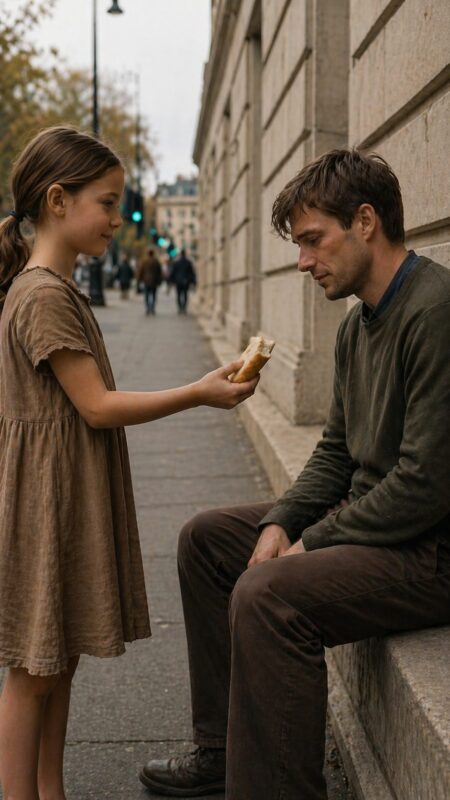
His elbows rested on his knees.
One hand covered his face.
The other hung uselessly at his side.
A fresh red mark stained his cheek.
He had spent the last hour trying not to fall apart in public.
He had failed.
Then a small shadow stopped in front of him.
He looked up quickly.
A barefoot little girl stood there, wearing a torn brown linen dress. Her hair was messy, her knees dusty, and one hand was stretched toward him.
In her palm lay a broken piece of bread.
Not much.
Just enough for one hungry child.
Her eyes were wide—moist, worried, and quietly brave.
“Are you hungry too?” she asked.
The man blinked.
For a moment, he said nothing. He only stared at the bread in her hand, then at her bare feet against the dirty pavement.
The bread was coarse and dry.
Clearly not fresh.
Clearly precious.
It was likely all she had.
Slowly, he lowered his hand from his face.
“No…” he said, forcing a faint smile through the tightness in his throat. “I’m not hungry.”
The girl didn’t move.
Her arm remained outstretched.
“You can have some.”
That made it worse.
So much worse.
The man turned his gaze away for a second and swallowed hard. He tried to steady himself, but the tears still burned behind his eyes.
He was supposed to be a grown man.
A lawyer.
A husband.
A provider.
Instead, he had just walked out of the family office after signing away the last piece of his life.
His brother had called him weak.
His wife had told him not to come home until he “got himself together.”
And when he tried to respond, his brother had slapped him in front of everyone.
Not because of business.
Not really.
Because in that family, men were never allowed to fall apart.
The girl took a small step closer.
Her voice softened.
“Please.”
He looked back at her.
There was no pity in her expression.
Only simple, genuine concern.
That innocent kindness struck him harder than any cruelty ever had.
He glanced at the bread again.
Then at her small fingers holding it.
Then at the torn hem of her dress.
Then back to her face.
A shaky breath escaped him.
“Why would you give me your bread?” he asked.
She frowned, as if the answer were obvious.
“Because you look sad.”
The world behind them seemed to blur.
Something shifted in his face.
He let out a faint, broken laugh.
The girl studied him with the seriousness of someone far older than she should have been.
Then she asked softly, almost lost beneath the sound of traffic:
“Then why are you crying?”
The question struck like a hand reopening an old wound.
The man tried to answer.
Nothing came out.
His throat tightened.
His eyes burned.
His hands trembled.
Finally, he managed to say, “I think… I’ve lost everything.”
The girl stood still for a moment.
Then, without asking again, she gently broke the bread in half and placed one piece into his hand.
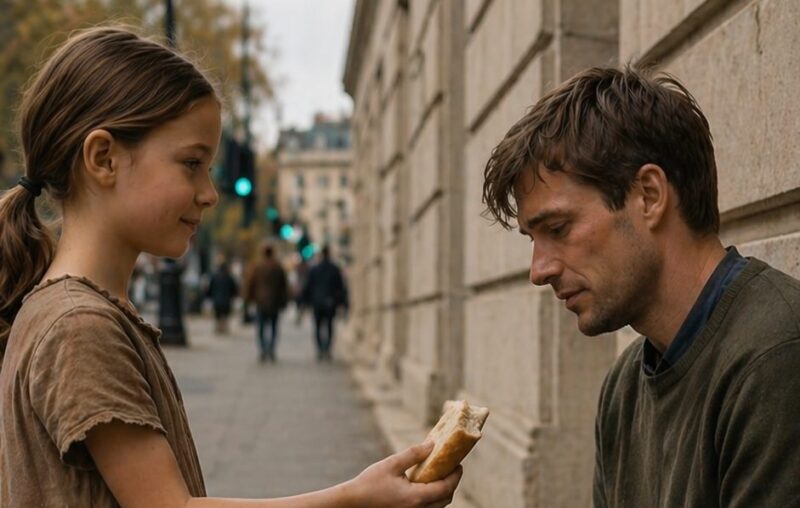
Her fingers brushed against his.
The instant they touched, he froze.
Because for one impossible moment, it felt familiar.
Not the child’s hand.
The gesture.
The tenderness.
The exact same way she broke the bread.
A memory surged through him so sharply it nearly took his breath away—
A rainy afternoon years ago.
A young woman on another sidewalk.
Dark hair, tired eyes, laughing softly as she split a piece of bread and pressed it into his hand.
“You look hungry,” she had said.
Not with pity.
With love.
Her name was Elena.
And she had disappeared from his life seven years earlier.
Gone before he could reach her.
Gone before he could undo what his family had done.
Gone before he even knew if the child she carried had survived.
His fingers tightened around the bread.
He stared at the little girl as if the world had tilted beneath him.
The same quiet kindness.
The same eyes.
Even the same stubborn lift of her chin when she was afraid.
His voice trembled.
“What… did your mother say your name was?”
The little girl blinked at him.
Then she said very softly:
“My mama says my name is Rose.”
The man’s breath caught.
Rose.
He and Elena had once stayed up all night in a tiny apartment, gently arguing over baby names. If it was a girl, Elena wanted Rose.
“She’ll be small,” she had said with a smile, “but strong.”
His fingers began to tremble around the bread.
He leaned forward, suddenly afraid of the answer—and unable to stop himself from asking more.
“Rose… what?”
The girl hesitated.
“Rose Elena.”
Everything inside him went still.
The traffic.
The footsteps.
The city.
All of it faded away.
He stared at her as if she were a ghost made of sunlight and dust.
His lips parted, but no sound came out.
The little girl slowly lowered her hand.
Her eyes searched his face.
“My mama said,” she whispered, “if I ever met a man who cried like he lost someone… and looked at me like this… I should tell him my full name.”
He couldn’t breathe.
She swallowed.
“My name is Rose Elena Carter.”
Carter.
His name.
Not the version his wealthy family used in boardrooms. Not the polished identity.
His real name.
The one Elena had loved before money ruined everything.
His eyes filled instantly.
“Where is your mother?” he asked, his voice catching.
Rose turned and pointed down the street.
Across the road, near the side entrance of a church shelter, a woman sat wrapped in a worn coat, her head bowed, one hand pressed against her chest.
Even from a distance, he knew.
He recognized the shape of her face. The curve of her shoulders. The quiet way she carried pain.
“Elena…”
The name escaped him before he could stop it.
The woman looked up.
For a moment, she didn’t move.
Then her expression shifted.
First shock. Then fear. Then something deeper—
something she had spent years trying not to hope for.
The man stood up too quickly and nearly lost his balance.
“Rose,” he said, kneeling in front of the little girl, “stay right here for just a second, okay?”
But Rose shook her head and took his hand.
“No,” she said softly. “Mama doesn’t like it when I cross alone.”
That nearly broke him.
So he held her hand.
And together, they crossed the street.
Elena was already standing by the time they reached her, though she looked weak and unsteady.
For a long moment, none of them spoke.
The man’s eyes searched her face, taking in every lost year—the exhaustion, the fragility, the pain—and still, somehow, her.
“Elena…” he said again, his voice trembling. “You’re alive.”
Her eyes filled with tears.
“I tried to tell you,” she whispered. “Your brother found me before I could reach you. He said you were married. He said you wanted nothing to do with us.”
The red mark on his cheek no longer mattered.
His face crumpled.
“He lied.”
“I know that now,” she said, tears falling freely. “But by the time I realized… Rose was already here. And I had nothing. I couldn’t risk your family taking her away from me.”
He dropped to his knees on the sidewalk.
Not from weakness.
But from grief.
From relief.
From the overwhelming weight of finally seeing what had been taken from him.
His gaze lifted to Rose.
The little girl watched them both with quiet seriousness, still holding the smaller piece of bread.
“She said you were sad,” Rose murmured, looking at her mother. “So I gave him some.”
Elena covered her mouth and began to cry.
The man looked at Rose again and let out a broken sound—half laugh, half sob.
“You gave me your only piece of bread,” he said.
Rose shrugged, as if kindness were the simplest thing in the world.
“You looked like you needed it.”
That was the moment he completely fell apart.
He slowly opened his arms, uncertain, afraid to move too quickly.
Rose glanced at her mother.
Elena nodded through her tears.
And the little girl stepped forward into his embrace.
He held her as if she were something he had searched for his entire life and never expected to find.
His daughter.
At last.
Rose rested her cheek against his shoulder and whispered, small, sleepy, and sure:
“See? I told you—you were hungry too.”
He closed his eyes, tears flowing freely now.
Not for bread.
For love.
For home.
For all the years they had lost.
And standing there on that city sidewalk, holding the child he had been denied and looking at the woman he had never stopped loving, he understood in a single, overwhelming moment—
he hadn’t lost everything.
He had just found what mattered most.