The street glowed with that quiet, golden beauty that often disguises hidden pain.
String lights stretched overhead like soft, glowing stars, while shop windows cast warm reflections across the pavement.
People drifted past in blurred motion—absorbed in dinners, laughter, and lives that seemed untouched by trouble.
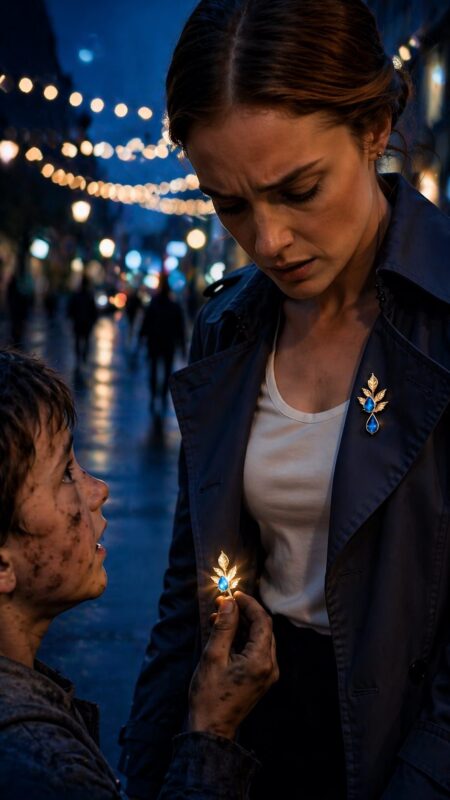
Then, suddenly, a small hand seized the gold chain of her handbag.
The elegant woman in the beige trench coat turned sharply—alert, offended, defensive. Her hand snapped the bag back against her side.
“Don’t touch me.”
In front of her stood a young boy in worn clothes, his face smudged with dirt, fear flickering in his eyes—yet something heavier than fear weighed in the way he held himself.
He flinched at her voice…
but he didn’t run.
That was the first unusual thing.
The second was what he said next.
“But… you have the same pin.”
Her anger didn’t disappear—it hesitated, lingering for a moment.
Slowly, the boy opened his trembling hand. Inside lay a delicate gold pin shaped like a leaf, with a blue teardrop gem at its center. The light caught the stone, making it glow.
Without thinking, the woman lifted her hand to her collar—where an identical pin was fastened.
Her expression shifted. Not yet recognition… but the fear of it.
“What are you talking about?”
The boy looked up at her, eyes wet, fighting back tears—holding onto the moment as if it might slip away.
“My mom has one just like it.”
That should have been impossible.
Years ago, the pins had been made as a pair—one for her, one for her younger sister—on a summer night when they promised never to let their father tear them apart.
A week later, her sister disappeared.
The family claimed she had run away. The newspapers said she died crossing the border. Their father forbade anyone from ever speaking her name again.
But the second pin was never found.
The woman stepped closer, slowly. Her voice softened, trembling with fear.
“That’s impossible.”
The boy’s lip quivered. He looked at her as if he had carried this truth alone for far too long.
Then he whispered,
“She said… the woman with the other pin…”
The noise of the city seemed to fade, as if the world itself held its breath.
The boy tightened his grip on the pin and finished:
“…is my mother’s sister.”
The woman froze—not just shocked, but undone.
Because the child didn’t merely remind her of someone she once loved.
He had her sister’s exact eyes.
Before she could speak, the boy reached into his pocket and pulled out a folded photograph.
He held it up—
and in the blurred image was her younger sister, older now, thinner… but alive, standing beside the same boy.
For a long moment, the street no longer felt real. Not the lights. Not the passersby. Not the glowing reflections.

Only the photograph mattered.
The woman stared at it as if the past had stepped into the present and called her by name.
Because her sister was alive.
Not the girl preserved in memory.
Not the runaway her father had described with contempt.
Not the tragedy whispered about by the city.
Alive.
Older.
Worn.
But alive.
Her breathing shifted.
“Where is she?” she asked—but it sounded more like a plea.
The boy clutched the photograph tighter.
“She couldn’t come.”
A pause.
“She said they’re watching you.”
The woman instinctively glanced over her shoulder—down the street, into the crowd, toward every shadowed window and passing stranger.
Because the fear she once buried began to return.
Her father hadn’t simply feared scandal.
He controlled people.
Moved them.
Erased them.
And when her sister fell in love with the wrong man and became pregnant, the family didn’t call it rebellion.
They called it contamination.
Days later, her sister vanished.
No funeral.
No body.
Only silence.
For years, the woman told herself she believed the story.
But deep down, she never had.
That was why she still wore the pin.
The boy’s voice pulled her back.
“She said… if you still loved her, you’d keep yours.”
That nearly broke her.
Because she had.
Through marriages.
Through passing years.
Through every moment she was told to forget.
Now she studied the boy more closely—his cheeks, his mouth, the pin trembling in his hand.
Then the truth grew heavier still.
“How old are you?”
He answered.
And the number matched perfectly—exactly what it should have been if her sister had survived, hidden away, and raised him in secret.
The woman’s lips parted again—not from shock, but from grief that had arrived too late.
The boy lowered his voice.
“She’s sick.”
There it was.
The real reason.
Not reunion.
Not coincidence.
Urgency.
“She said if I found you,” he whispered, “you’d know where to hide us.”
In that moment, everything from the past fell into place.
This wasn’t only about family.
It was about a danger that had never truly disappeared—one still capable of finding them.
Her father was gone, but men like him never leave nothing behind. They leave networks—lawyers, watchers, loyal figures bound to old power. Her sister hadn’t sent the boy out of sentiment.
She sent him because the only person she still trusted from that life… was the sister who never took off the pin.
The woman lowered her gaze to the photograph once more.
To her sister’s face.
To the boy standing beside her.
To the years stolen by fear, silence, and separation.
Then, right there on the glowing city sidewalk, she knelt in front of him and asked the question that shattered whatever distance remained between them:
“Did she tell you my name?”
The boy nodded.
A tear slipped down his cheek.
“She said… if I got scared, I should say it once.
And you would come.”
In that instant, the beautiful street was no longer just a place where a stranger had grabbed her bag.
It became the place where her sister found her again—
through a child,
through a pin,
and through a truth powerful enough
to survive being buried.