Judge Varela had presided over 4,300 cases across twenty-two years—a figure carefully recorded by his secretary and quietly filed away among many other facts he could neither change nor act upon.
Over time, he became known for his “marble face”: an unyielding, expressionless discipline that kept emotion out of the courtroom, a stance he believed protected justice by shielding witnesses and arguments from personal influence.
But in case number 4,301, that discipline began to fracture.
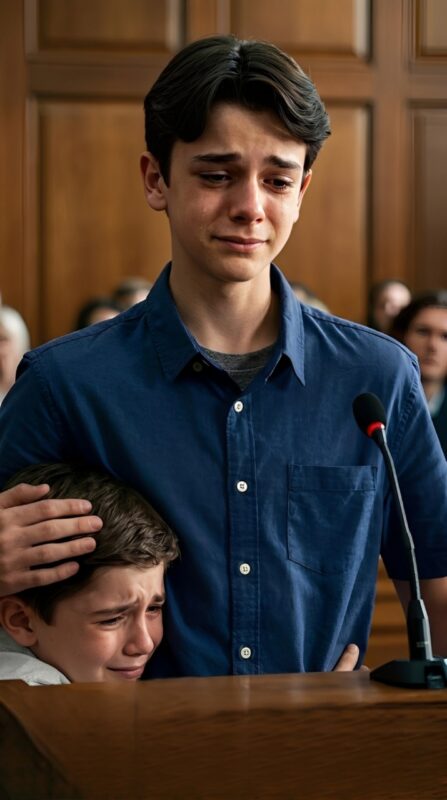
It was a guardianship hearing involving two orphaned brothers: Marcos, sixteen, and Tomás, eight.
Their parents had died within half a year of each other, leaving no close relatives willing or able to take them in.
On paper, the case was routine—filed in administrative language and directed toward foster care as the standard outcome.
Yet the record was missing everything that truly mattered.
It did not note that Marcos had been working since the age of fourteen to keep the household afloat, nor that he had quietly assumed the role of caretaker when their mother fell ill.
It said nothing of how Tomás relied entirely on his older brother, or how their shared routines had become a fragile system holding their world together.
After their mother’s death, Tomás had fallen silent for weeks.
Marcos did not force him to speak. Instead, he simply stayed—sitting beside him each night, reading aloud from a dinosaur book until silence gradually softened back into words.
Only when Marcos, in simple, uncertain promises, assured him he would not leave, did Tomás begin to speak again.
In court, lawyer Patricia Sánchez presented the case with measured precision.
She had already understood that this was not an ordinary situation: Marcos did not fit the profile of a typical teenager, and the bond between the brothers could not be easily replaced by institutional care.
She requested permission for Marcos to speak.
When Marcos rose, Tomás rose with him. The younger boy refused to let go, clinging tightly as his brother addressed the court.
Marcos admitted he had no legal training, but insisted that truth could not be captured in documents alone.
He spoke of their daily life—shared meals, surviving grief, and the simple reality that Tomás felt safe only when Marcos was near.
His voice wavered, yet his conviction held firm.
He acknowledged he could not legally serve as a guardian, but argued that separating them would destroy the last remaining stability they had.
“We are all we have,” he said, explaining that even without parents, he could still carry responsibility for his brother.
The courtroom fell into silence. Even observers—among them a social work student—were visibly affected.
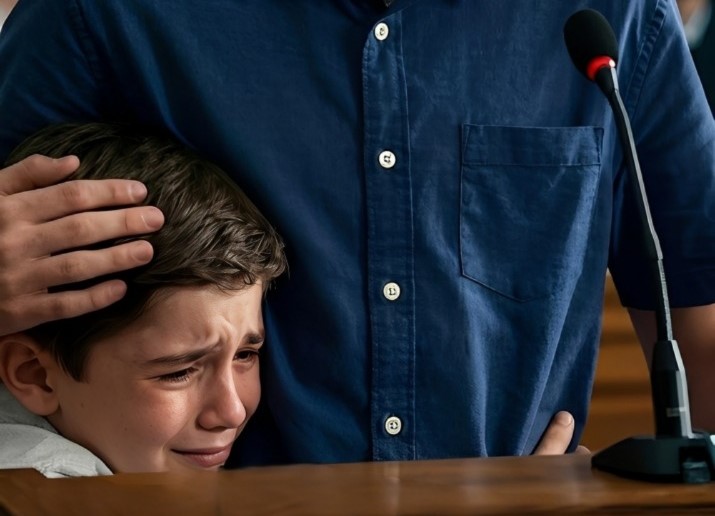
Judge Varela, whose marble composure had endured thousands of cases, showed the first visible sign of strain. After a long pause, he called for a recess.
In the corridor, Marcos held Tomás as the boy struggled through exhaustion and emotion.
Their lawyer soon returned, cautiously hopeful, explaining that the judge had requested further documentation:
school records, employment details, and possible foster arrangements that might allow the brothers to remain together. It was not a verdict—but it was a possibility.
When proceedings resumed, Judge Varela delivered his decision with restrained gravity.
He acknowledged Marcos’s responsibility, the stability he provided, and the undeniable bond between the brothers.
The court approved a joint foster arrangement rather than separation, subject to periodic review.
Six months later, their lives had begun to settle. Marcos continued working while attending school, and Tomás’s progress improved steadily.
Their foster placement provided structure without breaking their connection. At a subsequent review, the arrangement was made more secure.
Outside the courthouse afterward, Tomás asked if the decision was forever. Marcos told him that nothing in life truly is, but that this came as close as the system allowed.
Tomás considered this, then shifted to something simpler—deciding that grated cheese really did taste better than sliced.
They stepped into the cold February air together, hands clasped—not out of necessity, but choice.
And beyond the files, hearings, and formal rulings, one truth remained unchanged: their sense of home had never depended on institutions, but on each other.