Five minutes after my divorce, I fled to the airport with my children while my billionaire ex-husband celebrated his new future.
At 10:03 a.m., I signed the divorce papers without crying. Richard Sterling signed with a triumphant smile. Then his pregnant mistress, Chloe, entered the room.
Richard proudly signed another document transferring 40% of his Vanguard Industries shares into an irrevocable trust for Chloe’s unborn baby, whom he considered his future heir.
Chloe was named executor.
It was as though our children, seven-year-old Matthew and five-year-old Lily, no longer mattered.
Before I left, Chloe slid a check across the table.
“Pocket money,” she mocked. “Your kids will only complicate Richard’s new life.”
Everything was being recorded.
I simply picked up my blue folder containing our passports, custody documents, and evidence Richard knew nothing about.
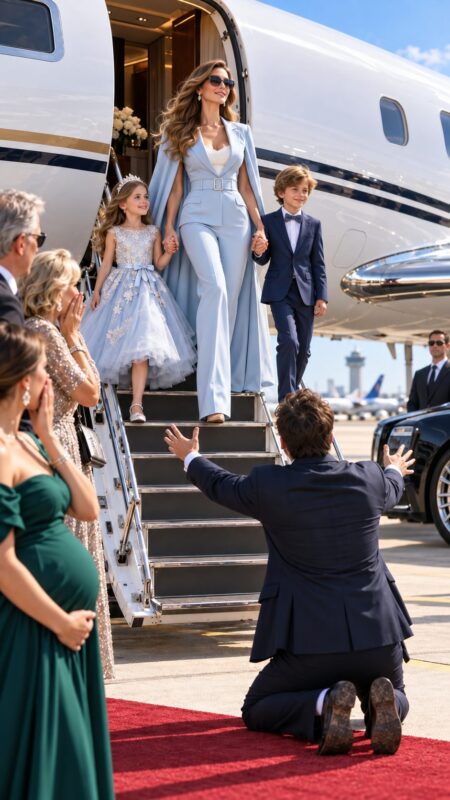
Less than two hours later, my children and I were flying to Spain.
Meanwhile, Richard, Chloe, fifty guests, and Vanguard executives gathered in a luxurious hospital suite for Chloe’s ultrasound.
Richard expected to introduce everyone to his future heir.
Instead, every phone in the room suddenly vibrated.
The ultrasound image vanished from the large screen and was replaced by a document sent through an automatic scheduled disclosure.
Dr. Evans studied it and turned pale.
The genetic information associated with Chloe’s pregnancy did not match Richard’s profile.
Then another disclosure arrived.
Photographs. Hotel reservations. Messages. Security footage.
And one name appeared repeatedly:
Logan Pierce.
Richard’s best friend.
The evidence showed that Chloe and Logan had been secretly meeting for months.
When Richard demanded an explanation, Logan finally admitted the affair had lasted eleven months.
The disaster was being livestreamed.
But Richard’s humiliation was only beginning.
His attorney arrived with two Vanguard board members and explained that Richard’s newly created trust
required the unborn beneficiary to be his biological child.
If the baby was not his, the 40% stake would pass to the secondary beneficiaries named in the existing family trust.
Matthew and Lily.
Thousands of miles away, Lily slept against my shoulder while Matthew drew dinosaurs.
My attorney messaged me:
“The trust triggered exactly as expected. Do not respond.”

I had hacked nothing and fabricated nothing.
Years earlier, during a federal investigation into Vanguard, I had helped establish an automatic compliance system.
Any attempt to transfer more than 25% of controlling shares into a trust involving an unverified
beneficiary would trigger disclosure of relevant records.
Richard himself had approved the system.
His arrogance had activated it.
But my blue folder contained something even more dangerous.
For eighteen months, I had collected evidence that Richard had used my credentials to authorize
suspicious financial transactions: altered statements, forged approvals, and transfers connected to shell companies.
Within seventy-two hours, Vanguard launched an independent forensic audit.
Richard was removed from executive authority, and Logan began cooperating with investigators.
Independent testing later confirmed that Chloe’s baby was Logan’s.
Four months later, Richard appeared outside Matthew’s school in Spain.
He had lost control of Vanguard and looked nothing like the powerful billionaire I remembered.
“I came to see my children,” he said.
I told him the decision belonged to them.
Then Richard handed me documents transferring his remaining interest in their family trust into an
independent structure reserved entirely for Matthew and Lily—their education, future, and choices.
He finally understood that he had spent his life chasing an heir while ignoring the two children who already loved him.
When Matthew saw him, Richard did not demand forgiveness.
“I’m sorry, Matthew.”
Matthew handed him his dinosaur notebook.
“You missed a lot.”
“I know.”
“Then you can start here.”
Richard sat on the pavement while Matthew showed him every drawing. Lily stayed in my arms, and Richard respected her distance.
That was when I understood what winning truly meant.
It was not Richard losing Vanguard or Chloe being exposed.
It was knowing that nobody owned us anymore.
Two years later, Richard permanently left Vanguard after accepting responsibility for financial misconduct.
The company was restructured, while Matthew and Lily’s shares remained protected.
Richard never became the king of the empire he imagined.
Instead, slowly and imperfectly, he became a father.
The day I thought my family ended at 10:03 a.m. was actually the day it finally began.
Richard had signed away 40% of an empire trying to create an heir.
In the end, that fortune went to the two heirs he had already abandoned.
But their greatest inheritance was not Vanguard.
It was the freedom to choose who they wanted to become.