“Roberto? Is that you… the one picking up cans on the street?”
The words stuck in my throat as I slammed the brakes in the middle of Cuauhtémoc Avenue. A taxi honked furiously, someone shouted from a window, but I heard nothing.
My eyes were fixed on a hunched man under the midday sun, a black bag over his shoulder, wearing a stained T-shirt that had once been white.
With his foot, he crushed a soda can as if he were crushing whatever little life he had left.
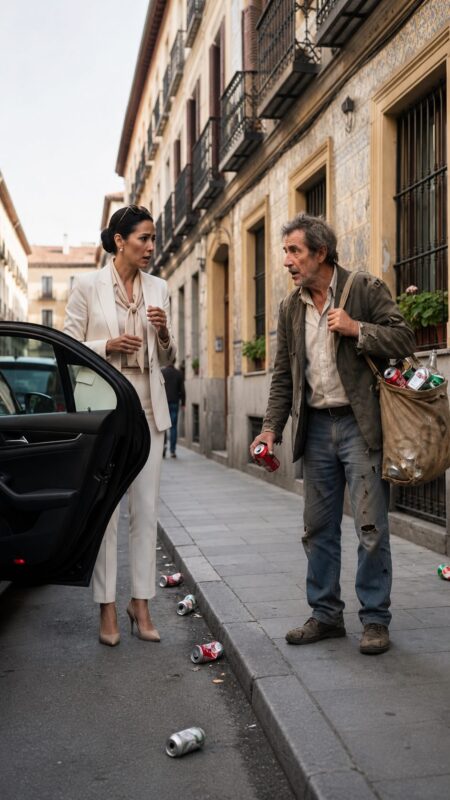
It couldn’t be him. Not Roberto. My ex-husband. The most beloved history teacher at the private high school where we both taught.
The man who ironed his shirts every Sunday, smelled of cedar cologne, and corrected exams with a patience that always irritated me.
I parked as best I could in front of a pharmacy and got out, trembling. When he looked up, I felt the ground split beneath me. His brown eyes were still the same—but sunken, exhausted, framed by wrinkles I didn’t remember.
When he saw me, he didn’t smile. He was afraid.
He grabbed his sack and tried to slip away down a narrow street beside a taco stand.
“Roberto, wait!”
I ran after him, my heels striking the hot pavement, catching him before he crossed.
“Leave me alone, Mariana,” he murmured without looking at me. “You don’t need to see me like this.”
“What do you mean I don’t? What happened to you? Where are you living?”
He pressed the bag to his chest.
“In a shelter near La Merced. But I’m fine. I work. I collect cans, sell them, and buy food.”
Tears came before I could stop them. I pulled money from my purse—several bills I had planned to spend on lunch in Polanco.
“Take it. Let’s go to a hotel. I’ll get you clothes, something to eat…”
Roberto stepped back.
“I don’t want your money.”
“Don’t be proud.”
“It’s not pride. It’s all I have left.”
His dignity hurt more than his dirty clothes. I begged him to get into my truck. At first, he refused, saying he would stain the seats, that my new husband would be angry. I simply replied:
“The truck is mine. And my husband doesn’t control my conscience.”
I took him to a small café in Narvarte. He ate a sweet roll and drank a café latte as if he hadn’t had anything warm in weeks. When I asked him why his life had fallen apart, he lowered his gaze.
“I did what I had to do.”
“What does that mean?”
He suddenly stood up.
“Ask your family.”
And he left me there, the blood freezing in my veins.
I couldn’t believe what was about to come next…
That night I didn’t sleep. Roberto’s words kept echoing in my head like a bell: “Ask your family.”
The next day, I called Claudia, an old colleague from school.
“Clau, I need to know why Roberto stopped teaching.”
There was silence on the other end.
“Mariana… you didn’t know? He didn’t resign. He was fired. It was a scandal.
A court notice came in—something about tax fraud, debts with the tax authority, shell companies. The administration removed him to protect the school’s reputation.”
I felt my breath catch.
Roberto wasn’t a fraud. He kept receipts from every small purchase. He never even crossed the street on a red light.
I went upstairs and opened the old boxes from my divorce. Beneath dust and papers, I found the blue folder. I reread the agreement I had signed five years earlier, during a time of exhaustion and resentment.
One clause stated that Roberto accepted full fiscal, civil, and administrative responsibility for the period 2018–2020, releasing me from any consequences.
Why had I signed that?
I called Salgado, my company lawyer, and asked him to investigate. Two days later, he summoned me to his office.
“Mariana, this is serious. Roberto has an enforced debt of nearly eighteen million pesos in fines, penalties, and legal liabilities. He lost his accounts, his car, his apartment—everything.”
“How does a teacher end up with that kind of debt?”
The lawyer adjusted his glasses.
“Because it wasn’t his. A shell company was created using a woman’s documents.
The original trace leads to your tax ID. But Roberto took responsibility and accepted the debt to close the investigation against that person.”
I felt sick.
2018 to 2020. The years my father, Don Ernesto, had his ‘new business ventures’ and kept asking me for copies of my ID, digital signature, and proof of address. He said it was just family paperwork—that I should trust him.
I drove to his house in Coyoacán with shaking hands. I walked in without knocking. My father was watching television in his armchair.
“What did you do with my tax ID?” I asked, throwing the documents onto the table.
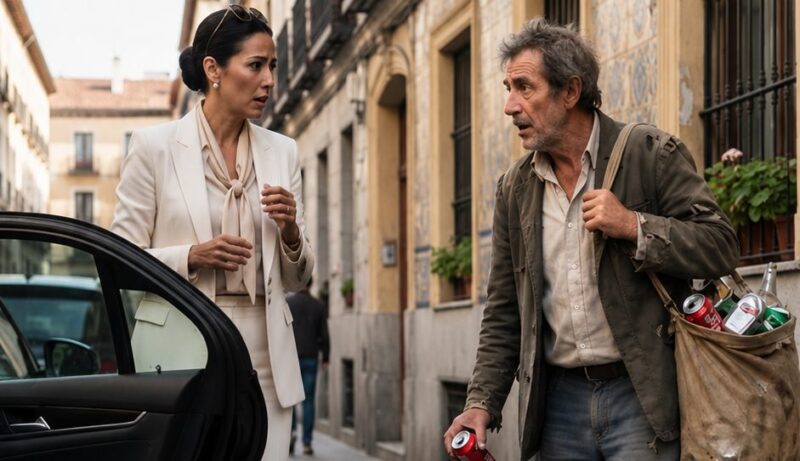
His face went pale.
He didn’t deny it. He said he was desperate, that his name was ruined, that he opened a company using my information “only for a few months,” and that he planned to fix it before the tax authority noticed.
“And Roberto?”
My father broke down.
“He found everything. He wanted to report me. I told him if he did, you would be the first to fall. The company was under your name. It would have destroyed your life.”
“So he took the blame…”
My father cried.“Because he said he would rather lose everything than see you in prison. And he made me swear never to tell you.”
I stared at the man who raised me, and for the first time in my life, I felt ashamed of the blood I carried.
But the worst part was still ahead: Roberto had no idea I already knew the truth.
I left my father’s house with one part of my soul shattered and the other burning with a clarity I had never felt before.
Before looking for Roberto, I went home. Carlos, my second husband, was in the living room, phone in hand.
“There she is, the saint of the poor,” he mocked. “Did you already give your homeless ex-husband some charity? People end up like that because they choose to.”
I looked at him as if I were seeing him for the first time. Expensive suit, expensive watch, empty heart.
“Get out of my house, Carlos.”
He laughed.
“What?”
“Get out. Today. I can’t share my life with someone who mocks a man who sacrificed himself out of love—while you wouldn’t give up a single comfort for anyone.”
He shouted, threatened, called me insane. But this time, I wasn’t afraid. Within an hour, he was packing his things.
That night, I found Roberto on a bench near Plaza de la Merced, wrapped in a thin blanket. When he saw me, he stood up, startled.
“Mariana, you shouldn’t be here.”
I didn’t answer. I just hugged him—holding him with all the pain I had carried for five years of ignorance.
“I know everything, Roberto. I went to my father. I know you took on a guilt that wasn’t yours to protect me.”
His body went rigid.
“You shouldn’t have found out.”
“You shouldn’t have destroyed yourself.”
“I didn’t want you to lose your father. Or your freedom.”
I cried against his chest.
“You saved my life, and I spent years believing you were a failure. How could you carry something like that alone?”
He lowered his gaze.
“Because I loved you. And because even after we separated, I never stopped wanting you to be okay.”
That night, I took him to a hotel. He refused at first until I told him:
“It’s not charity. It’s justice.”
I sold my truck, some jewelry, and part of my investments. My father signed a full statement accepting his moral and legal responsibility.
It wasn’t easy—there were lawyers, procedures, investigations, humiliation—but little by little, Roberto’s name began to clear.
I also took him to the doctor. He had anemia, an old cough, damaged teeth, and a sadness no test could measure.
Still, week by week, I watched him come back to life: straighter posture, a steadier voice, the gaze of a teacher returning.
Three months later, we met at a café downtown. He walked in wearing a simple blue shirt, neatly pressed. He looked like himself again.
“I got accepted at a public high school,” he said with a smile. “I start Monday. Mexican history.”
I cried without shame.
“They gave you back what they never should have taken.”
He took my hand.
“You gave me my life back.”
I shook my head.
“No, Roberto. You saved mine first.”
We left walking slowly, without dramatic promises or perfect endings.
I lived in a smaller house now, drove a modest car, and no longer carried the image of the perfect family I once obsessed over. But for the first time in years, I felt at peace.
Because I finally understood that wealth is not what you show to the world—it’s what you’re willing to lose when no one is watching.
And Roberto, the man so many once dismissed as a beggar, turned out to be the most dignified of them all.