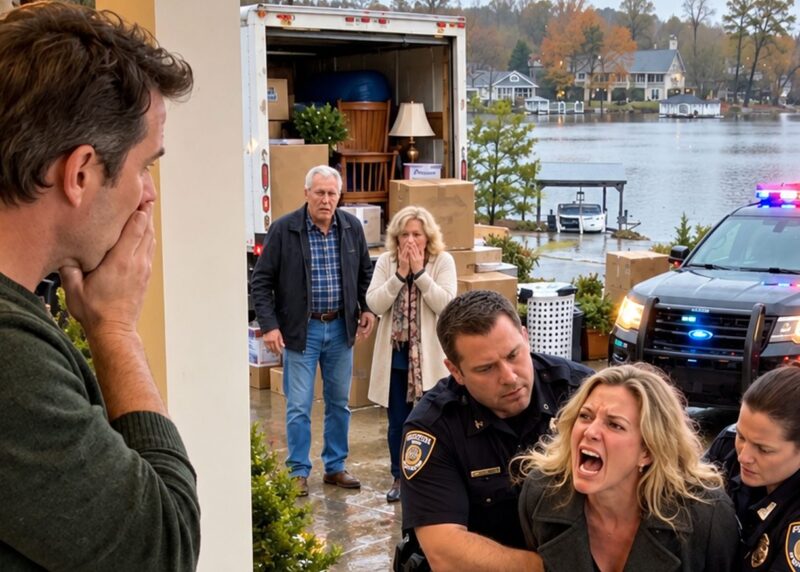
My parents sold their fully paid-off house to rescue my sister from debt, then arrived at my lake house with a moving truck as if they already had the right to live there.
“We’re your parents,” my father snapped. “We don’t need your permission to stay here.”
I’m Carter, thirty-six, unmarried, and I built my Lake Superior home after years of brutal work and sacrifice.
My younger sister Chloe had always been the golden child. Whenever she made a mistake, I was expected to fix it.

That night, my parents announced they had sold their $487,000 Ohio house to save Chloe from debt and were moving in with me.
“You have four bedrooms,” Dad said. “You live alone.”
When he tried to push past me, I stopped him, locked the door, and refused to let them inside.
They slept in their Buick while relatives bombarded me with messages calling me selfish. But something didn’t make sense.
Their house had no mortgage. Even after helping Chloe, they should have had plenty of money.
Then someone slipped a handwritten note under my door:
“Carter, don’t let them inside. Ask where the $312,000 went.”
I searched property records and discovered their house had been purchased by an LLC created only eleven days earlier. Its registered agent, Derek Sloan, had appeared in Chloe’s social media posts.
Even stranger, the same LLC owned a $720,000 colonial house Chloe had recently posed beside.
Later, my security camera recorded Dad speaking secretly on the phone.
“He found the records,” he said. Then: “He doesn’t know about the signature.”
I immediately called my attorney, Melissa Grant.
Three months earlier, Mom had asked me for a copy of my lake-house deed, supposedly for estate planning.
Melissa investigated and discovered something terrifying: my parents had filed a quitclaim deed claiming I had transferred partial ownership of my property to them.
The signature looked like mine.
It wasn’t.
Dad texted me: “This can be handled quietly. Don’t make this a legal matter.”
The next morning Melissa arrived with bank-fraud investigator Daniel Ross.
He showed me that $312,000 from my father’s account had been transferred in three payments to the same LLC.
Then Chloe contacted me.
“Dad lied to you. He lied to me too.”
She came to my house and admitted her real debt was only about $80,000.
Dad had persuaded her to sign a power of attorney, supposedly so he could negotiate her debts. Instead, he moved $150,000 through an account in her name.
He had also convinced Chloe that I planned to sell my lake house and that she would eventually receive another property.
Daniel uncovered the deeper truth.
Derek Sloan had been Dad’s business partner twenty years earlier. Their failed construction company had left a dispute involving roughly $300,000.
Dad hadn’t sold his home simply to rescue Chloe. He needed money to cover an old financial obligation.
Worse, he had been creating records suggesting he had financially supported my lake house.
The forged quitclaim deed could potentially have been used to borrow against or sell my property.
Then Dad began pounding on my door.
Mom appeared behind him, crying.
“I wrote the note,” she confessed.
She had discovered his plan before they sold their house. Dad intended to move into mine, establish residency, and pressure me through relatives if I resisted.
Then Mom handed me another document she had secretly saved.
It was a handwritten agreement, dated six years earlier, falsely claiming my parents had contributed money toward my lake house.
“You planned this for six years?” I asked Dad.
He said nothing.
I ordered him off my property.
“You would do that to your own father?” he demanded.
“You did this to your own son.”
Three weeks later, the forged deed was rejected. Accounts connected to the LLC were frozen, and investigators discovered Dad had used Chloe’s identity and accounts to move money.
My lake house remained unquestionably mine.
Chloe moved into a modest apartment and began paying her real debts. Mom left Dad, rented a small place near Columbus, and started rebuilding her life.
Eventually, Dad sent me a letter containing only two sentences:
“I thought you owed me. I was wrong.”
Months later, another envelope appeared beneath my door. Inside was an old photograph of me sitting on Dad’s shoulders.
Mom had written on the back:
“You were never the problem, Carter. We were just too afraid to admit we had become one.”
That was when I finally understood.
The fight had never really been about bedrooms, money, or property.
It was about boundaries.
Family doesn’t give someone ownership of your life simply because they believe you owe them.
Standing beside the frozen lake, inside the home I had protected, I finally stopped feeling guilty.
I felt free.