“Adrian was meant to raise our son until Meridian became his.”
Daniel’s words froze me.
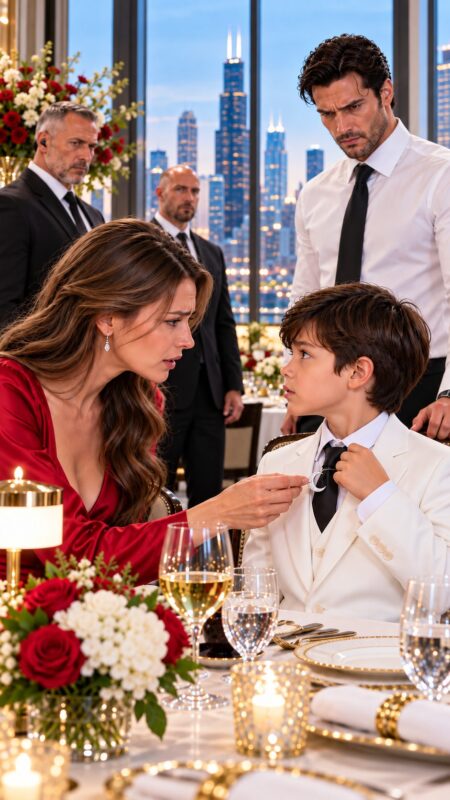
Across the hospital conference room, Adrian Kane stood beside Evan—the seven-year-old boy I had just discovered was my biological son.
Daniel admitted that my father, Thomas Carter, had never intended Evan to disappear.
He had hidden him because my grandfather Samuel’s trust granted my first biological child a protected thirty-percent interest in Meridian at age seven.
Daniel had even redirected investigators when I searched for my baby.
I was furious, but Evan was listening, so I controlled myself.
Then another truth emerged. Adrian had adopted Evan after losing his own daughter.
Thomas had arranged the adoption, convincing everyone Evan’s mother was dead.
Victor had helped, believing he was placing an orphan with a grieving father.
Watching Evan hug Adrian changed something in me. Adrian had unknowingly participated in the deception, but he had genuinely loved and raised my son.
Then Evan mentioned an older man he had seen near the elevators.
I showed him a photograph of Thomas.
“That’s Grandpa,” Evan said.
My supposedly dead father was alive.
Security searched the building but found only an envelope addressed to me in Thomas’s handwriting. Inside was a warning:
Adrian was not my enemy, Daniel could not be trusted, and if I wanted to understand why Samuel had chosen age seven,
I should return to my grandfather’s old garage in Pasadena.
Soon afterward, security found Thomas’s old cane with a brass key tied beneath its handle.
Victor recognized it. Thomas had carried that key the night he delivered newborn Evan for adoption.
But the mystery deepened when Evan revealed that “Grandpa” regularly brought him science books and repeatedly asked whether he dreamed about numbers “in sevens.”
Evan wrote down a doubling sequence—the same mathematical pattern Samuel had taught me as a child.
Then my phone rang.
Thomas.
Alive.
I demanded answers, but he insisted he had hidden Evan to protect him from Daniel.
More shockingly, Thomas claimed he had not forged my surrender papers.
Someone Samuel once trusted had done it, and the plan had begun long before Evan was born.
Then Thomas warned me not to go to Pasadena.
I stared at the envelope. “You told me to go there.”
“No,” he replied. “I left no note.”
Someone had perfectly copied his handwriting and deliberately tried to lure me there.
Thomas finally revealed that Evan’s thirty-percent inheritance was more than stock. It was a legal,
voting, and cryptographic key connected to something Samuel had secretly built into Meridian.
Twelve days earlier, when Evan turned seven, something had activated.
Then Daniel texted me: DON’T TRUST THOMAS.
He sent a photograph showing Thomas beside an underground steel door bearing an old Meridian logo dated from when I was twelve—years before I founded Meridian Robotics.
Thomas admitted there had been an earlier Meridian: a secret family project designed to identify something Samuel believed could be inherited.
Before he could explain further, every light went out.
The elevators locked. Backup generators failed.
“They found you,” Thomas warned.
Then a hidden wall panel slid open.
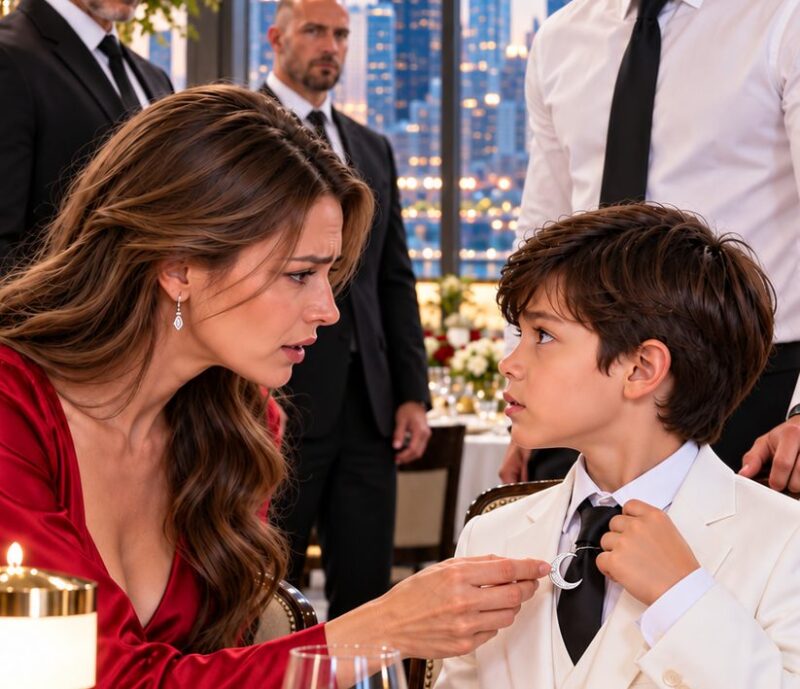
Inside was a black case engraved with the exact imperfect crescent moon I had handmade for Evan as a newborn.
The case activated automatically.
HEIR IDENTIFIED.
MATERNAL LINE CONFIRMED.
Then:
PATERNAL LINE: INCONSISTENT.
Daniel had never actually been DNA-tested. We had simply assumed he was Evan’s biological father.
Terrified, Evan asked, “Who is my father?”
“I am,” Adrian answered immediately. “No screen can change that.”
Then the display changed again.
A name appeared.
Samuel Carter.
My grandfather.
PATERNAL SOURCE.
Impossible.
Before we could understand it, the case opened and projected an old recording onto the wall.
Samuel appeared behind a workbench, younger and very much alive when the video had been made.
He stared directly into the camera.
“If you’re watching this, Emily, then they lied to you about who your son is.”
Everyone fell silent.
Samuel leaned closer.
“And if the boy is seven years old, we’re almost out of time.”