The Mother of the Groom Was Humiliated for Wearing an Old Dress to Her Son’s Wedding… But What the Bride Did in Front of Everyone Brought the Entire Hall to Tears
Doña Carmen was 58 years old, her hands rough and weathered from a lifetime of exhausting work.
Every morning at 3 a.m., she would set up her humble vegetable stand in the busy street markets of Iztapalapa, Mexico City.
Whether beneath scorching heat or freezing rain, she sold tomatoes, onions, chili peppers, and fresh nopales.
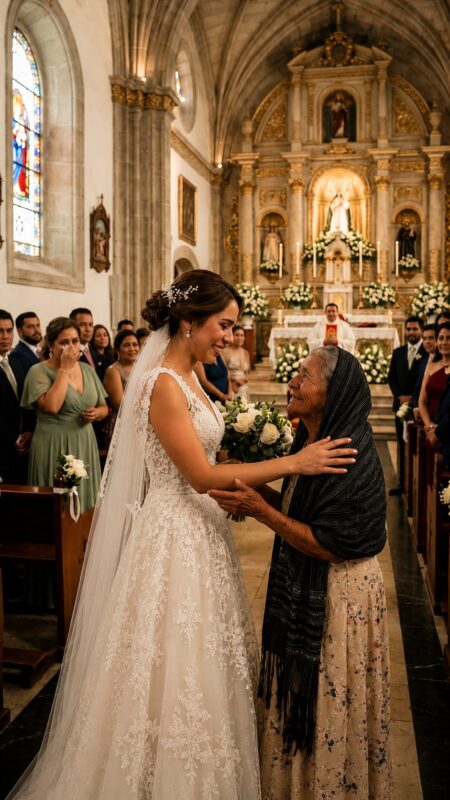
She had spent most of her life raising her son Mateo alone, sacrificing everything she had so he could build a brighter future.
Mateo never took her sacrifices for granted. He graduated from university with honors and eventually secured a prestigious corporate position.
One evening, he came home with news that would change both of their lives forever: he had fallen in love with Sofía, a graceful and sophisticated young woman from one of the wealthiest families in Polanco.
Her father was a powerful businessman, and her mother was a respected surgeon.
Carmen feared she would embarrass her son among such refined people, but Sofía always treated her with sincere affection and respect.
Three months before the wedding, Mateo announced that the ceremony would take place at an elegant hacienda in Cuernavaca.
Carmen was filled with joy, yet deep inside she felt terrified. She owned nothing suitable for such an extravagant event.
Every peso she had ever saved had gone toward food, bills, and Mateo’s education.
After searching through her old wardrobe, she found the only dress she could wear: a faded green cotton dress with delicate handmade embroidery.
It was the same dress she had worn when she gave birth to Mateo and later when she proudly watched him receive his university diploma.
The dress carried precious memories, but it was undeniably old.
On the day of the wedding, the hacienda looked like a scene from a fairy tale.
White roses decorated every corner, crystal chandeliers sparkled overhead, and hundreds of elegantly dressed guests arrived wearing designer suits and expensive jewelry.
The moment Carmen stepped inside wearing her worn green dress, whispers immediately spread through the crowd.
Then Leonor, Sofía’s wealthy and arrogant aunt, approached with a cruel smile on her face.
“Excuse me,” she said loudly enough for nearby guests to hear, “the kitchen staff enters through the service door.”
Carmen lowered her eyes in humiliation. “I’m the groom’s mother,” she replied softly.
Leonor let out a cold laugh.
“Then perhaps you should sit in the back. We wouldn’t want you ruining the wedding photographs.”
Holding back tears, Carmen quietly walked to the last row and sat alone. Mateo, nervous at the altar, had no idea what had just happened.
The ceremony began. Music filled the garden as Sofía appeared in a breathtaking white gown.
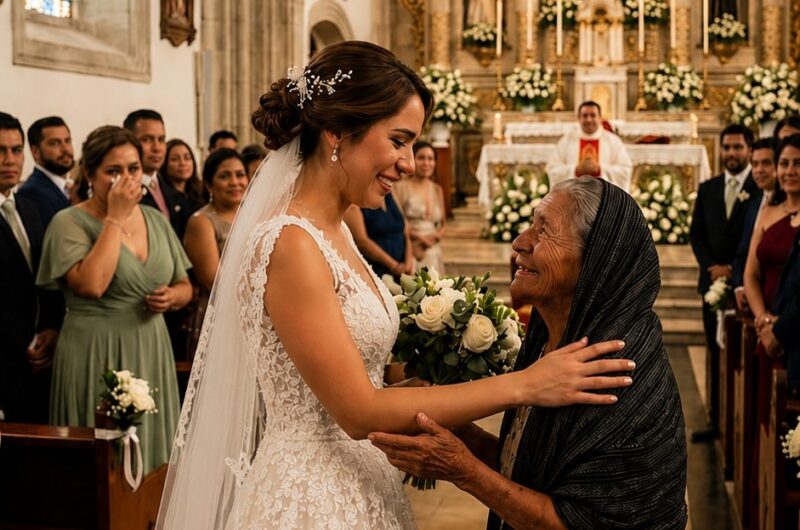
Everyone stood in admiration. But halfway down the aisle, Sofía suddenly stopped.
Her eyes found Carmen sitting silently in the back row, wiping away tears, and she instantly realized something was wrong.
Without hesitation, Sofía dropped her bouquet onto the floor, walked directly to the priest, and gently took the microphone from his hands.
The entire hacienda fell silent.
“Aunt Leonor,” Sofía said firmly, her voice echoing through the speakers, “please leave my wedding immediately.”
Gasps swept through the crowd. Leonor stood frozen in disbelief while Sofía ignored every attempt to calm the situation. She walked straight toward Carmen and gently held her trembling hands.
“Mother Carmen,” she said softly, “you do not belong hidden in the shadows.”
Sofía guided her down the aisle and brought her beside Mateo at the altar.
The moment Mateo saw tears streaming down his mother’s face, he understood the humiliation she had suffered.
Overcome with emotion, he embraced her tightly and broke down crying.
Then Sofía turned toward the guests.
“Many of you judged this woman because of her dress,” she began. “But this is not just an old piece of fabric. It is a symbol of sacrifice.”
She pointed carefully to the embroidery.
“She wore this dress when she gave birth to the man I love.
She wore it again after spending twenty-five years waking before dawn to sell vegetables so he could receive an education. And today, she wears it once more to bring him to this altar.”
The guests lowered their eyes in shame.
“The most elegant person at this wedding is not me,” Sofía continued. “It is my mother-in-law.”
Mateo apologized through tears for failing to protect his mother. Carmen simply stroked his hair the way she had when he was a little boy.
Then Sofía revealed one final surprise. Lifting part of her wedding gown, she showed a hidden piece of green fabric sewn into the lining near her heart.
“A month ago,” she explained, “I secretly asked Mateo for a photograph of Carmen’s dress. I wanted a piece of it with me today because a marriage should begin with gratitude, not luxury.
I could never stand at this altar without honoring the woman whose sacrifices made this man possible.”
Thunderous applause filled the hacienda. Guests openly wept, and even Sofía’s strict mother approached Carmen with tears in her eyes.
“I spent years studying to save lives,” the surgeon admitted humbly. “But you accomplished something even greater. You gave your entire life so your son could truly live.”
For the first time that day, Carmen no longer felt ashamed. She no longer saw herself as the poor market vendor who did not belong among wealthy people.
At that moment, she finally understood the truth: she was the heart of the family.
Later that evening, during the reception, Mateo chose his mother—not his bride—for the first dance.
Beneath warm lights and soft music, the successful engineer danced slowly with the woman who had sacrificed everything for him.
When Carmen returned home that night, she carefully hung the green dress back inside her closet. It was still old, still simple, and still worn.
But to her, it had become priceless—a reminder that dignity, sacrifice, and love are worth far more than wealth or appearances.