“Your daughter isn’t losing her sight… someone is taking it from her.” — The homeless boy’s warning that shattered a billionaire’s world.
Marcus Bennett had once been a dominant figure in international finance, a man who built a global empire through decades of relentless ambition.
He had negotiated billion-dollar deals, advised governments, and stood at the center of global power.
But none of that mattered anymore.
His seven-year-old daughter, Lila, was fading away before his eyes.
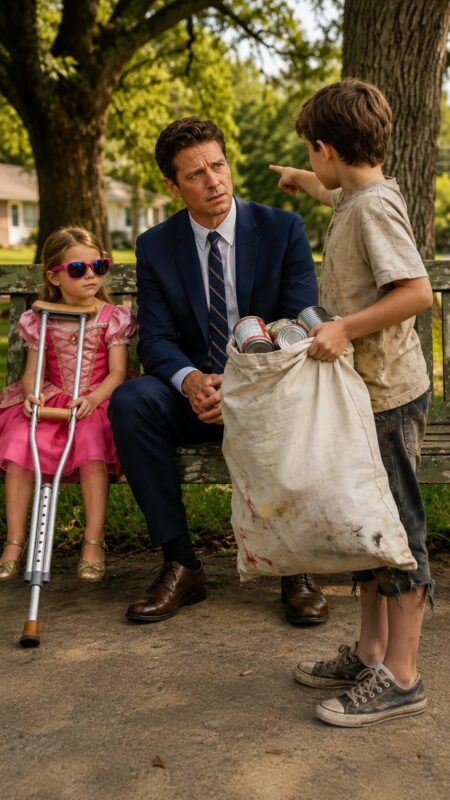
They sat together on a weathered bench in a park in Accra. Only months earlier, she had been a vibrant, energetic child—painting endlessly, running barefoot through their garden, full of laughter and light.
Now she needed assistance just to walk, a white cane resting in her small hands.
Specialists from London, Dubai, Paris, and New York had all delivered the same devastating verdict: a rare, progressive, incurable degenerative condition.
Marcus had spent millions searching for hope.
Every answer led to the same conclusion—Lila was going blind.
“Is it night already?” she asked softly.
“No, sweetheart,” Marcus replied gently, hiding his pain. “It’s just the clouds.”
Nearby, a thin boy—no older than ten—stood watching them.
He wore oversized, worn clothing and didn’t approach like the other street children begging for money.
Instead, he stepped forward with unsettling calm.
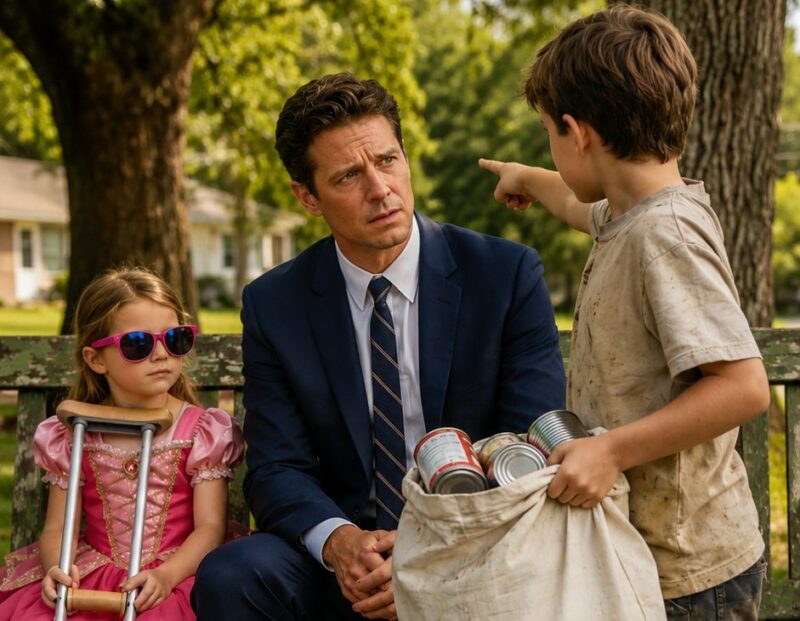
“Your daughter isn’t sick, sir,” he said.
Marcus frowned. “What did you say?”
The boy didn’t hesitate.
“She isn’t losing her sight,” he continued firmly. “Someone is taking it from her.”
Marcus rose instantly.
“What are you talking about?”
The boy glanced around nervously before meeting his gaze again.
“It’s your wife.”
The words hit like a blow.
He explained that he had seen Vivian—Marcus’s wife—moving alone through the kitchen at night, near Lila’s food. He had noticed strange behavior, secretive moments, and patterns that didn’t fit.
Marcus struggled to process it. Vivian was graceful, loving, and had always acted like a devoted mother.
And yet…
The timeline unsettled him.
Lila’s condition had begun shortly after Vivian returned to the household following their reconciliation.
The boy introduced himself as Kofi. He admitted he sometimes slept behind the mansion and had watched through the kitchen window. He had seen Vivian alone at night near the meals prepared for Lila.
Still, Marcus was torn between disbelief and a growing, uncomfortable fear.
Kofi spoke again, quieter this time.
“My sister got sick once. No one believed me either.”
That was the moment doubt took root.
Marcus did not confront Vivian immediately. Instead, he contacted Dr. Elena Rhodes in London, a pediatric specialist who had previously questioned the diagnosis.
He instructed her to prepare for Lila’s arrival and to test everything she consumed.
The next morning, Vivian served breakfast as usual, smiling warmly, unaware of what was already in motion.
Marcus carefully avoided confrontation, secured samples of Lila’s food, and arranged an emergency flight to London—with Kofi accompanying them.
At the hospital, Dr. Rhodes conducted extensive examinations.
Hours later, she delivered the truth.
Lila was not suffering from a degenerative disease.
She had been repeatedly exposed to a harmful substance that affected her vision—and the damage could still be reversed if the exposure stopped immediately.
Relief surged through Marcus, followed almost instantly by something colder.
Rage.
He returned to Accra with medical reports, legal authorities, and Kofi by his side.
In the mansion, Vivian reacted with shock, fury, and denial when confronted. But Marcus remained calm as he placed the evidence on the table.
“She was never sick,” he said quietly. “And she is not your daughter.”
A search of the house followed.
Police discovered a hidden bottle matching the toxic agent in the kitchen. The household cook eventually admitted that Vivian had often insisted on preparing Lila’s meals herself.
Vivian’s explanations shifted—from denial to emotional justification—claiming she only wanted to feel needed after being pushed aside within the family.
But it was too late.
She was arrested.
After her removal, everything changed.
Lila’s recovery began slowly—first shapes, then colors, then clarity. Until one morning, she saw the sunlight again and smiled at the world she thought she had lost.
When her vision returned fully, she saw Kofi clearly for the first time and laughed, saying he looked better than his voice sounded.
Kofi, who had once lived on the streets, broke down in quiet tears.
In the months that followed, Marcus stepped away from much of his corporate empire. He established The Clear Light Foundation in Accra, dedicated to abandoned children and accessible medical care.
At the opening ceremony, he stood beside Lila and Kofi.
“I once believed power was money,” he told the crowd. “But the person who saved my daughter had nothing the world values.”
He placed a hand on Kofi’s shoulder.
“No home. No protection. But he chose courage.”
Then, overcome with emotion, he added softly:
“From today… Kofi is my son.”
Lila embraced him and nodded.
Marcus knelt before the boy. Kofi hesitated, then whispered uncertainly:
“Dad?”
Marcus pulled him into an embrace.
Under the bright Accra sun, Marcus Bennett finally understood something profound:
Truth and heroism are not defined by wealth or status.
Sometimes they arrive quietly, in the voices of those the world overlooks.
And sometimes, the smallest voice is the one that saves everything.