The Price of Kindness
The air inside the French bakery was saturated with the aroma of toasted almonds and soft vanilla.
Sunlight spilled across polished marble floors, while glass displays shimmered with rows of flawless, vividly colored pastries.
For Leo and his younger sister Mia, it felt as if they had stepped into another world entirely.
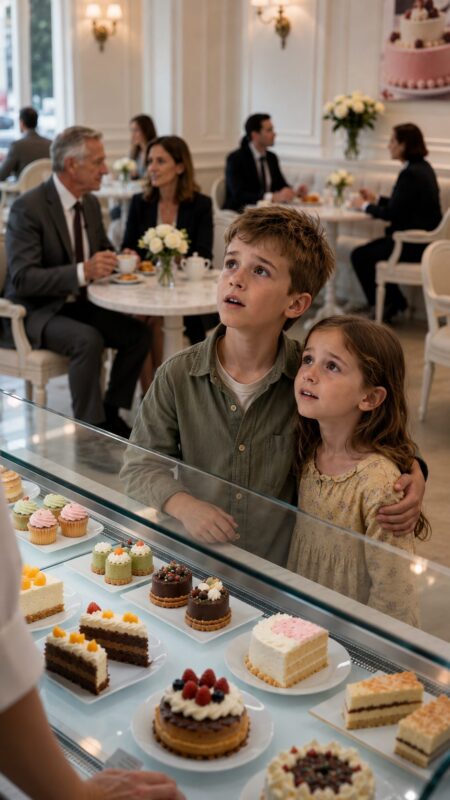
Their clothes were worn and frayed, their faces dusted with street grime, making them appear like muted shadows drifting through a world of white and gold.
Leo forced himself to stay composed, holding Mia close at his side.
“Excuse me,” he said quietly, though his voice remained steady. “Do you have any bread from yesterday that you sell at a lower price?”
The cashier, wearing a crisp black apron, didn’t even hesitate. There was no smile, no warmth in her tone.
“We don’t sell day-old products here,” she replied flatly, already turning her attention toward the wealthier customers behind them.
Mia’s lip quivered. A single hot tear traced a line through the dirt on her cheek. “I’m hungry,” she whispered, hiding her face in her brother’s chest.
Leo held her tighter, feeling the cold pressure of the world far too soon on his shoulders. To the bakery, they were nothing more than an imperfection in an otherwise perfect display.
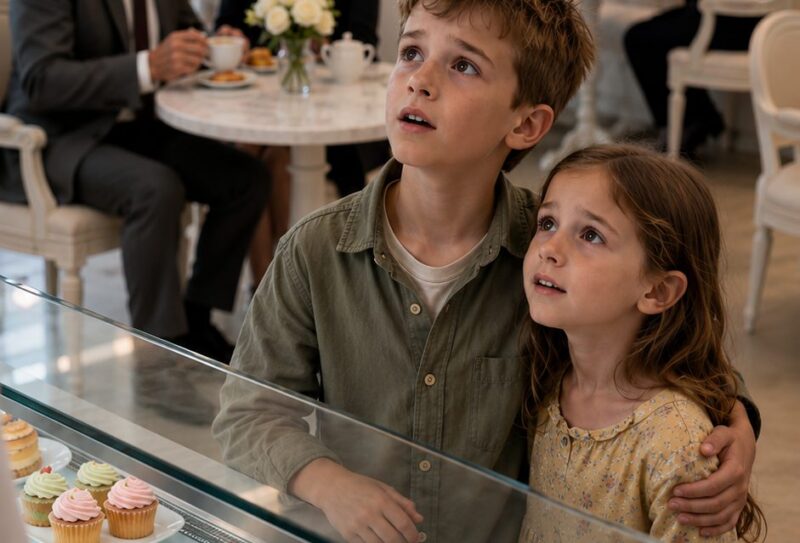
Then, the soft rhythm of footsteps and the murmur of voices suddenly faded.
An elderly man in a perfectly tailored charcoal suit rose from his table.
His expression was firm, his gaze locked on the cashier—not with pity, but with unwavering authority.
“Pack it all,” he said, his voice cutting cleanly through the silence like a bell.
The cashier froze. “All of it, sir? You mean a dozen pastries?”
“No,” he replied, gesturing toward the entire display—every croissant, every cake, every loaf of artisan bread. “Everything. And be quick about it.”
The atmosphere shifted at once. Cold indifference gave way to stunned silence.
The man walked over to Leo and Mia and knelt so he was at their level, placing a steady hand on Leo’s arm.
“Tonight, you eat like royalty,” he said gently, a warm smile softening his face.
“And tomorrow, we’ll make sure you never have to ask for yesterday’s bread again.”
The cashier hurried to pack box after box, her hands unsteady under the weight of her earlier cruelty.
As the man guided the children out and into a waiting car, the bakery was left empty of its sweets—but strangely filled with a lingering sense of warmth.
Wealth is not measured by what you keep, but by what you choose to give when no one is watching.