I condensed the full uploaded text to about 650 words, preserving the main characters, events, emotional arc, and ending.
Eli’s idea was simple: before approaching the one-eyed mother dog, everyone would stand where her left eye could see them, make the same gentle sign for safe, and wait.
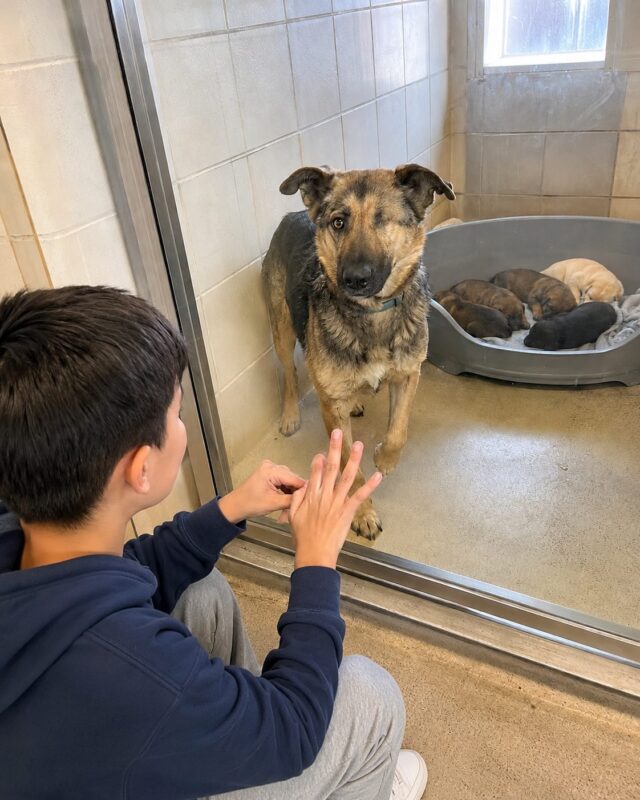
The gesture itself meant nothing to her at first. What mattered was what followed—no sudden movements, no reaching over her head, and nobody appearing unexpectedly from her blind side.
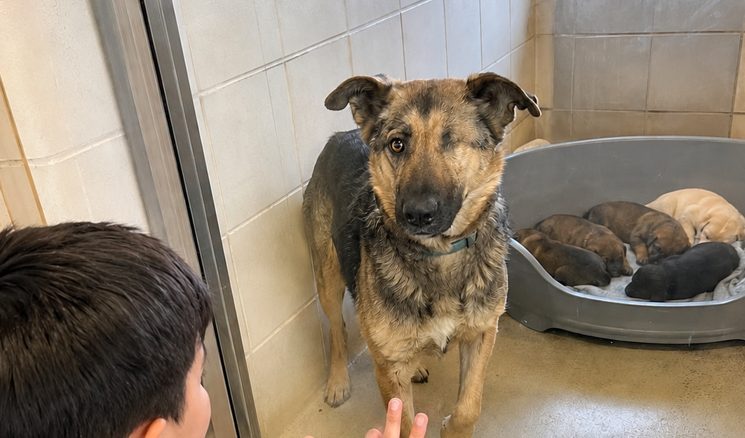
The nursing mother had been at the shelter for seventeen hours, yet veterinarian Dr. Priya Shah still could not examine her.
She was thin and exhausted, constantly protecting her five puppies. One small black male was struggling to nurse.
We marked the edge of her visual field with blue tape.
Staff approached only from the left, signed, paused, and withdrew. Slowly, something changed.
The mother stopped pacing. She ate several pieces of chicken and eventually rested beside her puppies.
We named her Mara.
That evening, the smaller puppy became chilled, making an examination necessary.
Using a portable barrier, Rosa, Dr. Shah, and I separated Mara from the puppies without taking them out of her sight.
The little male weighed only fourteen ounces but responded to warmth. We named him Button because of the tiny white marking on his chest.
Examining Mara was harder.
She panicked when objects moved near her missing right eye. Instead of forcing her into a crate, we covered its right side with my jacket, creating a boundary she could feel.
After several attempts, Mara finally entered.
Dr. Shah discovered that Mara was about eight pounds underweight, but her heart, lungs, and remaining eye were healthy.
Her missing eye socket had completely healed. Her greatest problems were exhaustion, low body weight, and the demands of nursing five puppies.
The next morning, we transferred the family to foster volunteer Hannah Ruiz’s quiet home outside Denver.
A slamming fire door briefly frightened Mara back into her old pacing pattern, but we returned to the familiar routine: approach from the left, sign safe, and wait.
Eventually, Mara entered her crate voluntarily.
At Hannah’s home, everything was arranged around Mara’s remaining vision.
Her bed stood against a wall, food and water stayed on her left, and furniture remained predictable.
That night, Mara finally slept beside her puppies.
Recovery came gradually. Button gained weight, Mara ate regularly, and she became calmer around Hannah.
Eli visited and continued using the sign. He never forced contact. Eventually, Mara began approaching him voluntarily.
There were setbacks. During the second week, a falling laundry basket startled Mara from her blind side.
She paced for hours and refused food. Rather than forcing her to “get used to” surprises, Hannah returned to the original routine.
Over four days, Mara settled again.
The experience taught us that Mara did not need fear eliminated; she needed information.
We developed visual signals for someone entering, placing down food, or stopping movement.
Weeks passed. The puppies grew healthy, and Mara gained six pounds. Her pacing became rare.
At eight weeks, the puppies began leaving for adoptive homes one by one.
Button eventually left too. When the final puppy departed, Mara searched the room and returned to her old pacing route.
Hannah simply remained visible.
Days later, Eli visited. Mara approached him and, for the first time, allowed him to gently touch her shoulder.
Eli’s family had never planned to adopt a dog, but they began supervised visits.
They installed a secure fence, kept furniture predictable, and learned Mara’s visual cues.
Six weeks later, they submitted the adoption application.
Four months after Eli first sat outside the shelter glass, Mara officially became part of his family.
On the first snowy evening of winter, a delivery box dropped outside. Mara woke abruptly and prepared to pace.
Eli stepped into the vision of her remaining amber eye.
He signed safe.
Mara looked at the door, then at him. Instead of pacing, she walked across the room and lay beside his feet.
The first time Eli had made that sign, Mara had been trapped behind kennel glass, exhausted and terrified while guarding five newborn puppies.
Now there was no glass between them.
Eli lowered his hand. Mara placed one paw across his fingers, closed her eye, and rested as the house grew quiet around them.