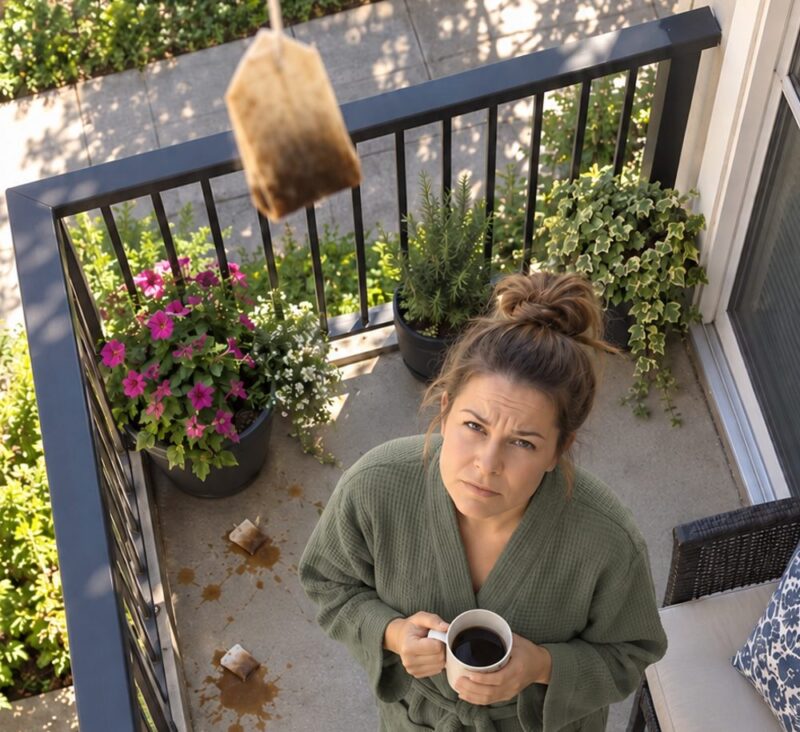
I asked my upstairs neighbor three times to stop throwing used tea bags onto my balcony.
The first time, he apologized. The second time, he shrugged. By the third, he laughed.
So I stopped asking.
At first, I assumed the tea bags were accidents. But they kept appearing—usually around seven in the morning and sometimes again at night.
One stained a white towel.
Another ruined the cushion on my favorite balcony chair.
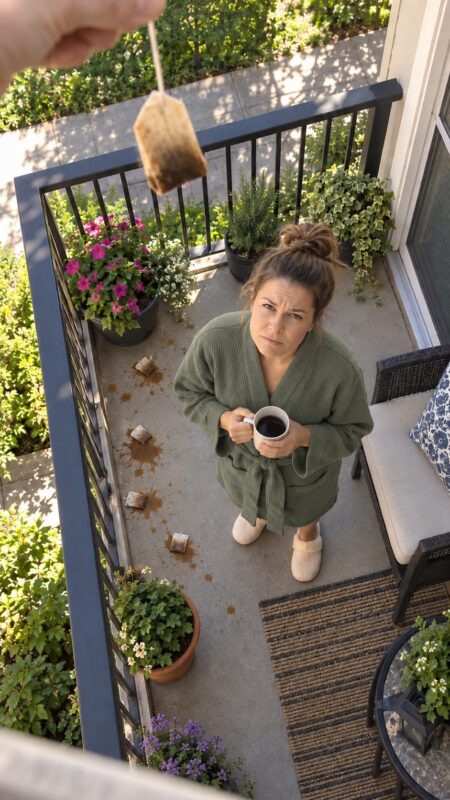
When I confronted him again, he only smiled.
“It’s just tea,” he said. “You live underneath me. Things fall.”
“They aren’t falling. You’re throwing them.”
He laughed. “You should probably be grateful it’s only tea.”
That was when I realized arguing wouldn’t help.
The next morning, at exactly 7:04, another wet tea bag landed beside my flowerpots.
Instead of getting angry, I smiled.
That afternoon, I built something.
I installed a clear angled plastic panel above the edge of my balcony.
A small drainage tube ran from the panel and redirected anything landing on it back toward his balcony.
The following morning, I sat outside with coffee and waited.
His balcony door opened.
A tea bag dropped.
But instead of landing on my balcony, it struck the plastic panel, slid into the tube, and disappeared.
Seconds later, I heard him yell.
“Hey! What the hell?”
The tea bag had landed inside a transparent container on his balcony.
Beside thirty-seven other tea bags.
I had saved every one I could find.
On the container I had taped a sign:
PROPERTY OF APARTMENT 4B.
He stared at the container, then at me.
“You collected them?”
“Every one.”
His embarrassment quickly became anger.
“You can’t put garbage on my balcony!”
I looked at him.
“That’s interesting. You seem to understand the problem now.”
Minutes later, he was pounding on my door demanding that I remove the “contraption.”
“You’re redirecting garbage onto my property!” he snapped.
Before I could answer, several neighbors stepped into the hallway.
I showed them the video I had recorded that morning: his hand dropping the tea bag and the bag returning directly to his balcony.
He insisted tea was biodegradable.
One neighbor replied, “So are banana peels. You don’t throw those onto someone else’s balcony.”
Then I showed him the folder I had prepared: photographs of the stains, dates, times, thirty-seven
documented incidents, summaries of our conversations, and the building rules against throwing objects from balconies.
“I reported you yesterday,” I said. “The building manager is coming at nine.”
Later, the manager revealed something important.
My neighbor had already been warned before for similar behavior.
At his previous apartment, someone had complained about cigarette ash and food wrappers falling from his balcony.
He knew the rules.
A few days later, however, he appeared at my door carrying my professionally cleaned cushion and a new towel.
“I owe you an apology,” he said.
Then he admitted something unexpected.
The first tea bag really had been an accident. Maybe the second too. But after I complained, a friend joked that I sounded uptight.
So he deliberately threw another one.
Then another.
He thought it was funny.
Until the building manager showed him security footage.
One of his tea bags had missed my balcony completely, fallen four floors, and landed less than a foot behind a little girl walking into the building.
His face went pale.
“I kept telling myself it was only tea,” he said. “But that wasn’t the point.
I kept dropping my problem onto somebody underneath me because I didn’t have to see where it landed.”
After that, he changed.
He stopped throwing things.
He began helping neighbors with groceries, packages, pets, and even carrying a walker upstairs when the elevator broke.
Months later, he left a new balcony cushion and a box of tea outside my door with a note:
“For your balcony. The tea stays upstairs now. —4B”
Eventually, he moved away.
Three years passed.
Then I received a letter.
Inside was a photograph of him with his wife and young son.
His note explained that his son had recently dropped a candy wrapper from their balcony.
He made the boy go downstairs, pick it up, and apologize.
His son protested that it was “just one little wrapper.”
My former neighbor wrote:
“For some reason, I immediately thought of you.
Turns out the lesson made it farther than the tea bags did.”
I still keep that letter.
Because sometimes people don’t change when you yell louder.
Sometimes they change when you finally make them see exactly where their behavior lands.
And sometimes the best revenge isn’t making someone suffer.
It’s making sure the lesson follows them long enough that they become someone better.
So I’m curious:
If you had lived below apartment 4B, would you have built the tea-bag return system too—or handled him completely differently?