A Poor Girl Was Mocked at a Grand Ballroom Piano — Until Her Music Exposed a Secret That Silenced the Entire Room
“The Girl at the Piano”
The ballroom felt like a place beyond reach.
Crystal chandeliers glimmered above flawless marble floors. Champagne sparkled in tall glasses.
Men in tuxedos and women adorned with diamonds laughed as though pain could never enter a space designed for people like them.
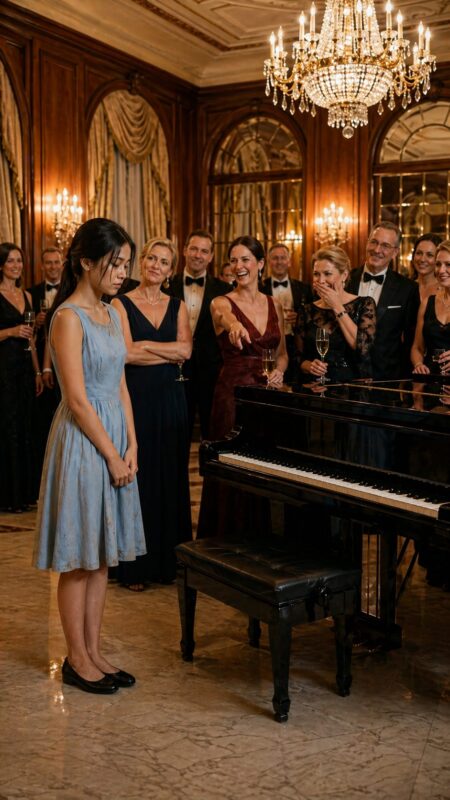
Then every gaze turned toward her.
A young woman in a worn, pale-blue dress stood beside the grand black piano. Her clothing was simple. Her hands remained still.
Her eyes stayed lowered, as if she already understood she didn’t belong in their world.
And that was exactly why they found her amusing.
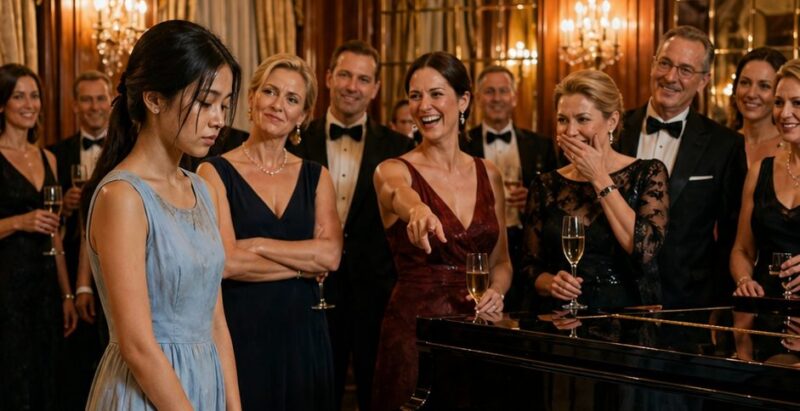
At the center of the room stood an older woman in a striking red evening gown, diamonds blazing at her throat, her smile sharp and cutting.
She lifted her hand, stopping the girl before she could leave. Then, with a cold, mocking laugh, she said:
“If you play that piano, I’ll give you a hundred thousand dollars.”
The room erupted in laughter.
Some guests whispered.
Some pointed.
Others waited eagerly, expecting the girl to embarrass herself.
The young woman stood frozen for a moment.
Then she slowly turned back.
Walked toward the piano.
And sat down.
The laughter continued—
until her fingers touched the keys.
The first notes drifted into the room like something sacred.
Not loud.
Not dramatic.
Elegant. Haunting. Strangely familiar.
The laughter faded almost instantly.
Expressions changed.
A man at the back lowered his glass.
An elderly guest closed her eyes.
Someone beneath the chandelier covered their mouth.
Because this wasn’t just beautiful.
It was personal.
The melody moved through the ballroom like a long-buried memory rising to the surface.
The woman in red stopped smiling.
Her breathing grew uneven.
The color drained from her face.
The young woman played the final note.
Silence followed.
Heavy. Absolute. Unbearable.
Then she lifted her gaze and looked directly at the woman in red.
Calm. Steady. Unshaken.
And said:
“I don’t want your money…”
A brief pause.
Her voice dropped, colder now—
“…I want you to tell them why this piano bears my last name.”
“Why the Piano Carried Her Name”
No one in the ballroom moved.
Not the guests.
Not the musicians.
Not even the servers.
The woman in red stood frozen, her hand still wrapped around her champagne glass, as if the truth had reached across the room and seized her.
The young woman rose slowly from the piano bench. Every eye followed her.
Because now everyone understood—this was never just about music.
It was about ownership.
Inheritance.
And a lie hidden beneath wealth and diamonds.
The woman in red tried to regain control first. Her voice came out tight and brittle.
“You’re insane.”
But the young woman didn’t react. She placed a hand gently on the piano and said:
“My father had that name engraved in the commission papers the week I was born.”
A wave of shock passed through the room.
The woman in red stiffened.
Years earlier, before the wealth had been refined into perfection, the ballroom, the fortune, and even the piano had belonged to a renowned composer
—a man known for brilliance, scandal, and a private life no one was allowed to question.
The woman in red had been his elegant wife.
But she was not the mother of his only child.
That child had been born to a young pianist he loved in secret. A woman from the staff. A woman he intended to leave everything to—until she suddenly vanished.
The story told to society was simple: she had run away, ashamed and unstable.
The truth was far darker.
She had been paid to disappear. Silenced. Erased.
And the child—the girl now standing in the ballroom—grew up in poverty while her father’s name, legacy, and music were worn like ornaments by those who had taken them.
An older guest whispered, “My God…”
The young woman looked across the room, then back at the woman in red.
“You told everyone my mother lied,” she said quietly. “You told my father I was dead.”
That sentence shattered the silence.
The woman in red’s hand began to tremble.
Because it was true.
And worse—the melody the girl had just played was one the composer had written only once, for the daughter he was never allowed to raise.
It had never been published.
Never performed.
Never heard by anyone outside the family.
Until now.
That was why the woman in red had gone pale at the very first note.
She wasn’t hearing talent.
She was hearing proof.
The young woman’s voice remained steady.
“You can keep the necklace.”
A pause.
“But you’re giving me back my name.”
And in that golden ballroom, filled with quiet cruelty and polished lies, everyone finally understood—
The girl they had mocked at the piano was never an outsider.
She was the rightful heir, returning to reclaim what had always been hers.