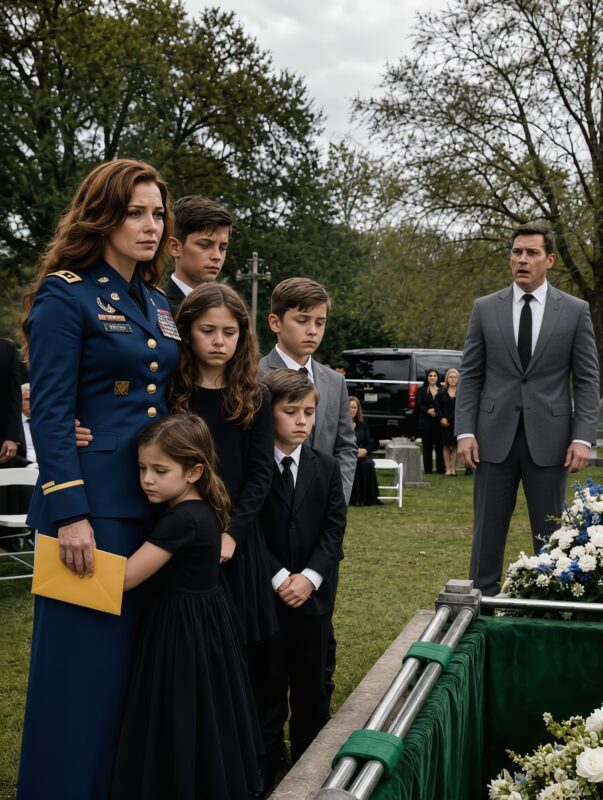
I returned to the Remington estate after ten years, wearing my military dress uniform and accompanied
by my five children: Gavin, Mason, Lucas, Clara, and Audrey.
We had come for the funeral of Theodore Remington, my ex-husband Garrett’s grandfather.
Theodore had been the only member of the family who ever treated me with kindness.
Although he never met my children, he sent me a Christmas card every year after my divorce.
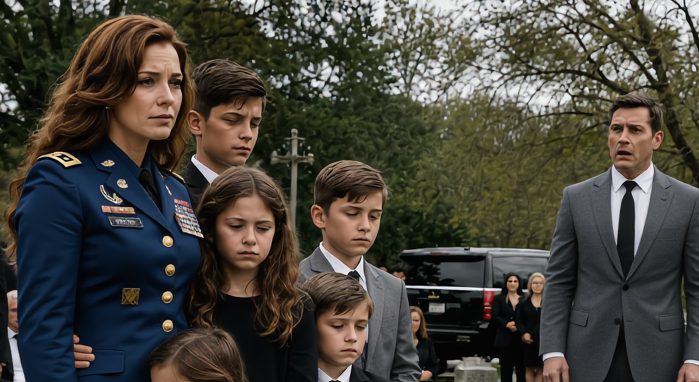
Whispers spread through the cemetery because all five children looked unmistakably like Garrett.
Felicia Stanford, the woman responsible for destroying my marriage, stepped into our path and claimed Theodore was not their family.
Clara looked toward the grave and answered, “He was our grandfather.”
Garrett finally turned and studied the children. Recognition appeared on his face. I raised the envelope I had carried with me.
“This is what you left behind ten years ago,” I told him.
Inside were a paternity report, a certified hotel record, and a notarized confession.
However, I refused to reveal them until after the burial because Theodore deserved a peaceful funeral.
Following the service, Theodore’s attorney, Elliot Crane, invited us to the reading of the will.
Theodore had left me access to his private archive.
He had also established a two-million-dollar trust for each child, provided genetic testing confirmed Garrett was their father.
Then came a warning: anyone who had knowingly interfered with our marriage would lose their inheritance.
Garrett opened my envelope. The paternity report confirmed with more than 99.99 percent certainty that all five children were his.
The second document proved that the hotel receipt used to accuse me of infidelity had been falsified.
Felicia had claimed I stayed in a hotel with Daniel Mercer, my Army recruiter. In reality, we had attended
a military career event there and left less than an hour later.
The third document contained a confession from Felicia’s former assistant.
Felicia had paid her to alter hotel records, manufacture photographs, intercept my doctor’s voicemail, and prevent Garrett from receiving my calls and letters.
Felicia finally admitted she had wanted my place in the Remington family.
But Theodore’s hidden archive revealed that she had not acted alone.
In a recorded message, Theodore explained that Garrett’s mother, Eleanor, had helped Felicia because she believed I was unsuitable for the family.
Theodore had discovered the fraud years earlier but remained silent to protect a business agreement with Felicia’s father.
“I called my silence caution,” Theodore confessed in the recording. “It was cowardice.”
He also reminded Garrett that forged evidence had only provided the weapon.
Garrett’s pride had ended our marriage because he trusted documents more than the wife asking him to listen.
The archive contained bank statements, emails, and sworn confessions proving everything.
Under Theodore’s will, Eleanor lost her company shares, which passed into the children’s trusts.
Felicia had expected to receive those shares after marrying Garrett, but Theodore had never included her in his will.
Garrett announced that investigators would receive the evidence.
Felicia left knowing she had destroyed our family for a future that had never belonged to her.
Garrett apologized, but Gavin told him it was not enough.
“I know,” Garrett replied.
He did not demand forgiveness. Instead, he knelt before the children and introduced himself.
“I haven’t earned the right to be called Dad,” he said. “But I would like to earn the right to know you.”
I allowed the children to decide. Clara asked him to begin by telling them about Theodore.
Six months later, new tests confirmed that Garrett was their father.
Felicia faced fraud charges, while Garrett transferred control of the children’s inheritance to an independent trustee.
We did not remarry, but we learned to cooperate as parents.
Theodore’s final surprise was an old barn on the land he had left us. Inside were five bicycles and plans
for the Briggs-Remington Home for Military Families—temporary housing for families separated by
deployments, medical care, or emergencies.
At its opening, Clara said, “Great-Grandpa didn’t leave us money to make us rich.
He wanted fewer children to grow up missing someone.”
Theodore had not tried to restore the old Remington family.
He had given my children the opportunity to build a better one.
Would you have allowed Garrett into the children’s lives, or were ten years of silence too much to forgive?