At a lavish Manhattan banquet, my CEO husband, Caldwell Vance, publicly humiliated me to defend his mistress. He threw his wedding ring at my feet and ordered security to remove me.
“I’ve supported this useless woman for ten years,” he announced.
His mistress, Vanessa, smiled triumphantly while my mother-in-law, Lorraine, applauded.
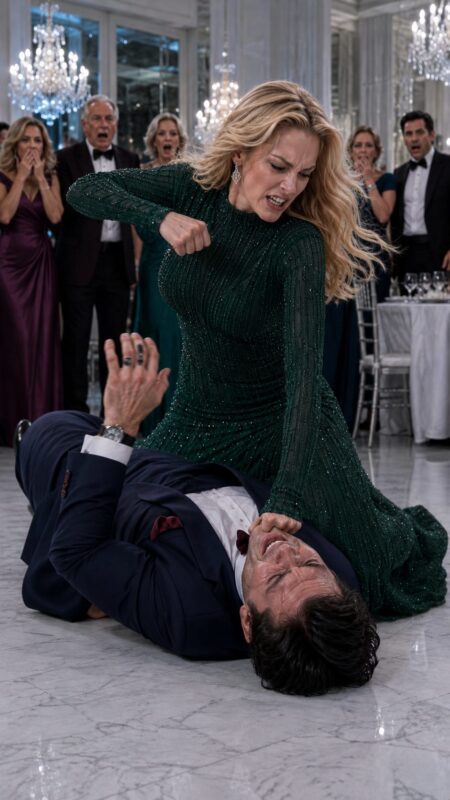
After wiping the wine Vanessa had thrown onto my face, I calmly took out my phone.
“Thaddius,” I said on speakerphone, “execute the emergency board resolution.
Remove Caldwell as CEO, freeze his corporate access, secure the Greenwich estate, and recover the three luxury vehicles.”
“Yes, Madam Chairman,” Thaddius replied.
The ballroom erupted in laughter. Caldwell called me a delusional housewife and claimed that only the company’s mysterious chairman could dismiss him.
“Let’s see whether you’re still laughing in thirty minutes,” I answered.
Moments later, every screen in the ballroom went black. A message appeared:
EMERGENCY BOARD RESOLUTION APPROVED
CALDWELL VANCE—REMOVED AS CEO
EFFECTIVE IMMEDIATELY
Caldwell’s phone rang. After answering, the color vanished from his face.
The chief financial officer confirmed that Caldwell’s accounts, email, corporate cards, and building access had been suspended.
Then the ballroom doors opened. Thaddius entered with six board members and a private security team.
“Madam Chairman,” he said, handing me a folder. “Every resolution has been executed.”
Lorraine protested that I could not seize their home.
Thaddius explained that the estate belonged to the Ashford Family Trust.
I had merely allowed Caldwell’s family to live there.
For ten years, Caldwell had assumed I possessed nothing because I worked quietly from home.
He never wondered why Ashford Capital approved every major acquisition—or discovered that Ashford was my maiden name.
“My grandfather founded this company, and my father expanded it,” I explained.

“When he became ill, he transferred the controlling shares to a trust and appointed me chairwoman.”
I had supported Caldwell’s appointment because he had once been ambitious, disciplined, and talented.
Unfortunately, he eventually convinced himself that he had created everything alone.
Vanessa stepped away from him after learning that the estate, penthouse, yacht, jet, and cars were not his.
Her expression changed again when Thaddius demanded the diamond necklace around her neck—the necklace that had belonged to my late mother.
Then I revealed something worse.
An independent audit had discovered millions of dollars missing from the company.
The money had passed through false consulting contracts approved by Caldwell, with several payments going to a business registered under Vanessa’s name.
Caldwell accused Vanessa of designing the invoices.
She shouted that he had promised nobody would investigate because he controlled the board.
Their argument became an accidental confession before hundreds of witnesses recording everything.
Financial investigators entered and ordered them to surrender their passports and attend formal questioning.
Lorraine begged me to protect the family name.
“That is exactly what I’m doing,” I replied.
Caldwell’s former supporters quickly abandoned him.
When he asked what would happen to our marriage, I told him that my attorneys had already filed for divorce.
However, I had originally attended the banquet to announce something else.
Onstage, I pledged thirty percent of my annual dividends to employee ownership grants, scholarships, and emergency assistance.
No innocent worker would lose a job or pension because of Caldwell’s actions.
Six months later, investigators uncovered every hidden account.
Vanessa testified against Caldwell, Lorraine left the estate, and Caldwell lost his position, fortune, and reputation.
During our divorce hearing, he demanded half my wealth.
My attorney produced the prenuptial agreement Caldwell had insisted upon before our wedding, believing I was penniless.
It stated that each spouse would leave with their premarital assets—and that infidelity eliminated additional support.
Caldwell had built the trap that ultimately caught him.
“You hid who you were!” he shouted outside court.
“No,” I replied. “You simply believed a quiet woman could never be powerful.”
A year later, the company became Ashford Meridian. In its headquarters, I displayed the ring Caldwell had thrown away beneath one sentence:
NEVER MISTAKE SOMEONE’S SILENCE FOR POWERLESSNESS.
He thought the ring was the most valuable thing he discarded that night.
It wasn’t.
I was.
If you had been in my position, would you have exposed Caldwell publicly—or allowed the truth to destroy him quietly?