PART 3
At 8:15 the morning after my wedding, I sat in a boardroom beside Drake while the Vance family confronted the company’s hidden financial crisis.
An anonymous spreadsheet revealed that three hotel properties secured nearly sixty million dollars in debt.
One loan had already violated a performance covenant, meaning Vance Hospitality might have to refinance under unfavorable terms or sell assets quickly.
The private-equity offer was not simply about succession—the company desperately needed money.
Calvin Ross, the CFO, finally explained what had happened.
Four years earlier, Arthur had begun renovating three aging hotels.
Construction costs rose, one project fell behind schedule, and another lost an important convention contract.
Arthur borrowed money, believing the company would recover.
Instead, he suffered a stroke.
Afterward, Eunice entered financial discussions she did not fully understand, Warren concentrated on operations,
Drake avoided the company’s finances, and Calvin tried to protect everyone by hiding how serious the situation had become.
Calvin then produced a notebook containing Arthur’s handwritten instruction: “Consider full sale.”
Arthur slowly remembered authorizing a market test before his stroke.
Eunice had misunderstood his comment that it might be time to let someone else “carry” the responsibility.
She believed he intended to sell everything they had built, while Arthur had only meant that he no longer wanted to manage the entire burden alone.
The suspicious trust amendment also proved less sinister than expected.
Eunice had asked Warren whether she could receive temporary voting authority.
Warren asked his assistant, Paula, to draft hypothetical language, but his vague instructions made the document appear official.
Paula placed the draft and an explanation inside an envelope marked “EV.”
Because Eunice was Eunice Vance and Warren’s full name was Edward Warren Vance, Calvin mistakenly delivered it to Eunice.
She interpreted the document as a warning that Drake’s marriage would make the company’s sale unstoppable.
There had been no conspiracy—only a mislabeled envelope, hidden financial problems, and a family that refused to communicate.
But Eunice acknowledged that none of this excused destroying my mother’s wedding dress.
“I was wrong,” she told me.
She admitted she had spent Drake’s entire life preparing him to inherit a company he had never wanted.
Rather than accept that he had made his own decision, she blamed me for influencing him.
The board postponed the private-equity decision for thirty days and hired an independent restructuring adviser.
Calvin remained temporarily under increased supervision, while Warren agreed to stay for sixty days during the company’s reorganization.
Eunice eventually resigned from the board and considered returning to the Vance Foundation, where she had once supported hospitality students.
Two days later, Drake and I visited Ruth Kaplan, the textile conservator examining my ruined dress.
Ruth explained that it could never be worn again, but some lace, pearls, and lining could be preserved.
Most importantly, the tiny blue thread my mother had sewn beneath the hem had survived.
We chose to use the remaining lace in an album for our wedding photographs.
The dress could not return to its original form, but part of it could continue with us.
Three months later, Vance Hospitality decided against selling the entire company.
One failing hotel was sold, stronger properties supported refinancing, and an outside CEO was hired.
Arthur became an adviser, Warren retired, and Eunice returned to the foundation.
I declined Arthur’s offer to become permanent trustee because loving Drake did not mean placing myself inside every part of his family’s business.
On our first anniversary, we opened the album Ruth had created.
Beneath a clear protective layer rested my mother’s blue thread.
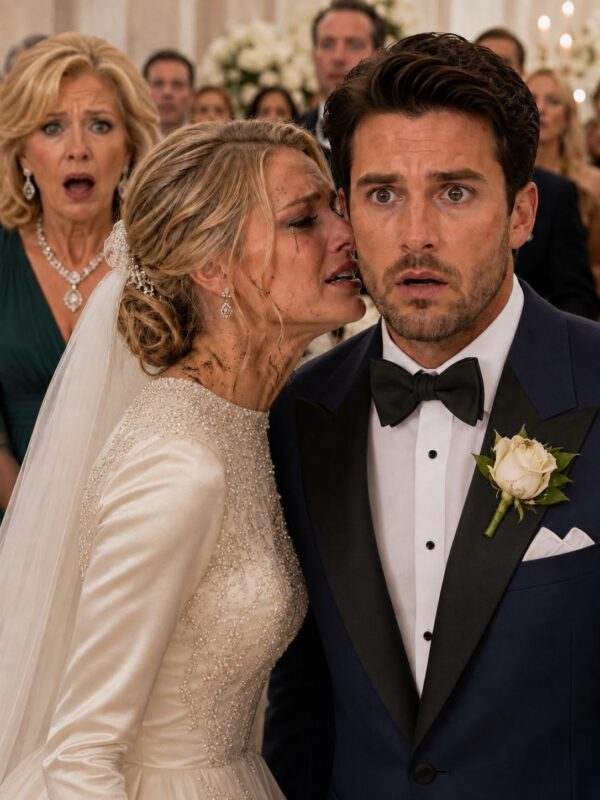
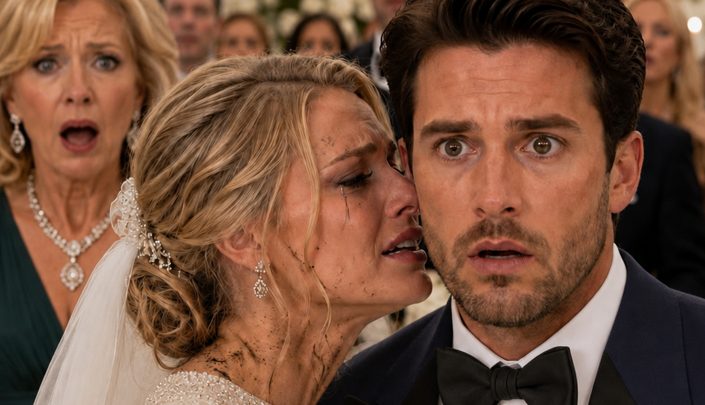
Drake reminded me what he had whispered at the altar after learning what Eunice had done:
“Then we choose us.”
Those four words became the true foundation of our marriage.
We did not choose the company, anger, or forgiveness before we were ready.
We chose each other, repeatedly.
My mother’s dress had been beautiful, but in the end, the marriage mattered more.