“If anyone aboard has fighter-pilot experience, please identify yourself to the cabin crew immediately.”
The announcement frightened everyone on the overnight flight from New York to Madrid.
No one suspected that the quiet woman in seat 8A might be their only hope.
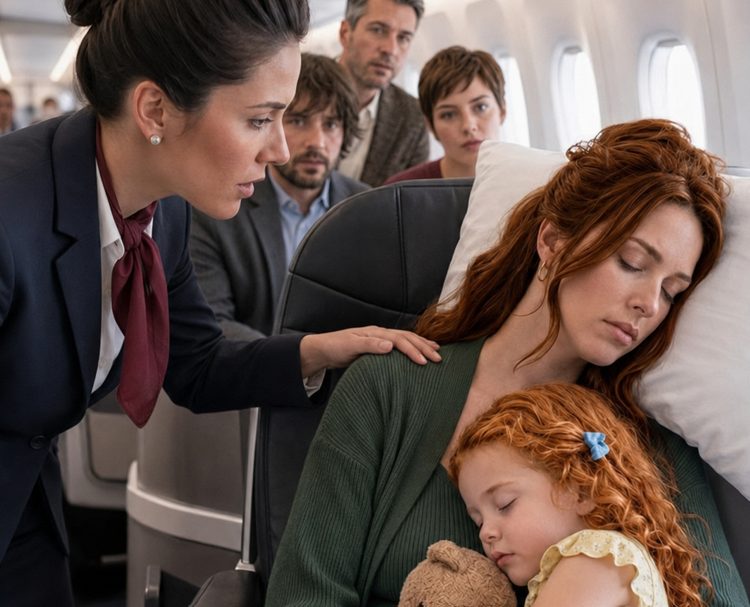
Laura Vance, thirty-eight, appeared to be an exhausted passenger in a green sweater.
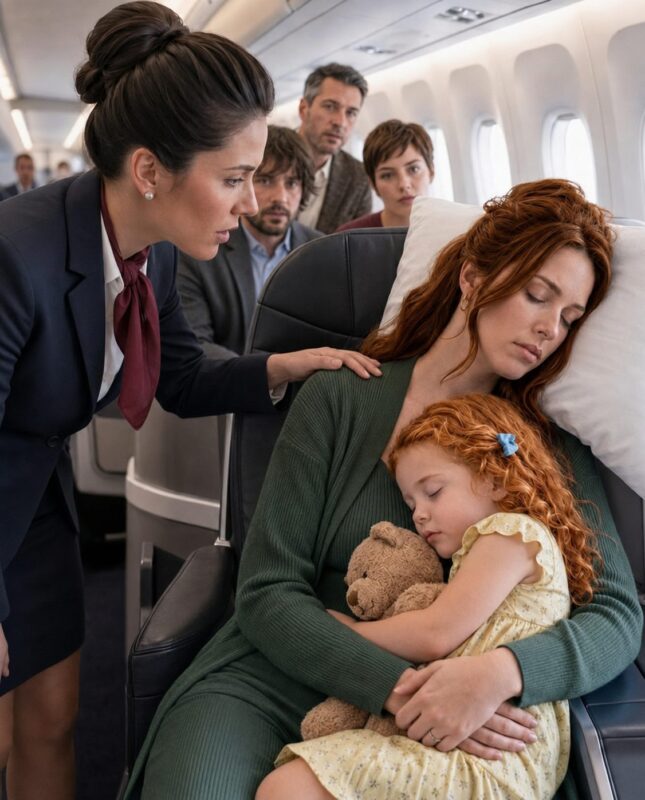
In reality, she had once been an accomplished U.S. Air Force pilot who flew F-16s.
Eighteen months earlier, however, a devastating accident had ended her career.
She wanted nothing more to do with aviation, responsibility, or being called a hero.
When the announcement was repeated, Laura recognized the fear beneath the captain’s controlled voice.
She noticed frightened families and children around her.
Remembering that a pilot never abandoned people who needed help, she finally spoke.
“I’m a former Air Force fighter pilot.”
A flight attendant immediately escorted her to the cockpit.
Captain Andrew Vance was struggling with the controls while his first officer lay unconscious nearby.
The autopilot had disconnected, the flight computer was reporting conflicting errors, and the aircraft was shaking in a strange mechanical rhythm.
Laura studied the instruments and realized Andrew was fighting incorrect computer commands.
She advised him to isolate one of the secondary flight-control channels.
He followed her instructions, and the violent vibration stopped.
A doctor then reported that the first officer’s symptoms suggested chemical poisoning.
His coffee thermos had also disappeared.
Laura understood that the technical failure and medical emergency might be connected.
“Lock the cockpit door,” she ordered. “Someone wanted your first officer unable to fly.”
As the aircraft descended toward an emergency airport in northern Spain, hydraulic pressure controlling the right landing gear began falling.
Someone also tried to enter the cockpit.
The person outside was Richard Sterling, the airline’s director of flight operations, who claimed his executive position gave him authority to enter.
The crew refused.
Moments later, a flight attendant reported that the doctor had found a plastic vial cap beneath the first officer’s seat.
Andrew and Laura focused on landing.
Heavy rain and powerful crosswinds battered the jet, and the right landing gear failed to confirm that it was locked.
Laura took the secondary controls, despite never having flown that type of airliner.
The wheels struck the runway, and the aircraft tilted dangerously right.
Laura corrected with rudder and asymmetric thrust while Andrew held the nose straight.
Finally, the landing gear locked, and the jet stopped safely. Nearly three hundred passengers erupted in applause.
Spanish police detained Sterling after the evacuation.
Seeing Laura, he smiled coldly and revealed that he knew her.
Investigators later uncovered a massive scheme involving counterfeit aircraft components and falsified maintenance records.
Sterling had diverted millions of dollars and feared an upcoming audit.
Authorities concluded that the first officer had been deliberately incapacitated and the aircraft’s systems
compromised so the plane—and evidence of the fraud—would disappear in a catastrophic accident.
The investigation also revealed that Sterling had previously worked with a defense contractor that supplied defective avionics to Laura’s former squadron.
One such failure caused the accident that killed her wingman and closest friend, Captain Gabriel Torres.
For eighteen months, Laura had blamed herself for Gabriel’s death.
However, recovered records contained his final transmission: the controls had locked, and Laura had done everything correctly.
Weeks later, Laura visited Gabriel’s mother and apologized for believing she had failed him.
“You never abandoned Gabriel,” his mother told her.
“But you don’t have to stop living because he died.”
Sterling was eventually convicted.
Laura did not return to military service, but she became an instructor at a commercial aviation academy.
On her first day, she wrote on the board:
“THE AIRCRAFT DOESN’T CARE WHO YOU USED TO BE.”
She taught her students that emergencies were survived through clear thinking, sound decisions, and teamwork—not ego.
Later, Laura received a letter from a boy who had been aboard Flight 412.
Her calm nod as she walked toward the cockpit had reassured him. Inspired by her, he was beginning his first flying lesson.
Laura placed the letter beside Gabriel’s photograph. Watching a training jet rise into the blue sky, she no longer saw only her painful past.
She saw the future waiting for her.
With a quiet smile, she whispered, “I’m home.”