“Lady, stop playing the victim. You chose to travel with a newborn and a young girl.”
The woman spoke loudly enough for several passengers in Row 11 to turn around. Six-week-old Leo
slept against my chest in the blue carrier my late mother had given me, while my ten-year-old daughter,
Maya, stood beside me clutching her purple, star-covered backpack.
We were flying from Chicago to Orlando.
My husband was working out of state, and after weeks of caring for both children alone,
I desperately needed my sister’s help. Knowing how difficult the journey might be,
I had paid extra to reserve two adjoining seats with additional legroom.
But when we reached Row 11, a woman in her early fifties was sitting in my seat.
“I believe these are ours,” I said, showing her our boarding passes.
“I’m already comfortable,” she replied, pulling her headphones over her ears.
When I insisted, she accused mothers of expecting the world to accommodate them.
A flight attendant checked our passes and confirmed there had been a seating problem.
However, because the woman refused to move, the attendant asked me to take an available seat three rows back.
“You want me to leave my daughter beside a stranger?” I asked.
Maya gently touched my arm. “It’s okay, Mom. I can stay here.”
As she placed her backpack under the seat, she noticed something near the woman’s leg. Maya tried to speak, but the woman interrupted her.
“Don’t start, kid.”
I nearly called the attendant again, but Maya gave me a calm shake of her head.
She wanted me to trust her, so I reluctantly moved to Row 14 with Leo.
For the first ten minutes after takeoff, I watched Maya between the headrests.
She sat upright, determined to prove she could manage.
Then she bent toward the floor and tried once more to speak to the woman. Again, the woman dismissed her.
When the seatbelt sign turned off, Maya stood.
“Ma’am, my mom taught me never to embarrass anyone in front of strangers,” she said clearly. “That’s why I tried to tell you quietly before takeoff.”
The woman tore off her headphones. “Then keep your mouth shut now.”
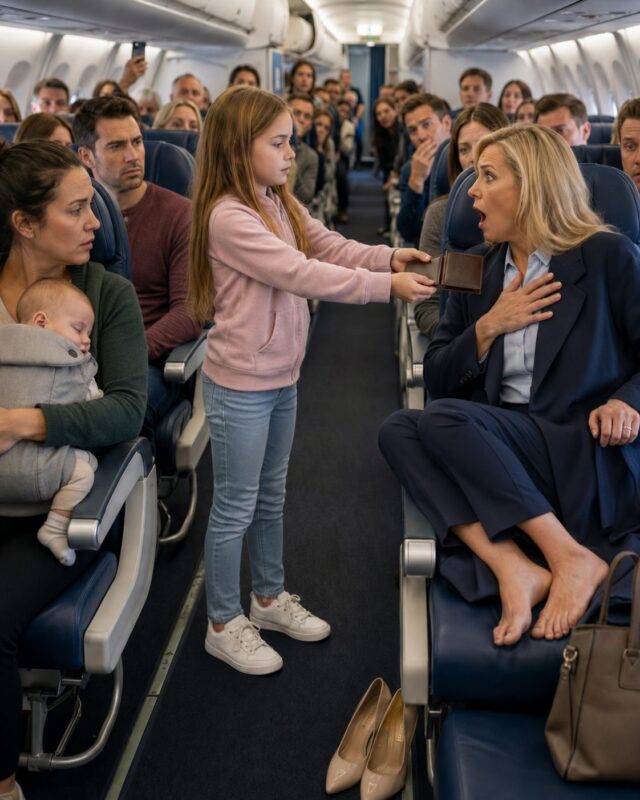
Maya calmly opened her backpack and removed a clear plastic pouch containing a dark brown wallet.
“Is this yours?” she asked.
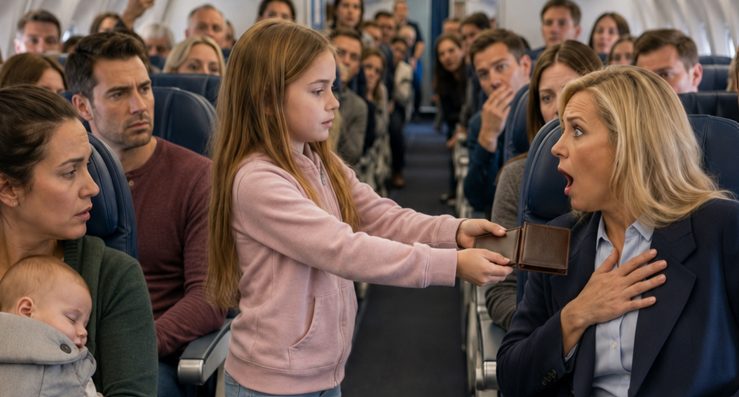
The cabin fell silent.
“It was wedged beneath your leg,” Maya explained. “I tried to tell you twice, but you wouldn’t listen.”
The woman snatched the wallet and examined its contents. Her hands began trembling when she found a folded envelope inside.
“Thank you,” she whispered.
A few minutes later, she surrendered the seat and apologized to Maya and me.
“My mom says you return things that aren’t yours,” Maya told her, “even when people are mean to you.”
The woman, whose name was Patricia, later explained that her seriously ill sister’s medical documents and cashier’s checks for treatment were inside the wallet.
Losing them could have been disastrous. She admitted that her worries did not excuse her behavior.
The flight attendant also apologized.
She acknowledged that she had chosen the easiest solution by pressuring the quieter passenger instead of enforcing the correct seating arrangement.
Before leaving the plane, Patricia gave Maya a worn prayer card her sister had carried for years.
She said it belonged with someone who did the right thing even when nobody was watching.
“Don’t ever let anyone make you feel quiet,” Patricia told her.
At baggage claim, Maya admitted she was still angry despite accepting Patricia’s apology.
“Forgiving someone doesn’t mean pretending nothing happened,” I explained.
“It means letting go of the desire to hurt them back while remembering that their behavior was wrong.”
Walking into the Florida sunshine, I realized Maya had learned something far more valuable than how to confront a rude stranger.
Patience was not permission for others to mistreat her, and kindness did not require silence.
Justice had not arrived through shouting or punishment.
It had come through a ten-year-old girl who refused to become cruel, even when cruelty would have been understandable.