A Wealthy Father Went Searching for a Princess Dress — But a Child’s Song Behind a Locked Door Changed Everything
The Harrison estate was enormous, immaculate, and unnervingly quiet. Every polished surface seemed to reflect the same painful truth: people could share a home and still live emotionally miles apart.
Most evenings, Caroline Harrison devoted herself to preparing for charity galas and exclusive social gatherings.
She had perfected elegant smiles that rarely reached her eyes.
From her place on the staircase, six-year-old Chloe often watched in silence, gradually learning a lesson no child should ever learn—that beauty, status, and perfection mattered more than anything else.
One evening, Chloe decided she wanted a princess dress.
Not just any dress, but an exact replica of the gown worn by her favorite television heroine, complete with sparkling silver sleeves and tiny embroidered stars.
And she wanted it that very night.
Caroline had a formal dinner to attend and little patience for discussion.
“Your father can handle it,” she said while spraying perfume around herself. “And Chloe… pretty girls don’t cry over unimportant things.”
Then she left.
The delicate scent lingered behind, along with a little girl who was slowly beginning to mistake loneliness for privilege.
Chloe’s father, Daniel Harrison, was a self-made millionaire. He was brilliant in business but far less confident when it came to parenting.
There was no doubt that he loved his daughter.
The problem was that he showed that love in the only way he understood—by giving her everything she asked for.
Gifts.
Surprises.
Expensive solutions.
As if material possessions could somehow fill the silent emptiness inside their home.
That evening, the boutique he usually relied on had already closed. For most families, that would have meant waiting until the following day.
Daniel refused to accept that.
Determined to find a solution, he remembered a shop he had passed countless times while driving through the city—The Silver Thread Atelier, an upscale boutique famous for creating custom-made gowns.
“They’re known for accomplishing the impossible,” he told Chloe.
The little girl lifted her chin confidently.
“If the dress exists,” she declared, “I’ll be wearing it tonight.”
And so they drove across the city.
On the opposite side of town, Maria Lopez was returning to a cramped apartment where evenings brought exhaustion instead of comfort.
She had just finished cleaning the third office building on her schedule that day.
Her shoulders ached. Her hands were rough from hours of exposure to harsh cleaning chemicals.
But the heaviest burden she carried wasn’t physical.
It was guilt.
A constant feeling that she could never provide the life her daughter deserved.
When Maria entered the apartment, her husband Carlos sat silently at the kitchen table staring at a stack of unpaid bills.
The money they had carefully saved to buy their daughter a new pair of school shoes was gone.
Again.
Lost to alcohol and gambling.
From a corner of the room, nine-year-old Isabella listened quietly. To her, every argument about money sounded exactly the same.
You are the problem.
Without saying a word, she crossed the room and wrapped her arms around her mother.
“It’s okay, Mom,” she whispered softly. “My old shoes still fit.”
That simple embrace was often the only thing keeping the family together.
Carlos’s sisters, Diana and Patricia, owned The Silver Thread Atelier.
They had offered to watch Isabella after school as a favor.
Family helping family.
Exhausted and desperate for support, Maria accepted without asking too many questions.
But behind the boutique’s elegant displays and welcoming smiles, Isabella was not treated like family.
She was treated like unpaid labor.
Every afternoon, while other children played outside or completed their homework, Isabella sat sewing dresses.
One day she quietly asked if she could rest because she felt dizzy.
Patricia placed a hand on her shoulder—firm enough to hurt, gentle enough to leave no mark.
“You should be grateful,” she whispered. “Without us, you’d still be trapped in that rundown apartment.”
Then she sent Isabella into the back room.
The room felt like a prison.
There were no windows.
No fresh air.
Only peeling paint, damp walls, and a heavy atmosphere that seemed to press down from every direction.
Isabella hated being there.
But she never complained.
Being called a burden hurt far more than exhaustion ever could.
That evening, Diana dropped a bundle of expensive white fabric onto Isabella’s worktable.
“Finish this dress tonight,” she ordered. “And if it isn’t perfect, don’t expect dinner.”
The gown was delicate, complicated, and clearly intended for an affluent customer.
Without protest, Isabella nodded and began sewing.
Her small hands moved with a skill no child should ever need to possess.
To keep herself from crying, she quietly hummed the theme song from her favorite television show:
Princesses of the Silver Sky.
The melody was her escape.
Her secret doorway into a world where children were allowed to simply be children.
At that very moment, Daniel and Chloe arrived at the boutique.
Warm golden light illuminated the showroom.
Soft music drifted through the air.
The rich aroma of freshly brewed coffee floated from the counter.
From the outside, The Silver Thread Atelier looked like a place where dreams came true.
Neither Daniel nor Chloe had any idea what was hidden behind its locked doors.
Diana and Patricia greeted Daniel and Chloe with warm, practiced enthusiasm, clearly pleased to see such a high-value customer in their boutique.
They guided them to a plush velvet sofa and assured them that the requested gown would be prepared without delay.
While they spoke, Chloe began to wander through the showroom, her initial excitement slowly fading into impatience.
Then she stopped.
A faint sound drifted through the air.
A child’s humming.
Barely audible.
Soft, delicate.
And strangely filled with sadness.
“Dad,” Chloe whispered. “That’s the song from my show.”
Daniel paused and listened.
The sound wasn’t coming from the showroom.
It was deeper.
Somewhere behind the polished walls—somewhere customers were clearly never meant to go.
For the first time in years, Daniel felt something that wealth, influence, and control could not explain.
“Come on,” he said quietly. “Let’s see.”
They moved toward a narrow corridor at the back of the boutique.
Immediately, the atmosphere shifted.
Warm lighting disappeared.
Cold fluorescent bulbs flickered overhead.
Soft carpeting gave way to raw, cracked concrete.
The scent of perfume was replaced by damp air and dust.
At the end of the hallway stood a wooden door.
Slightly ajar.
Locked from the outside.
Daniel’s expression hardened.
He pushed it open.
Heat rushed out like a trapped breath.
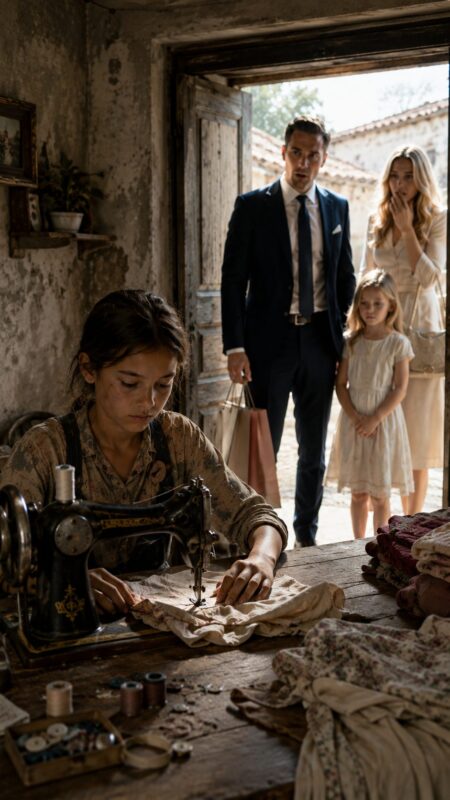
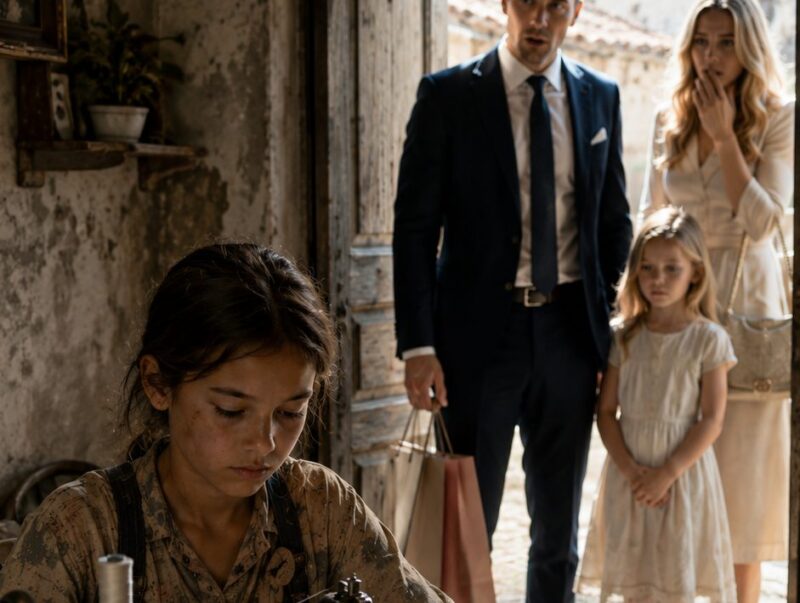
Inside, under a single harsh bulb, a small girl sat bent over a sewing machine.
Sweat traced lines down her face, dripping onto delicate white fabric embroidered with tiny stars.
She wasn’t playing.
She was working.
The sound of the door startled her.
She jolted violently, and the sewing needle pierced her finger.
A drop of blood stained the fabric.
Panic flooded her face as she quickly hid the dress behind her back.
“I’m sorry! I’m almost done, Aunt Patricia, I promise!”
Daniel’s voice softened.
“I’m not your aunt,” he said. “I’m just a customer.”
The girl froze.
Her eyes shifted between Daniel, Chloe, and the open door.
Daniel lowered himself beside her.
“Why are you locked in here?”
Her answer hit him harder than anything he expected.
“They said I have to be useful,” she whispered. “If I don’t work, I’m a burden. My mom can’t afford to take care of me. They’re helping us.”
Chloe stepped closer, her voice barely above a breath.
“Dad… look at her hands.”
They were covered in needle marks—some old, some still fresh.
Something inside Daniel shifted permanently.
“This ends now,” he said firmly.
But the girl suddenly grabbed his sleeve in panic.
“Please don’t tell them,” she begged. “They’ll say I’m ungrateful. My mom will lose their help.”
And in that moment, Daniel understood something devastating.
The worst part wasn’t the locked room.
It was the fact that she believed she deserved it.
Moments later, Diana and Patricia rushed in, faces pale with alarm.
“Mr. Harrison, we can explain—”
Daniel turned toward them slowly.
His voice was calm.
But colder than anger.
“You call this help?”
Silence.
“No child should be locked away and forced to sew luxury dresses,” he said.
He took out his phone.
But before making a call, he knelt beside the girl once more.
“I’m not leaving you here,” he said quietly. “No one will hurt you again.”
Later that evening, Chloe sat beside the girl in the boutique’s front room.
For once, she didn’t ask about her princess dress.
“Does it hurt?” she asked gently.
The girl gave a small, tired smile.
“Sometimes,” she whispered. “So I pretend the smell in the room is a magical garden.”
Chloe carefully took her hand and held it tighter.
Not long after, Maria arrived—still in her cleaning uniform—rushed in after Daniel’s call.
The moment she stepped inside, she stopped.
The scent of dampness.
The sewing table.
The closed door.
Everything told her what she had missed.
She collapsed and pulled her daughter into her arms.
“I’m sorry,” she cried. “I didn’t know.”
“It’s okay, Mom,” Isabella whispered. “I thought it was my fault.”
That night, Daniel took immediate action.
Authorities were contacted. Lawyers were called. Diana and Patricia came under investigation for child exploitation and illegal labor practices.
But Daniel didn’t stop there.
He offered Maria a stable position working in the kitchen at the Harrison estate.
“My house is large,” he said quietly, “but it has been empty for too long.”
Chloe looked at Isabella and smiled softly.
“You can stay near us,” she said. “And you won’t have to sing alone anymore.”
That night, something fragile but real entered two very different lives.
Not because of a princess dress.
But because a quiet child kept humming in the dark—
and someone finally chose to open the door.