Part 1: The Daughter I Believed Was Throwing Away My Money
My mother called me near the end of a fourteen-hour shift in Dallas.
Frustration filled her voice as she told me my daughter, Maya, had blown the $1,800 I had sent for a
laptop and had been hanging around with some boy who didn’t even go to her school.
“Your daughter is completely out of control. If you don’t come handle this, I’m finished.”
I was angry before she even hung up.
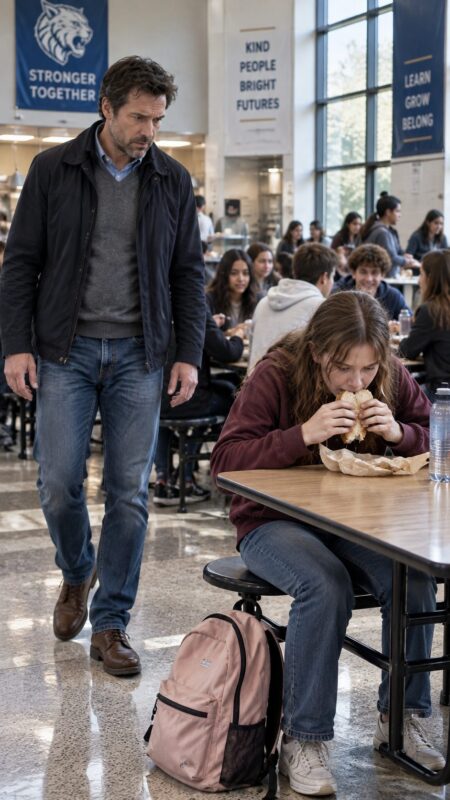
For the past five years, ever since my wife Sarah died of cancer, I had been working out of state trying to recover from the crushing medical bills that had nearly ruined us financially.
During that time, my mother, Evelyn, had remained in Austin and looked after Maya.
Maya was only ten when I left. Every month, without exception, I sent money for groceries, clothing,
transportation, school materials, doctor visits, tutoring, and unexpected expenses.
Still, Evelyn repeatedly told me Maya was becoming spoiled, careless, lazy, and increasingly obsessed with expensive things.
And for years, I believed every word.
That afternoon, I booked a flight to Austin without telling either of them.
I had decided it was time for Maya to hear directly from me that this behavior could not continue.
I arrived at her high school around lunchtime and spent several minutes searching the courtyard before I finally recognized my own daughter.
Maya was sitting by herself on the edge of a concrete planter.
She wore a faded school T-shirt and a pair of sneakers so worn down that the soles were beginning to peel away.
But what really stopped me was what she was eating.
She held half of a plain dinner roll in her hand.
She slowly took a few bites, wrapped the rest carefully in a napkin, and placed it back inside her backpack.
Then she drank from an old plastic water bottle and walked across the street toward a small convenience store.
I followed from a distance.
Inside, I watched her stare at the hot food behind the counter.
She counted several coins in her palm, looked at the prices again, and finally walked out without buying anything.
Four days earlier, I had sent Evelyn another $2,000.
I headed straight back to the school and went into the guidance office, where I introduced myself to Maya’s counselor, Mrs. Ortega.
The instant she heard my name, her expression shifted.
That alone made me nervous.
“I’m Jason Vance, Maya’s father.”
She stared at me.
“You’re Jason?”
Mrs. Ortega pulled up Maya’s records. Within moments, she noticed something unusual.
I was listed correctly as Maya’s father and legal guardian, but the phone number attached to my name wasn’t mine.
Then she opened another section of the file and frowned.
“Mr. Vance, Maya has been enrolled in our financial assistance program for several years.”
I stared at her in disbelief.
“Financial assistance?”
“Free meals, discounted school supplies, waived activity fees, and transportation support.”
For a second, I almost laughed. The idea sounded ridiculous.
“That can’t be right. I send my mother between two and three thousand dollars every month specifically for Maya.”
Mrs. Ortega froze.
“Every month?”
I pulled out my phone, opened my banking app, and showed her transfer after transfer stretching back years.
The more she looked, the more concerned she became.
“Then we may have a very serious situation here.”
She took me to a study hall where Maya was working on homework.
Through the small window in the door, I watched my daughter pull the other half of the dinner roll from her backpack.
She broke it into a paper cup, poured hot water over it, and waited for it to soften before eating it.
Mrs. Ortega spoke quietly.
“She does that a lot. She saves part of her lunch so she’ll have something later.”
Shame hit me before the anger did.
Then Mrs. Ortega showed me a financial hardship form claiming Maya received no consistent financial support from her father.
At the bottom was my mother’s signature.
That was the moment everything changed.
I suddenly understood that I had not flown to Austin to correct my daughter’s behavior.
I had come home to find out who had been taking my money for five years while making Maya believe her father had abandoned her.
Part 2: The Messages I Never Received
Before I talked to Maya, Mrs. Ortega warned me about something I wasn’t prepared to hear.
She explained that Maya might actually be afraid of me.
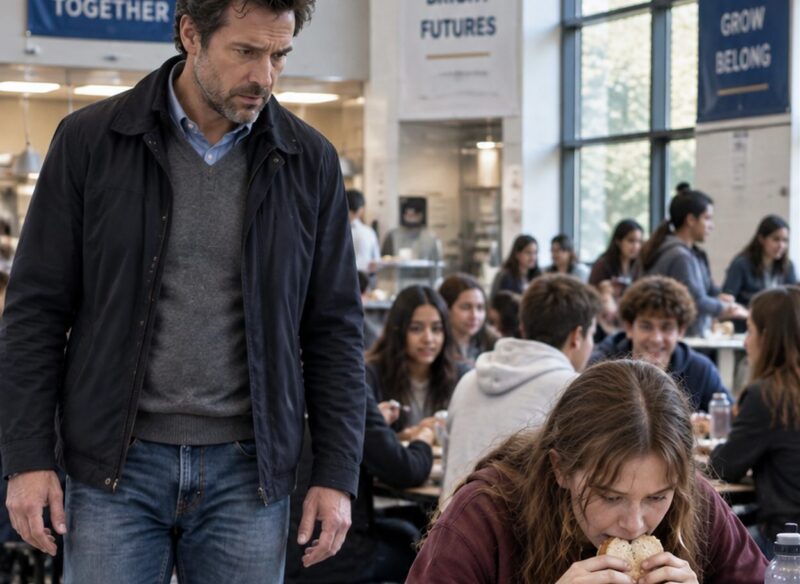
According to notes in her school records, Maya believed I became angry whenever anyone spent money on her.
“Afraid of me?”
Those words hurt more than anything my mother had told me.
Then I remembered a phone call from two years earlier.
Evelyn had claimed Maya spent two hundred dollars on video games. Without asking questions, I immediately called my daughter furious.
“Do you have any idea how hard I work to send you that money?”
“Dad, I didn’t—”
“I don’t want excuses.”
I hung up before she could finish explaining.
Standing in that school hallway, I finally saw what had happened.
My mother had taken my frustration and used it as evidence that I didn’t want Maya.
When Mrs. Ortega and I entered the study hall, Maya dropped her pencil the second she saw me.
She didn’t smile.
She didn’t run toward me.
Instead, she took a small step backward.
That one movement told me more than anything written in her school file.
“Dad…”
“I’m not here to yell at you.”
She stared down at the floor.
“I’m sorry about the laptop money.”
I asked her what had happened to it.
Maya admitted she had handed every dollar back to Evelyn.
My mother had told her that my company was struggling and that I was close to losing everything financially.
Maya believed returning the money would help me survive.
I lowered myself so we were looking directly at each other.
“Tell me everything.”
At first, she barely spoke.
Then, once she finally started, five years of lies came spilling out.
Evelyn had told Maya that I was exhausted from supporting her.
She claimed Sarah’s cancer treatment had wiped out all my savings and said no woman would ever want to marry me because Maya was too much responsibility.
She had even convinced my daughter that the best thing she could do was cost me as little as possible so she wouldn’t become a burden.
“She told me you were embarrassed by me.”
I pulled out my phone and opened my bank records.
One transaction after another appeared on the screen: money for groceries, clothes, school expenses,
tutoring, birthdays, Christmas gifts, and the laptop Maya believed I could no longer afford.
“I sent money every month, Maya. Every single month.”
She immediately shook her head.
“No. Grandma said you never sent anything.”
Then she began crying harder.
She told me she had been texting me every week.
I said I had never received a single message.
Maya pulled out an old phone with a cracked screen and showed me the contact saved as “Dad.”
The area code was correct.
The prefix was correct.
But the final three numbers were wrong.
It was the exact same fake number entered in the school system under my name.
My mother had changed both.
“I thought you stopped answering because you didn’t love me anymore.”
I wrapped my arms around her.
“I never stopped loving you. Not even for a second.”
She cried against my shoulder.
Then she said something that I had no defense against.
“But you never came home either.”
She was right.
Evelyn had deceived both of us, but staying away for all those years had still been my decision.
That part belonged to me.
Then Maya started telling me about everything I had missed.
Evelyn had said her middle-school graduation wasn’t important.
Mrs. Ortega quietly informed me that Maya had actually given the valedictory speech.
I also knew nothing about the statewide mathematics competition.
Maya had finished second.
Standing there, I realized my daughter had worked hard, succeeded academically, gone hungry, and spent years believing her father wanted nothing to do with her.
Meanwhile, I had been hundreds of miles away, sending money and trusting the very person who was hurting her.
That evening, I took Maya out to dinner.
Halfway through the meal, I noticed her quietly wrapping a piece of chicken in a napkin.
“What are you doing, sweetheart?”
“It’s for tomorrow.”
My throat tightened.
“There will be food tomorrow too. I promise.”
The expression on her face broke something inside me because I could tell she wasn’t completely sure she believed me.
Later that night, I asked her a question I had been afraid to ask.
“Has Grandma ever physically hurt you?”
Maya went completely still.
For several seconds, she said nothing.
Then she finally whispered,
“Not very much.”