For Twelve Years, I Packed My Husband the Same Lunch Every Morning
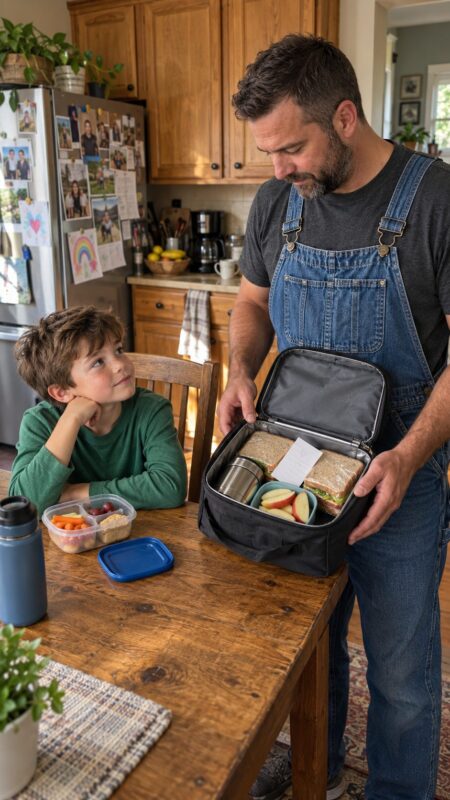
Every morning, I packed Edward two sandwiches, apple slices, black coffee, and a handwritten note. It had been our routine throughout twelve years of marriage.
Then one Tuesday, our ten-year-old son, Jamie, entered the kitchen and said, “Mom, maybe you shouldn’t make Dad lunch anymore.”
When I asked why, he replied,
“Because he leaves it beside the trash every morning. And yesterday, he changed into his wedding suit before getting into a woman’s car.”
Edward had always told me he worked in construction.
Every evening, he returned wearing dusty overalls and carrying an empty lunchbox. I had never questioned him.
The next morning, I followed his truck.
Edward stopped on a residential street and carefully placed his lunch beside a trash can.
However, he removed my note, read it twice, and slipped it into his pocket.
Then he changed out of his overalls and put on the navy suit he had worn at our wedding.
A silver car soon arrived. A professionally dressed woman stepped out, hugged him, and drove him to a modern building. I followed them inside.
Near the entrance, I heard her say, “Twelve years, Edward. Your wife still thinks you’re a construction worker?”
Edward answered, “I can’t keep hiding who I really am. I’ll tell her tonight.”
I stepped forward and demanded the truth.
Edward insisted the woman, Margaret Chen, was not his lover. She was his business partner.
Then he led me into the building, where architectural models, awards, and photographs filled the lobby. A polished sign read:
MERIDIAN ARCHITECTURE GROUP.
“This is my firm,” Edward admitted. “I’ve owned it for nine years.”
I was stunned. My husband was an architect, and several buildings I admired—including a children’s hospital, a library extension, and a pedestrian bridge—had been designed by him.

Edward explained that he really had been a construction worker when we met.
Later, he secretly attended architecture school, passed his licensing exams, and established Meridian with Margaret. He had initially hidden his ambitions because he feared failure.
After succeeding, he worried that becoming someone different might change how I felt about him.
His fear had turned one lie into nine years of deception.
When I asked about the lunches, Edward explained that a struggling sixty-two-year-old diner worker named Robert collected them each morning. Robert even called them “Rachel sandwiches.”
Then Edward showed me his office.
Photographs of Jamie and me covered the walls. From his desk drawer, he removed an old shoebox containing every note I had written during our marriage.
There were hundreds of them—messages about Jamie’s birth, school mornings, vacations, arguments, jokes, and ordinary days. Edward had saved every one.
“I’ve carried the truth of our life in my pocket for twelve years,” he told me.
I was deeply hurt that he had not trusted me, but seeing those notes reminded me that our marriage had still been real.
That evening, Edward told me everything about his hidden career. Then I asked him to show me the pedestrian bridge he had designed.
As we walked across it, he explained the challenges, compromises, and years of work behind it. His face lit up as he spoke.
“This is who you are,” I said.
“Yes,” he replied.
At home, we told Jamie the truth. After listening carefully, he asked Edward, “Are you a spy?”
When Edward said no and explained that he was an architect, Jamie considered it.
“That’s actually cooler,” he decided.
The following morning, I packed Edward another lunch. This time, he wore his navy suit openly.
My new note said:
I know who you are now.
I want to know everything else.
Edward read it at the kitchen table and placed it carefully inside his wallet.
“I’ll be home by six,” he said.
“I know,” I replied.
Then he walked out the door without overalls, disguises, or another life waiting around the corner.