Merritt stood in a silent church dressing room on the morning of her wedding while her sister Lorie fought back tears.
She wore an ivory dress with long sleeves and a high neckline—chosen not only for elegance, but to conceal the burn scars she had carried since she was thirteen.
A gas explosion had destroyed her home, taken her parents, and left her permanently scarred.

Authorities called it an accident and told her she was “lucky” to survive, though survival meant a life filled with stares, whispers, and isolation.
After losing both parents and later their aunt, Lorie became her only family, raising her through years of grief, recovery, and quiet endurance.
She met Callahan in the basement of a church where he taught piano to children. Blind after a later tragedy, he moved through life with steady calm, always accompanied by his guide dog, Buddy.
Unlike everyone else, he never reacted to her scars or treated her as fragile. He joked lightly, corrected his students with patience, and spoke to Merritt as though she were simply another person—not someone broken.
His blindness gave her a strange sense of safety, as if she could finally exist without being judged. Over time, she grew close to him, feeling for the first time that she was truly seen without being stared at.
On their wedding day, Callahan stood at the altar with Buddy by his side while his piano students played a trembling but heartfelt melody. The ceremony was imperfect, yet warm and sincere.
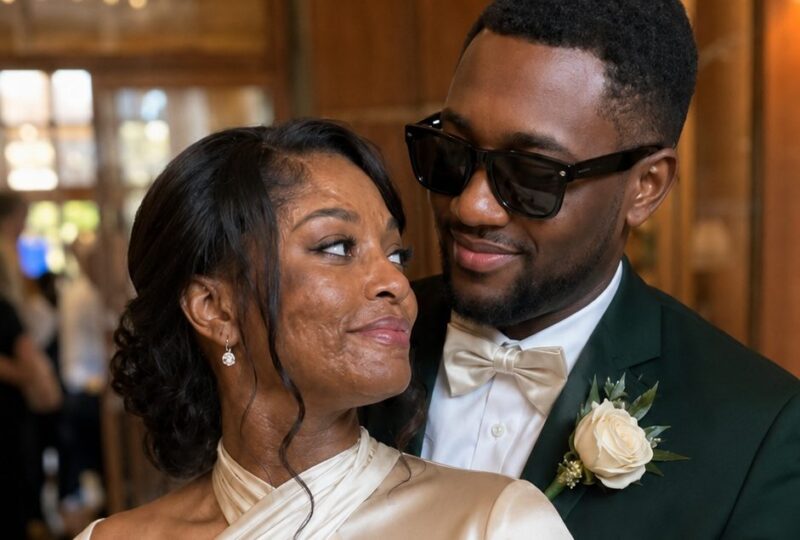
When Merritt said “yes,” she felt something she had never known before—belonging. The celebration afterward was simple: children laughing, cheap cake, Lorie wiping away tears of joy.
For the first time, Merritt was not defined by her scars, but by love and acceptance. She believed she had finally found a place where she was safe.
That night changed everything.
In their new home, Callahan gently touched her scars and called her beautiful. Overwhelmed, Merritt broke into tears—tears of relief she had waited years to release.
But that peace collapsed when he revealed he had been hiding a truth for two decades.
He asked her about the explosion that had injured her—details she had never fully shared—and a sudden wave of shock replaced her comfort as she realized he knew more than he should.
Callahan confessed that, as a teenager, he had been near the site of the gas explosion.
He and his friends had been recklessly tampering with fuel, and one mistake triggered the blast that destroyed Merritt’s life.
In the aftermath, he saw reports about a surviving girl named Merritt and carried the weight of guilt for years.
Later, a separate car accident took his family and his sight, leaving him blind and emotionally shattered.
When he eventually met her again as an adult, he recognized her immediately—but said nothing, terrified that the truth would destroy the fragile connection forming between them.
Devastated, Merritt left in shock and went to Lorie, who stayed with her through the night. Torn between betrayal and love, she struggled to make sense of everything she had learned.
But with time, she understood that avoiding the truth would not heal her wounds.
She returned to Callahan.
What followed was not instant forgiveness, but a slow, fragile rebuilding built on honesty. In a quiet moment at home, even a burnt breakfast turned into unexpected laughter, easing the weight between them.
And for the first time, Merritt understood something important: healing was not about erasing the past, but about learning to move forward with someone willing to face it with her.