The Rag Doll That Uncovered a Hidden Crime
My ex-husband vanished from our lives for three years without paying a single cent in child support. Then, one ordinary afternoon, a package arrived at my apartment.
Inside was a filthy old rag doll.
“Three years,” I muttered, staring at it on my kitchen table. “Three years of silence, and this is what he sends his daughter?”
After our divorce, Alexander moved on as if Sophie and I had never existed.
He married Camila Whitmore, the glamorous heiress to a Manhattan fortune, and their lavish lifestyle appeared on magazine covers while my daughter and I struggled to make rent in Queens.
The doll looked like it belonged in a garbage dump.
Its fabric was stained.
Its seams were ripped.
It smelled of dust and neglect.
I was seconds away from throwing it into the trash when Sophie rushed across the room and grabbed it from my hands.
“No, Mommy!” she cried. “Daddy sent her to me.”
The hope shining in her eyes stopped me cold.
So I let her keep it.
That night, I woke to a strange scratching sound.
At first I thought it was a dream.
Then I heard it again.
Scratch.
Scratch.
Scratch.
The noise was coming from Sophie’s bedroom.
I quietly opened her door and froze.
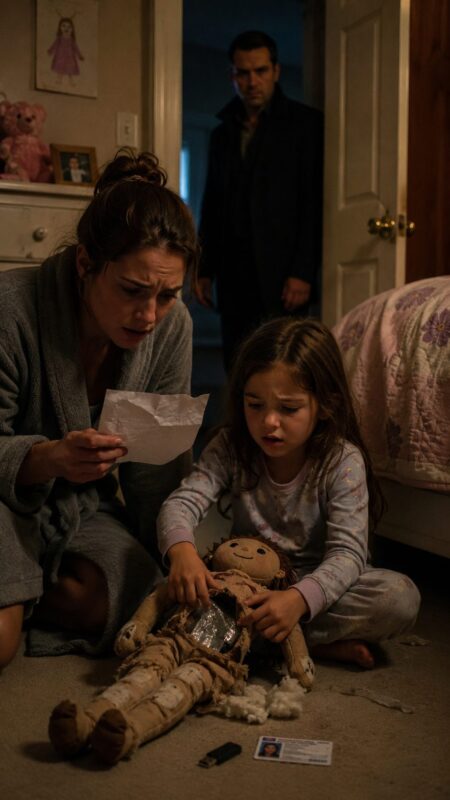
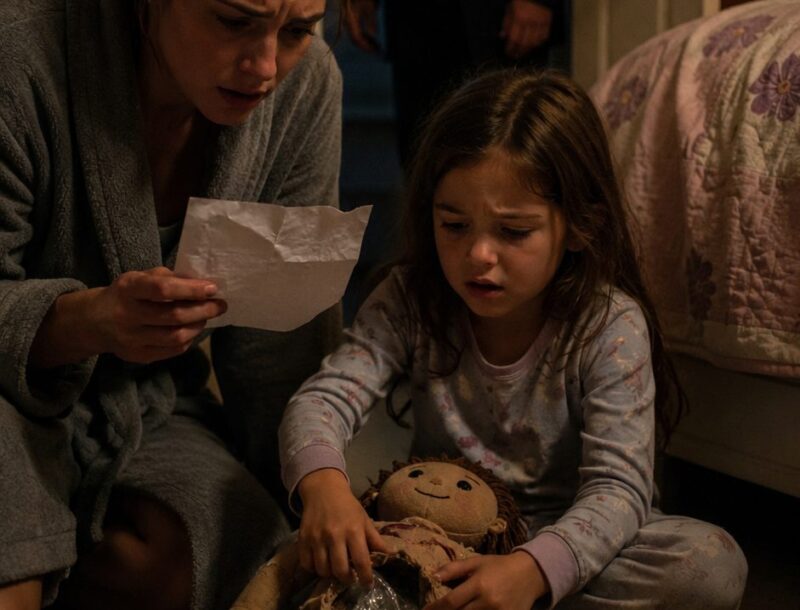
My five-year-old daughter was sitting on the floor with the doll in her lap. One of its seams had been torn open.
Beside her lay a crumpled note and a small bundle wrapped in clear plastic.
“Sophie?” I whispered.
She looked up nervously.
“Daddy told me there was a treasure inside,” she said softly.
After settling her back into bed, I picked up the note.
My stomach tightened the moment I recognized the handwriting.
It was Alexander’s.
The message contained only four words:
Save me. Don’t trust her.
A chill ran through me.
I opened the plastic bundle.
Inside was a USB drive and a driver’s license belonging to Camila.
Except the name wasn’t Camila Whitmore.
It was Lucy Hernandez.
Confused and increasingly frightened, I locked my bedroom door, turned on my laptop, and plugged in the USB drive.
A single video file appeared.
I clicked play.
Alexander stared into the camera from a dimly lit room.
He looked nothing like the polished man from the magazines.
His face was thin.
His eyes were hollow.
He looked exhausted and terrified.
“Elena,” he said, staring directly into the lens, “if you’re watching this, I’m running out of time.”
My heart nearly stopped.
“The woman I married isn’t who she claims to be,” he continued. “She’s taken everything. She keeps me drugged, isolated, and under constant watch. Please—”
The screen suddenly went black.
The recording ended.
A second later, violent pounding shook my apartment door.
BANG.
BANG.
BANG.
The walls rattled.
My pulse spiked.
I hurried to the door and peered through the peephole.
Two men in expensive suits stood outside.
“Open the door,” one of them called. “We’re here on behalf of Mrs. Whitmore.”
My blood turned to ice.
I remained silent.
Instead, I called 911 and reported that strangers were attempting to force their way into my apartment.
The men disappeared minutes before police arrived.
The following morning, I contacted an investigative journalist I knew from a legal-aid case years earlier.
I showed her everything.
The doll.
The note.
The fake identification.
The video.
Within days, she uncovered a shocking truth.
“Camila Whitmore” was actually Lucy Hernandez—a woman linked to fraud, identity theft, and financial crimes spanning several states.
Years earlier, she had vanished after investigators accused her of stealing millions from elderly investors.
Using a carefully crafted new identity, she reinvented herself as Camila Whitmore and targeted Alexander after discovering his valuable business connections and financial assets.
The journalist found evidence that Alexander had quietly transferred major assets into Lucy’s control shortly after their marriage.
Not long afterward, he disappeared from public view.
The story exploded nationwide.
Federal investigators reopened old cases and launched an extensive search.
Three weeks later, they found Alexander alive.
He was being held inside a secluded estate in upstate New York owned through a network of shell companies connected to Lucy.
The basement from the video was real.
The drugs were real.
For months, Alexander had been manipulated, isolated, and controlled while Lucy emptied his accounts and planned her escape overseas.
Authorities arrested her at a private airport while she was preparing to board an international flight.
The evidence hidden inside Sophie’s rag doll became a crucial piece of the case.
Months later, after the trials were over, Alexander stood awkwardly in my living room.
He looked healthier.
Older, too.
As though the experience had aged him years.
Sophie peeked out from behind me.
“Daddy?”
His eyes instantly filled with tears.
“I’m sorry,” he whispered.
No apology could erase the years of abandonment.
No explanation could heal every wound.
But Sophie stepped forward and wrapped her arms around him anyway.
Children often find forgiveness where adults struggle to.
A year later, Alexander was paying support, attending every scheduled visit, and slowly rebuilding a relationship with the daughter he had nearly lost forever.
One evening, while helping Sophie clean her room, I noticed the old rag doll sitting quietly on a shelf.
It was still dirty.
Still torn.
Still ugly.
Yet I couldn’t bring myself to throw it away.
Because hidden inside that forgotten doll was the truth that exposed a criminal, saved a man’s life, and reunited a father with his daughter.
Sometimes the most worthless-looking things carry the secrets capable of changing everything.