My Son Was Seven Days Old When I Found Him Burning With Fever Beside His Unconscious Mother. The Doctor Took One Look and Said, “Call the Police.”
My name is Ethan Miller. I live in a modest suburb in Ohio and work as a warehouse supervisor.
My wife, Emily, is the kindest person I have ever known. She had a gift for making our small rented house feel warmer and brighter than it really was.
Seven days before my world fell apart, she gave birth to our first child.
A beautiful baby boy named Noah.
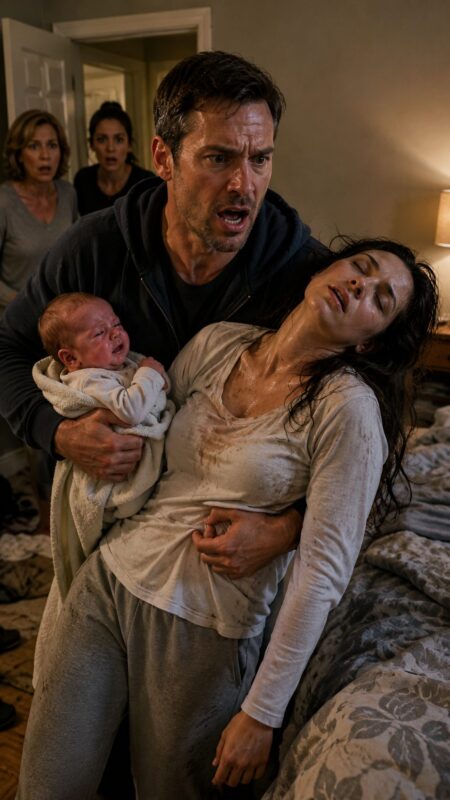
The day he was born, I held him in my arms, wrapped in a white hospital blanket with a tiny blue cap resting on his head. In that moment, I thought life could not possibly get any better.
I was wrong.
Four days after Emily returned home from the hospital, I received an urgent call from work.
A serious issue at another branch required immediate attention. At first, I refused to go. My wife was recovering from childbirth, and our son wasn’t even a week old.
But my manager kept pushing.
The company could lose an important client.
My position might be at risk.
Against my better judgment, I agreed.
It was the biggest mistake of my life.
Before leaving, I asked my mother, Linda, and my younger sister, Ashley, to stay with Emily and help care for her and the baby.
“She needs rest, proper meals, plenty of water, and help with Noah,” I told them.
My mother smiled reassuringly.
“Stop worrying,” she said. “They’ll be perfectly fine.”
I trusted her.
I wish I hadn’t.
During the next four days, I called home constantly.
Every time, my mother answered.
Every time, she only showed me Emily for a few seconds.
With each call, Emily looked weaker.
Paler.
More exhausted.
Once, she barely managed to whisper my name.
“Eth…”
Before she could say anything else, Mom took the phone away.
“She’s emotional,” she said dismissively. “All new mothers cry.”
Another time, I heard Noah crying in the background.
The sound made my stomach tighten.
It wasn’t the healthy cry of a hungry baby.
It sounded weak.
Desperate.
Almost exhausted.
“Let me see him,” I said immediately.
“He just finished eating,” Ashley replied.
Something felt wrong.
Very wrong.
But I convinced myself I was imagining things.
On the fifth evening, the work assignment ended earlier than expected.
Without telling anyone, I got in my truck and drove home through the night.
I arrived just before dawn.
The moment I stepped through the front door, I knew something wasn’t right.
The house smelled stale.
There was no scent of fresh laundry.
No baby lotion.
No warm food cooking in the kitchen.
Only sour air hanging heavily in every room.
My mother and Ashley were asleep on the couch beneath the air conditioner.
Empty pizza boxes, soda bottles, and snack wrappers covered the coffee table.
“Where’s Emily?” I asked.
“In the bedroom,” my mother replied sleepily.
Then I heard Noah cry.
The sound barely resembled a cry at all.
It was thin.
Broken.
Weak.
I ran down the hallway.
The moment I opened the bedroom door, a wave of heat and sickness hit me.
The room smelled of sweat, dirty diapers, and stale air.
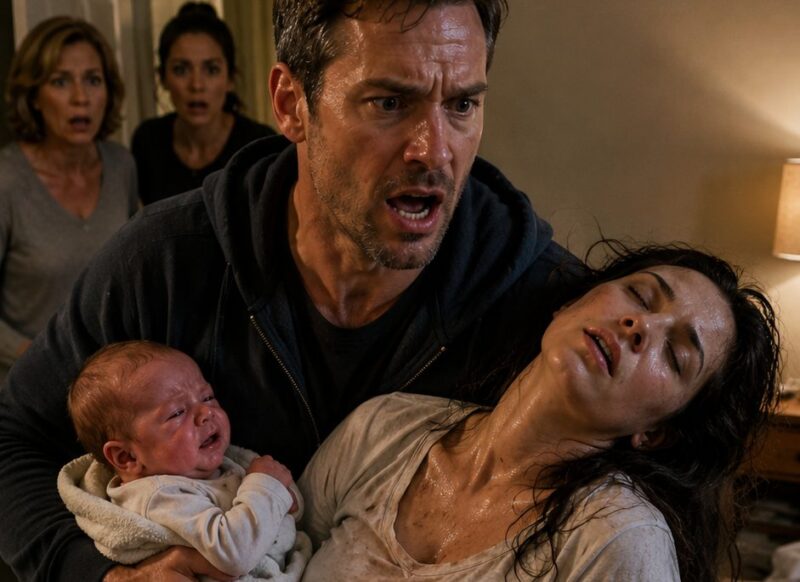
Emily lay motionless on the bed.
Her skin looked gray.
Her forehead burned with fever.
Beside her was Noah, wrapped in a stained blanket, his tiny body hot and limp.
“Emily!” I shouted.
She didn’t respond.
I picked up Noah.
He barely moved.
Panic exploded inside me.
“MOM!”
My mother and Ashley rushed into the room.
The second they saw Emily, they froze.
Not with surprise.
With guilt.
“What happened to her?” I screamed.
“She was fine last night,” my mother stammered.
“Fine?” I shouted. “She’s unconscious!”
Ashley nervously crossed her arms.
“Maybe she’s exaggerating,” she muttered. “Ever since the baby was born, she’s wanted attention.”
For one terrifying moment, I forgot she was my sister.
I wrapped Noah in my hoodie, lifted Emily into my arms, and rushed outside.
Our neighbor, Mr. Harris, heard the commotion and immediately offered to drive us to the hospital.
The nurses reacted the instant they saw Emily and Noah.
Noah was rushed to the pediatric unit.
Emily was taken for emergency treatment.
I stood trembling in the hallway.
“Please,” I whispered. “Please save them.”
A doctor examined both of them before approaching me.
“Who was caring for your wife and child?” she asked.
“My mother and sister.”
The doctor’s expression immediately hardened.
She instructed nurses to photograph Noah’s blanket, Emily’s discharge papers, and the contents of the diaper bag.
A few minutes later, my mother and Ashley arrived at the hospital.
“Don’t make this bigger than it is,” Mom said defensively. “Emily has always been dramatic.”
I stepped away from her.
Then Ashley’s phone vibrated.
She glanced at the screen—and her face went white.
A message thread was still open.
Mom: Don’t give her more food. She needs to stop acting helpless.
Ashley: The baby won’t stop crying.
Mom: Let him cry. She wanted to be a mother.
The world seemed to tilt beneath my feet.
Then Mr. Harris arrived carrying a grocery bag from our house.
Inside were items that should have been used days earlier:
An unopened container of baby formula.
Emily’s untouched medication.
A sealed bottle of water.
And the hospital discharge instructions.
One sentence had been circled in blue ink:
CALL YOUR DOCTOR IMMEDIATELY IF THE PATIENT DEVELOPS A FEVER, FAINTS, OR REFUSES TO EAT.
They had seen the warning.
They had read it.
And they ignored it.
For the first time, my mother stopped talking.
The doctor looked at both women, then turned toward a nurse.
Her voice was calm.
Cold.
Certain.
“Call the police.”
At that moment, I learned something more terrifying than fear itself.
Sometimes the greatest threat to the people you love is not a stranger.
Sometimes it’s the people you trusted most.
As police officers entered the hospital and my mother’s excuses began to crumble, I stood alone in the hallway with only one prayer:
That Emily and Noah would survive long enough for me to tell them how deeply sorry I was.