I never thought Thanksgiving dinner would be the moment that completely changed the way I saw my husband.
My father-in-law looked at my son, who uses a wheelchair, and said, “Maybe he should eat in the kitchen.
Some of the guests feel uncomfortable.” I waited for my husband to stand up for him. Instead, he silently passed the gravy.
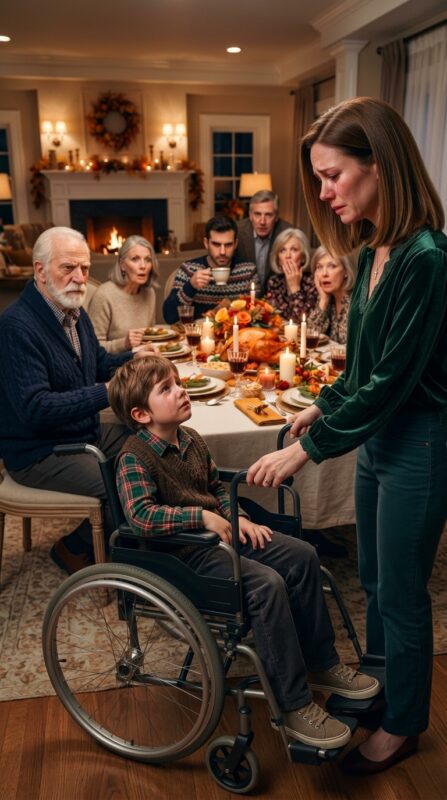
Then my son whispered, “Mom… did I do something wrong?” That was the moment I got to my feet—and what followed changed our family forever.
PART 1
By the time my father-in-law, Richard Bennett, suggested that my ten-year-old son have Thanksgiving dinner in the kitchen, I already knew the holiday was heading in the wrong direction.
My son, Ethan, had been born with a spinal condition and used a wheelchair. But he was independent, quick-witted, and far too aware of the moments when adults treated him as though he were somehow different.
We had driven two hours to Richard and Linda’s home outside Columbus because my husband, Mark, had assured me that Thanksgiving would be “peaceful” this year.
It wasn’t.
Dinner had barely begun when Richard glanced at Ethan’s wheelchair and remarked in an almost casual tone, “Maybe he should eat in the kitchen. Some of the guests aren’t comfortable around disabled kids.”
For a moment, I wondered if I had misunderstood him.
Then I looked at Mark.
He had heard every word.
But instead of confronting his father, my husband reached for the gravy boat and quietly handed it to his sister.
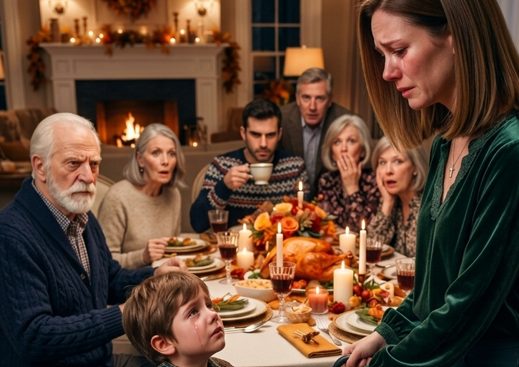
Ethan’s face changed instantly. His eyes dropped to his plate.
“Mom,” he whispered, “did I do something wrong?”
That question cut deeper than anything Richard had said.
I leaned closer to Ethan.
“No, sweetheart. You haven’t done anything wrong.”
Richard let out an irritated sigh, as though I were the person causing trouble.
“Claire, don’t make a big scene out of this. It’s only one meal. He can still eat.”
“Just not at the table with everyone else,” I replied.
Linda refused to meet my eyes.
Finally, Mark muttered, “Can we please just make it through dinner?”
I stared at him in disbelief.
“You’re actually willing to let our son sit by himself in the kitchen just so your father can feel comfortable?”
Mark’s voice dropped.
“Not here, Claire.”
And suddenly, I understood exactly what everyone sitting around that table wanted from me.
They expected me to stay quiet, ignore the insult, and pretend nothing had happened so their Thanksgiving could remain pleasant.
I pushed my chair away from the table and stood.
“Ethan, we’re going home.”
Richard scoffed.
“You’re leaving over this?”
I stepped behind Ethan’s wheelchair and guided him toward the hallway.
Mark didn’t get up.
He didn’t apologize.
He didn’t even try to stop us.
He simply stayed in his chair.
We were almost at the front door when Ethan stopped me.
“Mom,” he said softly, glancing toward the dining room, “Dad’s coming with us, right?”
I turned around.
Mark was still sitting at the table with his fork in his hand.
Then Richard gave me a smug smile.
“See? Even your own husband thinks you’re making too much of this.”
I looked at Mark for several long seconds, giving him one final chance to prove his father wrong.
He never moved.
So I opened the front door and wheeled Ethan outside.
The freezing air hit us the second we stepped onto the porch.
Ethan barely spoke while I helped him into the car.
Then, in a small voice, he asked, “Does Grandpa not like me because I’m in a wheelchair?”
I crouched beside him.
“Your wheelchair doesn’t change who you are. Grandpa said something hurtful because he was thinking about his own comfort instead of your feelings.”
Ethan nodded, but I knew reassurance couldn’t simply erase what he had heard.
We ended up at a little diner that happened to be open on Thanksgiving.
Ethan ordered pancakes and hot chocolate.
I ordered coffee and hardly drank any of it.
About twenty minutes later, my phone rang.
It was Mark.
“Where are you?”
I nearly laughed.
“Where do you think we are?”
“You embarrassed my entire family.”
“Your father humiliated our son.”
“He’s old-fashioned, Claire. He didn’t mean it the way you’re making it sound.”
Across the booth, Ethan was carefully stacking sugar packets into tiny towers.
“He literally said disabled kids make people uncomfortable.”
Mark fell silent.
Then he replied, “You know how Dad is. He gets nervous when things are different.”
Something shifted inside me when he said that.
For years, I had watched Mark brush aside little remarks. I had watched his family choose restaurants Ethan couldn’t easily access, position his wheelchair at the edge of family photographs, and organize birthday parties upstairs even after I reminded them that he couldn’t use the stairs.
And every time, Mark found an excuse.
I had convinced myself that he simply hated confrontation.
But sitting in that diner, I finally realized his silence wasn’t just avoidance anymore.
It was a decision.
“I’m not coming home tonight,” I said.
“What?”
“Ethan and I are staying with Rachel.”
Mark’s tone immediately hardened.
“You’re seriously going to destroy our marriage over Thanksgiving dinner?”
“No,” I replied. “I’m finally paying attention to what our marriage has been teaching our son.”
Then I ended the call.
My sister Rachel lived about forty minutes away.
The moment we arrived, she hugged Ethan before she even asked what had happened. Then she offered him leftover pie.
She waited until he was settled in the living room watching a movie before turning to me.
I told her everything.
Rachel listened without interrupting.
When I finished, she looked at me and said, “Claire, this isn’t the first time you’ve called me in tears because Mark refused to stand up to his parents.”
My first instinct was to defend him.
But I couldn’t.
Because she was right.
At exactly 10:47 that night, Mark finally showed up.
He stood on Rachel’s porch with Ethan’s backpack in his hand.
“I’m sorry,” he said.
I opened the door only halfway.
Then he hesitated before adding, “But you owe my dad an apology too.”
In that instant, I realized his apology wasn’t sincere at all.
I stepped outside onto the porch and quietly pulled the door shut behind me so Ethan wouldn’t overhear our conversation.
“I’m not apologizing for removing our son from a dinner table where people treated him like he was an inconvenience.”
Mark dragged a hand across his forehead.
“Dad says you humiliated him in front of the entire family.”
“He embarrassed himself.”
I told Mark he needed to leave.
We could discuss everything once Thanksgiving weekend was over.
He stared at me like he couldn’t believe what he was hearing, but I wasn’t changing my mind.
Ethan and I remained at Rachel’s house for six days.
Throughout that week, Mark called again and again.
At first, every conversation followed the same pattern.
Yes, his father had been insensitive—but according to Mark, I had taken things too far.
His mother was devastated.
Everyone in the family was arguing.
Eventually, I refused to discuss Richard anymore.
“This isn’t about your father,” I told Mark. “This is about you. Our son looked to you because he expected you to protect him, and instead, you stayed silent because you didn’t want to upset your dad.”
Mark had nothing to say.
Two days later, he asked if we could meet somewhere alone.
We met at a small coffee shop.
For the first time since Thanksgiving, Mark didn’t make excuses for his parents.
He admitted that he had spent most of his life trying to avoid conflict with Richard.
Keeping quiet had always seemed easier—and safer—than standing up to his father.
“But after you walked out,” Mark said, “I saw Ethan’s expression. He wouldn’t even look at me.”
I told him regret wasn’t enough.
Feeling ashamed wouldn’t repair what had happened.
If Ethan and I were going to return home, our family needed real changes.
Our son would never again be asked to tolerate being excluded simply to make another person feel comfortable.
Mark agreed to start counseling.
Then he contacted his parents and made something perfectly clear: from that point forward, we wouldn’t attend family events unless Ethan was welcomed and treated with the same dignity and respect as everyone else.
Richard immediately blamed me.
He accused me of manipulating Mark and turning him against his family.
But this time, Mark did something I had never expected.
“No, Dad,” he said firmly. “Claire isn’t making this decision for me. I am.”
It was the first time I had ever heard my husband openly stand up to his father.
Of course, one conversation didn’t suddenly fix our marriage.
There was no instant happy ending.
The trust I had lost returned gradually.
Mark began therapy and started confronting the habits he had spent years pretending weren’t a problem.
Months later, he sat down with Ethan and apologized directly to him.
There were no excuses.
He didn’t blame Richard.
He didn’t blame me.
He didn’t blame the circumstances.
He simply admitted that when Ethan needed his father to defend him, he had failed to do it.
By the time the following Thanksgiving arrived, we decided to host dinner at our own house.
Rachel joined us, along with several friends, neighbors, and some of Ethan’s cousins.
And this time, there was never a question about where Ethan belonged.
He sat right in the middle of the table, laughing and debating with everyone about who should get the last dinner roll.
Halfway through the meal, he leaned closer to me.
“This Thanksgiving is way better,” he whispered.
I smiled at him.
“Much better.”
Even now, I sometimes think about that first Thanksgiving and the way Ethan looked at me when he asked whether he had done something wrong.
No child should ever be taught to shrink themselves simply because the adults around them refuse to make space for them.
And that night taught me something I’ll never forget.
Silence can preserve the appearance of peace for a few hours.
It can keep arguments from starting and prevent uncomfortable conversations.
But when staying silent teaches your child that another person’s comfort matters more than their dignity, that silence is no longer peace.
It’s a choice.
And sometimes, protecting your child means being willing to make the choice everyone else is too afraid to make.
If you had been sitting at that Thanksgiving table, would you have taken your child and walked out—or would you have handled the situation differently?