I Saw My Ex-Wife Alone in a Hospital Corridor—And Everything Changed
Two months after our divorce, I walked into a hospital and saw my ex-wife sitting alone in a quiet hallway. The moment I recognized her, something inside me cracked.
I had come to visit my best friend after surgery. The air smelled of disinfectant and old coffee, and a cold draft drifted through the corridor from the ventilation system.
As I headed toward the recovery unit, I noticed a woman sitting near the wall with a blanket over her knees and an IV stand beside her.
Then she turned.

Emily.
My ex-wife.
For a few seconds, I couldn’t move.
My name is Michael Harris. I was thirty-four years old, an ordinary office employee who spent years pretending work was more important than facing difficult emotions.
Emily and I had been married for five years. People described us as stable. We weren’t the passionate couple who turned heads—we were simply reliable.
At least, we had been.
Emily expressed love through small acts of kindness. She prepared coffee before I woke up, reminded me to eat when I got busy, and shared dreams of a modest home filled with laughter and children.
We both wanted a family.
Then life had other plans.
The first miscarriage devastated us. Emily had secretly purchased a tiny pair of baby socks and hidden them in a drawer.
After we lost the pregnancy, I found her sitting on the bathroom floor holding those socks against her chest, unable to let them go.
The second miscarriage came a year later.
Friends and relatives offered comforting words, but nothing eased the pain. Slowly, silence settled over our home. Emily withdrew into herself, while I disappeared into work.
I stayed late at the office, answered emails at midnight, and convinced myself I was being productive when, in reality, I was running from grief.
Before long, every conversation turned into a disagreement.
Bills.
Laundry.
Schedules.
Even silence became something we argued about.
Then one evening, standing beneath the dim yellow light in our kitchen, I said the words that ended everything.
«Maybe we should get divorced.»
Emily looked at me for what felt like forever.
«You’d already made that decision before saying it, hadn’t you?»
I couldn’t lie.
I nodded.
The divorce happened quickly. Five years together were reduced to forms, signatures, and court documents. The day everything became official, she simply looked at me and said:
«Take care of yourself, Michael.»
Then we walked in opposite directions.
Afterward, I rented a small apartment and convinced myself that solitude was the same thing as peace.
It wasn’t.
I missed the grocery lists on the refrigerator.
I missed seeing her curled up on the couch.
Most of all, I missed the simple question she always asked:
«Have you eaten today?»
But despite missing her, I did nothing.
Until the day I walked into that hospital.
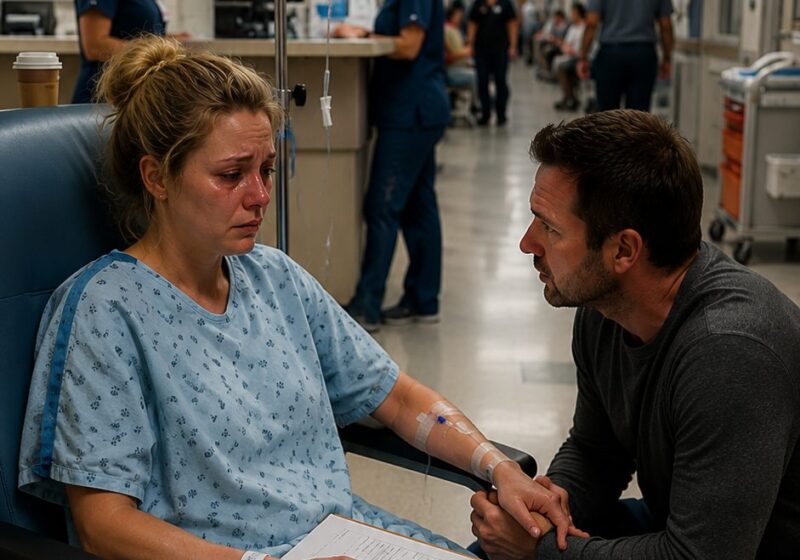
Emily looked thinner than I remembered. Her hair was shorter, dark circles shadowed her eyes, and a hospital wristband circled her wrist.
I sat beside her.
«What happened?» I asked quietly.
«It’s nothing,» she replied.
The answer sounded false the moment she said it.
As I gently pressed for the truth, a clipboard slipped from beneath her blanket. The intake paperwork was partially visible.
My eyes landed on the emergency contact section.
Michael Harris.
My name.
My phone number.
She had never changed it.
Before I could say anything, a nurse approached.
«The doctor would like to discuss discharge instructions,» she said. «Are you the emergency contact?»
For a brief moment, memories flooded back—the divorce papers, the courthouse hallway, and the gray suitcase Emily carried out of our apartment.
Then I stood up.
«Yes,» I answered.
The doctor explained that Emily had been dealing with health problems for weeks.
She had ignored the symptoms, postponed treatment, and tried to manage everything on her own. There would be more tests, more appointments, and a long recovery process ahead.
After the doctor left, I finally asked the question that had been haunting me.
«Why didn’t you call me?»
Emily let out a weary laugh.
«We’re divorced.»
«I know.»
«You were the one who wanted that.»
The words hurt because they were true.
When I admitted that leaving hadn’t fixed anything, she looked directly at me.
«Did it?» she asked.
I shook my head.
«No.»
It was the most honest answer I’d given in years.
From that day forward, I started showing up.
I drove her to medical appointments.
I helped with paperwork.
I picked up prescriptions.
I sat beside her on difficult days.
Nothing dramatic.
Nothing heroic.
Just consistent.
The one thing I had failed to be when we were married.
Over time, we talked honestly about everything—our marriage, our losses, our mistakes, and the grief we had both tried to carry alone. I apologized, but I stopped expecting forgiveness to erase the past.
Slowly, Emily began to trust me again.
Not because of what I said.
Because I stayed.
Months later, after a follow-up appointment, we sat together in my car while rain tapped softly against the windshield.
«I don’t want to go back to who we used to be,» she said.
«Neither do I.»
«The old marriage was lonely.»
«I know.»
«If there’s ever a future for us, it can’t be built on silence.»
«It won’t be.»
I couldn’t erase the pain I had caused.
I couldn’t undo the years of distance or the losses we endured.
But I could stop walking away.
Looking back now, I thought seeing Emily in that hospital hallway shattered me because she was sick.
I was wrong.
It shattered me because, for the first time, I understood what my absence had cost.
The real turning point wasn’t a dramatic apology or a grand romantic gesture.
It was a hospital folder sitting on a kitchen table.
A cup of tea cooling between us.
And the realization that love is not measured by how much you regret leaving.
It’s measured by what you choose to do when life finally gives you the chance to stay.