The hospital disappeared in my rearview mirror while Nora slept beside me in her car seat.
After thirteen days in the NICU, my daughter was finally coming home.
She weighed four pounds, eleven ounces and had her father’s dark curls, cleft chin, and unusual eyes—one bright blue, the other almost black.
Her father, Caleb, had disappeared the night I told him I was pregnant.
There had been no argument or warning.
He promised we would figure everything out together, kissed my forehead, and said he would call the next morning.
Instead, his phone was disconnected and half his apartment was empty.
Grandpa Walter helped me survive the pregnancy.
My parents had died when I was ten, and he had raised me ever since.
He built Nora’s crib himself and promised we didn’t need anyone who didn’t want to stay.
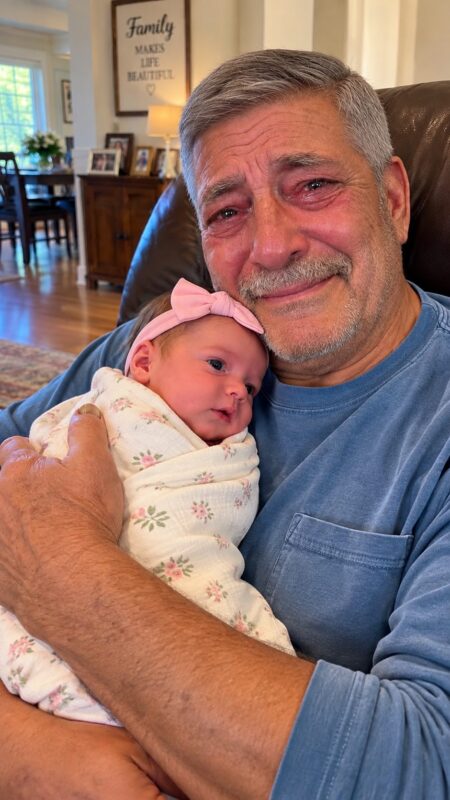
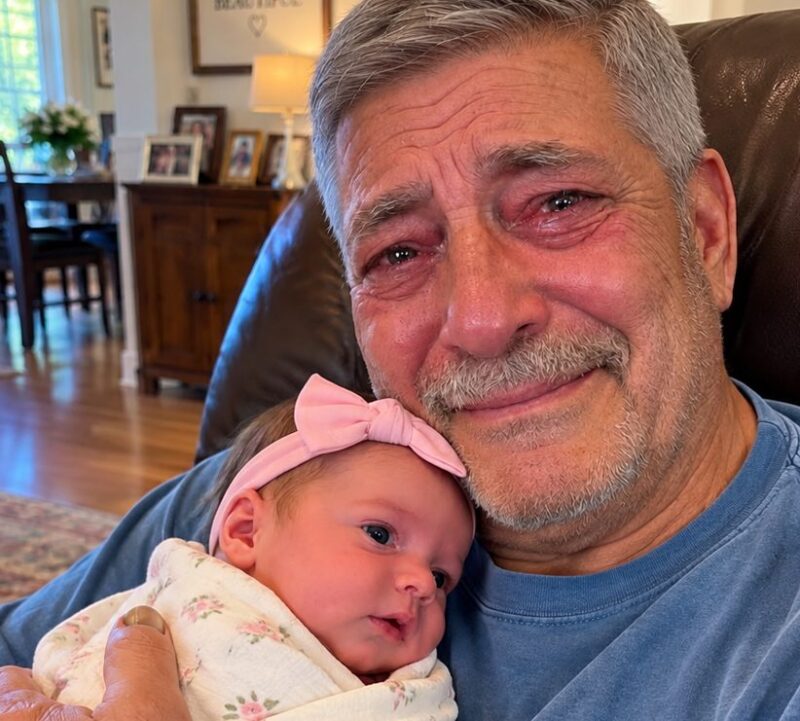
When I finally brought Nora to meet him, Grandpa rushed from his porch and took her into his arms. At first, he smiled.
Then he noticed her eyes.
His face went white.
“Who is her father?”
“Caleb.”
“And Caleb’s father?”
“William, I think.”
Grandpa sank into his chair.
“I promised your mother I would never tell you.”
He revealed that my mother, Sarah, had once worked as Caleb’s nanny. When I was four or five, we had lived in William’s house.
Suddenly, forgotten memories surfaced—a huge garden, a red bicycle, and a dark-haired boy running behind me while I learned to ride.
“That was Caleb,” Grandpa said.
After Caleb’s mother died, William became interested in my mother.
She rejected him, so he fired her and used his influence to prevent her from finding similar work. Frightened, she took me away.
That night, I opened the cedar box containing my mother’s belongings.
Inside was a photograph of four-year-old me on a red bicycle with Caleb standing behind me.
Then I found letters.
Caleb had written to my mother for years, beginning when he was seven.
“Where did the little girl go? Please tell me she’s okay.”
Later letters contained money he had saved for me. On the final letter, my mother had written five words:
“He isn’t like his father.”
I realized Caleb had recognized me when we met as adults. He had known who I was throughout our relationship.
The next morning, I drove to William’s house with Nora.
William answered and coldly insisted Caleb had knowingly abandoned me.
But as I walked away, another childhood memory returned: Caleb running after our car as my mother drove us away.
I turned back.
“I’m not leaving until Caleb tells me himself that he doesn’t want his daughter.”
Then Caleb appeared.
He admitted he had recognized me immediately when we met again.
He had wanted to tell me the truth but feared I would see his father whenever I looked at him.
Then he explained why he disappeared.
His grandfather had left him a $1.6 million trust controlled by William.
After learning I was pregnant, Caleb confronted his father about what he had done to my mother.
William offered him a deal: stay completely away from me until after the baby was born, and he would surrender control of the trust.
Caleb agreed.
“I thought I was buying our freedom,” he said.
I stared at him.
“And where was my choice?”
That was the real betrayal.
William had controlled my mother. Grandpa had hidden my childhood because he thought he was protecting me.
Now Caleb had decided what was best for me without allowing me to choose.
Still, Caleb asked for one thing.
“Can I be her father?”
“Yes,” I said. “But I’m not taking you back. Maybe not ever.”
He promised he would prove himself.
Three months later, Caleb had moved out of William’s house and was consistently present in Nora’s life.
Every decision about her was discussed together. No secrets. No private bargains.
I also confronted Grandpa with the letters.
“I thought I was protecting you,” he said tearfully.
“I know. That’s the problem. All of you thought you were protecting us.”
That evening, Caleb returned Nora exactly at six. He stopped at my doorway and didn’t enter because I hadn’t invited him.
That mattered.
Later, rocking Nora beside the crib Grandpa had built, I looked into her mismatched eyes and
understood what had finally changed.
For generations, men who claimed to love the women in my family had decided what truths we were allowed to know.
My mother had lived that story.
Then I had.
But it stopped with me.
I finally knew every secret—and, for the first time, I got to decide for myself who was allowed to stay.