For six months, my thirteen-year-old son, Evan, said every paycheck from his Saturday job was going toward a bicycle.
But the bike never appeared, and he became increasingly secretive.
One Saturday, his boss, Mr. Alvarez, called.
“Do you know what Evan does with every paycheck?”
“He’s saving for a bike.”
“Everything he’s told you about that money is a lie.”
Behind him, I heard Evan shouting, “Please don’t tell my mom!”
Mr. Alvarez told me to come immediately.
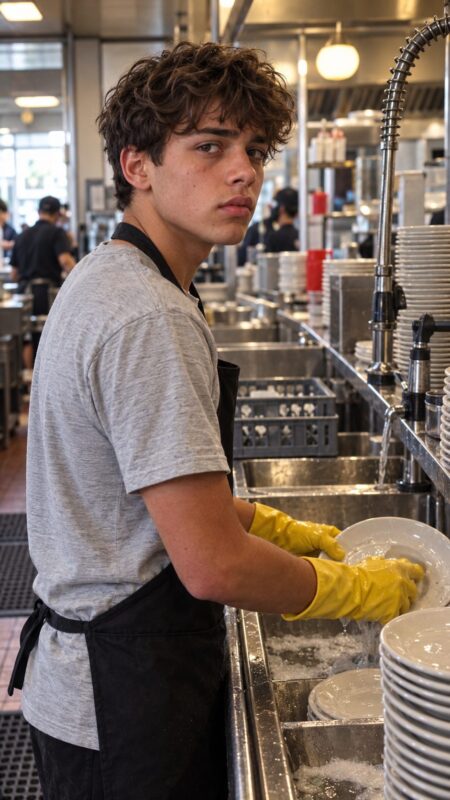
When I reached the diner, an overturned bus tub lay on the floor. Evan and an older employee named Cal were arguing over a white envelope.
“Your son tried to give me his entire paycheck,” Cal explained.
Evan insisted he owed Cal for helping him, but Cal refused the money.
Then Mr. Alvarez revealed that Evan had kept only one paycheck during his six months at the diner—the first.
“Where did the others go?” I demanded.
Evan wouldn’t answer.
Then I noticed his backpack lying open.
Several envelopes and a folded city bus map had fallen out. Red circles marked different locations, accompanied by notes such as TIRES, HAIRCUT, and STORE LADY.
Some had dollar amounts beside them.
Cal admitted he had followed Evan to a tire shop on Mason Street. I knew the place immediately.
Four months after my husband, Jeremy, died, our car developed a flat tire.
The shop owner discovered another tire was nearly bald, but I could afford to replace only one.
Seeing ten-year-old Evan beside me, the owner replaced both and told me I could pay later.

I never forgot his kindness, although I hadn’t thought about it in years.
Evan begged me not to go there, but I drove him to Mason Tire.
The owner recognized us. When he saw Evan, he sighed.
“You promised you were done.”
He explained that Evan had arrived months earlier carrying $180, insisting he owed the shop for the tire from three years before.
The owner had accepted the envelope only because Evan refused to leave, but he had saved every dollar, intending to return it.
I unfolded Evan’s map again. The tire shop, a barber, a grocery store, and a street near his old school were all marked.
“Why do you remember these places?” I asked.
“Dad would’ve remembered,” Evan replied.
Then the truth emerged.
After Jeremy died, neighbors and local business owners had helped us with food, transportation, haircuts, and repairs.
Evan remembered every act of kindness.
Because his father had always taught him to repay people, Evan believed it was now his responsibility to settle those old debts.
The Saturday he came home late with mud on his shoes and a torn sleeve, he had been repairing Mrs. Donnelly’s fallen fence.
She had driven him home from school for months after Jeremy died whenever I couldn’t leave work.
Certain I would make him stop, Evan had hidden everything from me.
I drove him to Jeremy’s favorite park, and we sat beside the bicycle path with the map between us.
“Your father kept Mrs. Donnelly’s ladder for eleven years,” I told him.
“He once borrowed money from Mr. Alvarez and forgot to repay it for six months. Your dad helped people, but people helped him too.”
Evan stared at the circles.
“But Dad can’t do his part anymore.”
“You inherited your father’s kindness,” I said. “You didn’t inherit his unfinished responsibilities.”
Evan finally leaned against my shoulder.
“I thought you needed me.”
“I need my son. I don’t need another caretaker.”
Back at the diner, Evan placed his paycheck in his own pocket.
Months later, he finally bought the used bicycle. One afternoon, he stopped to repair a younger boy’s fallen chain.
“What do I owe you?” the boy’s father asked.
Evan considered the question.
“Help somebody else when they’re stuck.”
Then he climbed onto his bike and called for me to time him. I raised my phone, and my son kept riding.