My daughter’s wedding was meant to be a joyful celebration—but the second I saw her husband, my past came crashing back. And before the night ended, a secret hidden for more than twenty years would change everything.
I became a mother at just twenty years old. Emily’s father and I married quickly and spent twenty-one years together before cancer took him two years ago.
After his passing, it was just the two of us again, trying to adjust to a home that felt far too quiet and empty.
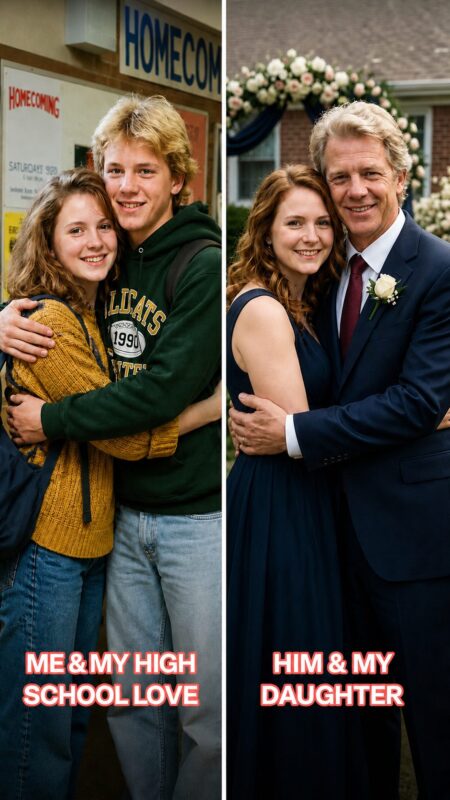
Emily grew up, finished her studies, and built a life of her own. Then one day, she called me, her voice full of excitement.
“Mom, I met someone.”
She mentioned he was older but avoided giving details. Over time, she described him as caring, emotionally mature, and someone who made her feel secure.
Still, she kept postponing the introduction.
Eventually, she invited him over for dinner.
I prepared anxiously, wanting everything to go perfectly. But the moment I opened the door, I froze.
Standing next to Emily was Mark—my high school love.
We stared at each other in disbelief. Emily looked confused, unaware of the history between us. I quickly pulled him aside into the kitchen, demanding an explanation.
He claimed he hadn’t realized at first that she was my daughter, but admitted he figured it out later—and chose to stay because he had fallen in love with her.
The tension only deepened from there. Emily stood by him, accusing me of letting my past interfere with her relationship. Every conversation after that turned into an argument.
A year later, she showed me her engagement ring.
“We’re getting married,” she said firmly. “You can accept it—or lose me.”
I had already lost my husband. I couldn’t bear losing her too. So I agreed, even though something inside me felt terribly wrong.
At the wedding, when the officiant asked if anyone objected, I found myself standing before I could stop it.
But Emily cut me off in front of everyone, asking me to sit down and respect her decision.
Humiliated, I sat. The ceremony went on.
Later that evening, Mark asked to speak with me in private. Outside, beneath the night sky, he finally told me the truth.

He wasn’t the Mark I once loved.
He was his son.
Everything shifted in an instant. He explained that his father—my Mark—had never truly moved on from me. He kept photos, memories, and often spoke about “the one who got away.”
Growing up in that shadow, Mark Jr. developed resentment.
Years later, he came across Emily on a dating app. She resembled me in my youth, and he recognized my name.
Driven by anger toward his father—and perhaps toward me—he pursued her, intending to hurt me indirectly.
But things didn’t go as planned.
He fell in love with her—genuinely.
The original motive disappeared, but the lie remained. He was too afraid to tell her the truth, fearing she would believe their entire relationship had been built on deceit.
After the wedding, Emily refused to speak to me. Realizing I couldn’t fix things on my own, I reached out to Mark Sr.
We met, and I told him everything. He was stunned—and deeply ashamed. Together, we agreed that Emily deserved the truth, no matter how painful.
A week later, I invited Emily and her husband to dinner.
But there was one more guest.
When Mark Sr. walked in, the room fell silent.
I stepped back and let them talk. From the kitchen, I could hear the wave of emotions—shock, anger, heartbreak. Eventually, everything grew quiet.
When I returned, Emily stood by the window, shaken.
“You knew,” she said softly.
“Only part of it,” I answered. “But no more secrets.
She didn’t decide anything that night. She left, saying she needed time.
Ten days later, she called me.
“I’m angry,” she said. “I feel betrayed. But I also know he loves me. I want to try to make this work.”
I held my breath.
“This is your life, not mine,” I told her gently. “It may have started with us, but it belongs to you now. I respect your choice.”
In that moment, I understood something important: letting go doesn’t mean losing someone—it means trusting them.
And maybe, at last, it means facing the past… without letting it define the future.