My Father Promised It Wouldn’t Hurt…
Yet a quiet second-grade girl kept repeating those words in class—and it wasn’t only what she said. It was how she sat, how she walked, and how she tried to conceal her discomfort that made her teacher realize something wasn’t right at home.
The Morning She Tried Not to Flinch
On a still Thursday morning in early October, as the trees lining a modest suburban street outside Pittsburgh began to fade from green into soft amber,
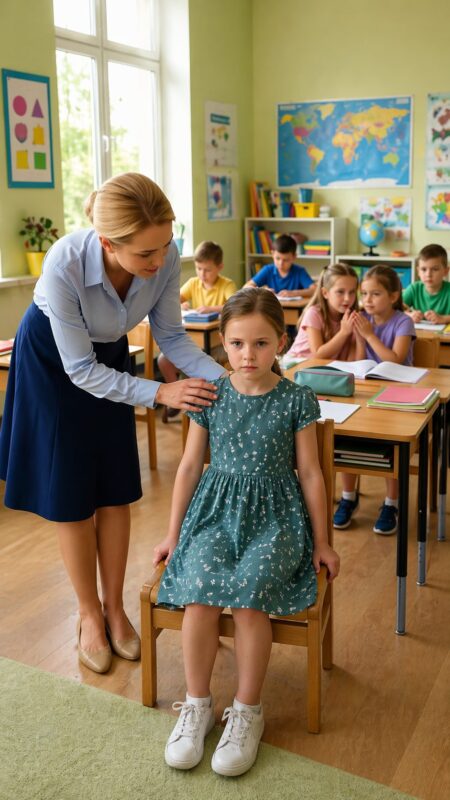
Ms. Valerie Kincaid stood at the front of her second-grade classroom, watching her students settle into their routines.
Over the years, she had learned that the smallest details—especially how a child entered a room when they thought no one was watching—could reveal far more than words ever could.
The classroom hummed with its usual youthful energy: chairs scraping lightly, quiet chatter rising and falling in uneven waves.
Yet Valerie’s attention drifted, almost instinctively, to a desk near the windows.
There sat Lila Mercer, unusually still—not with natural calm, but with a kind of practiced stillness, as though she had taught herself to take up as little space as possible.
Lila wasn’t disruptive, nor did she raise concern in obvious ways.
Still, there was something about her quietness that felt different from simple shyness. It carried a sense of caution, as if she had learned that drawing attention could bring consequences she would rather avoid.
That morning, Valerie noticed how Lila kept shifting in her chair—small, controlled movements that seemed less about comfort and more about endurance. It was as though even sitting required effort and careful control.
When it was time for students to bring their assignments forward, Lila stood more slowly than the others, placing one hand on the edge of her desk for support.
Though the room buzzed with children talking over one another, Valerie couldn’t ignore the uneven rhythm of Lila’s steps as she approached.
“Lila, are you feeling alright today?” Valerie asked gently, her tone light and conversational. She knew that too much concern could make a child withdraw instead of open up.
Lila paused for a brief moment, her shoulders rising slightly beneath her cardigan. She offered a faint smile that didn’t quite reach her eyes.
“I’m okay, Ms. Kincaid. I just need to sit up straight,” she said. There was something rehearsed in her voice, as if she had practiced those words until they sounded convincing.
Before Valerie could ask anything more, Lila’s expression changed. The color drained from her face almost instantly, and the papers slipped from her hands as her knees gave way in a motion so quiet it felt unreal.
Valerie reacted immediately, catching her before she could collapse. The child felt alarmingly light, her small frame offering almost no resistance. This didn’t feel like ordinary fatigue.
“Please call the nurse right away,” Valerie said calmly, even as her heart began to race beneath her composed exterior.
In the Nurse’s Office
Under the harsh fluorescent lights of the nurse’s office—lights that made everything seem more fragile than it was—Lila slowly regained consciousness, staring up as though the ceiling tiles gave her something steady to focus on.
The nurse spoke in calm, professional tones, mentioning dehydration and low blood pressure—explanations that sounded reasonable on the surface. Still, Valerie couldn’t shake the feeling that something deeper was being overlooked.
Then, in a voice so soft it nearly vanished into the quiet room, Lila spoke.
“My dad said it wouldn’t hurt… but it does,” she whispered.
The simplicity of her words carried a weight that tightened something deep inside Valerie’s chest.

“What hurts, sweetheart?” Valerie asked gently, leaning closer without pushing too hard.
Lila hesitated, her fingers tightening around the thin blanket draped over her legs. Then she slowly shook her head, the movement so slight it was almost invisible, as though the answer itself was something she wasn’t ready to say aloud.
The silence that followed wasn’t empty. It held something unspoken—something that could no longer be ignored.
The Man Who Always Smiled
Later that afternoon, as parents gathered outside the school and the air filled with the restless energy of children eager to go home, Lila remained seated on a stone bench near the entrance.
She held her backpack tightly against her chest, as if it offered some kind of protection.
A sleek, dark sedan glided up to the curb with quiet precision. A man stepped out, carrying the composed confidence of someone used to controlling his environment—his posture upright, his expression carefully neutral.
Warren Mercer introduced himself with polite efficiency, offering Valerie a brief nod as he adjusted the cuff of his tailored blazer. Everything about him suggested a man who placed order and discipline above all else.
“I understand Lila felt a bit faint today,” he said evenly, as though discussing something minor. “She’s always been somewhat sensitive.”
Valerie glanced at Lila, who now stood beside her father with her shoulders pulled back in a stiff, exaggerated posture that looked forced rather than natural.
For a brief second, their eyes met, and something unspoken passed between them—subtle, yet impossible to ignore.
“She mentioned she’s been experiencing some discomfort,” Valerie replied carefully, choosing each word with intention. “It might be a good idea to have her checked by a doctor.”
Warren’s expression barely shifted, though there was a faint tightening around his smile that hinted at quiet resistance.
“I already have a system for her,” he said, his voice still controlled but slightly firmer. “It’s about discipline and proper posture. Children today tend to develop bad habits far too easily.”
As he spoke, Lila’s grip on her backpack straps tightened almost imperceptibly. Valerie noticed again how rigidly the girl held herself—as though maintaining that position required constant effort rather than coming naturally.
In that moment, Valerie understood something clearly. Her concern was no longer vague.
The Rigid Lines Beneath Her Sweater
The following morning, Valerie arrived earlier than usual and positioned herself near the classroom door. She wanted to observe Lila more closely—without making it obvious.
When Lila entered, her movements confirmed Valerie’s growing suspicion. The girl walked with controlled stiffness, each step careful and deliberate, as though her body were being held in place by something unseen.
During a quiet reading period, Lila bent slightly to pick up a book.
For a split second, a flash of discomfort crossed her face before she quickly hid it. In that fleeting moment, Valerie noticed something unusual beneath the fabric of her sweater.
Two faint, rigid lines pressed subtly against the material along her back, creating a shape that didn’t match the natural softness of a child’s body.
“Lila, could you stay for a moment after school?” Valerie asked casually, presenting it as something related to classwork.
Later, in the quiet calm of the library, Valerie knelt beside her and spoke softly.
“You mentioned yesterday that something hurts,” she said gently. “Is it your back?”
Lila hesitated, her eyes fixed downward as if searching for the safest response. Then she gave a small, reluctant nod.
“My dad calls it a posture plan,” she whispered. “He says if I wear it long enough, it will make me strong.”
A tightness settled in Valerie’s chest as the meaning behind those words became clearer.
“Does it hurt when you move?” she asked quietly.
Lila nodded again—slower this time.
“Sometimes it hurts when I breathe,” she added in a barely audible voice.
At that moment, uncertainty gave way to certainty.
When Evidence Leaves a Mark
Two days later, during recess, Lila tried to join a group of classmates playing jump rope. She attempted to follow their rhythm, but her movements looked strained, as if her body resisted every motion.
When she stumbled, Valerie rushed to her side, steadying her. In that brief moment, the edge of Lila’s shirt shifted just enough to reveal what Valerie had feared.
Faint bruises marked her skin in symmetrical patterns, tracing the outline of something tight and restrictive.
“You don’t have to keep it on here,” Valerie said quietly, her voice steady despite the urgency beneath it. “You’re safe at school.”
Lila’s eyes filled with tears, and she shook her head.
“He checks,” she whispered. “He says if it hurts, it means it’s working.”
In that instant, any hesitation vanished. There was no longer room for doubt about what needed to be done.
Valerie acted immediately, documenting everything she had observed with careful precision. She knew that details mattered—especially when a child’s well-being was at stake.
The Evaluation
At the hospital, under the careful examination of a pediatric specialist, the situation became unmistakably clear. The patterns of pressure and strain were consistent with prolonged use of a restrictive device—one that had not been medically approved.
The doctor spoke in a calm, measured manner, explaining the physical consequences with clarity and precision. Her tone remained professional—free of accusation—yet she did not soften the seriousness of what had occurred.
For the first time, Warren’s composure began to crack. The certainty he had built around his reasoning weakened under the weight of medical authority he could not easily challenge.
“I was only trying to help her,” he said, though his voice lacked its earlier conviction.
“Helping a child should never come at the expense of their comfort or well-being,” the doctor replied firmly.
Valerie stood nearby, aware that what had started as a quiet concern in her classroom had grown into something far more significant.
The Hearing
In the courtroom, the air felt heavy with quiet anticipation. Lila sat beside a counselor, her small hands tightly clasped in her lap as she waited to answer questions she wasn’t fully prepared for.
When the judge addressed her, the tone was gentle yet deliberate, reflecting the importance of the moment.
“Can you tell us how it makes you feel?” the judge asked.
Lila lowered her gaze to her shoes, her voice soft but steady.
“It hurts,” she said. “I try not to complain because I don’t want him to think I’m weak.”
Her honesty filled the room with a silence that felt almost tangible.
“Why didn’t you tell someone sooner?”
She hesitated, then spoke with a mix of confusion and loyalty.
“Because he said he was helping me… and I love him.”
That answer said more than anything else could. It revealed how easily care and control can become intertwined—especially in the mind of a child.
Learning to Breathe Again
In the weeks that followed, Lila began adjusting to life without the restriction she had grown used to. Even though the absence of discomfort should have brought immediate relief, her body needed time to relearn what comfort truly felt like.
Physical therapy became a gentle space where movement was slowly reintroduced, helping her rediscover the natural flexibility that had once been taken from her.
Warren, meanwhile, attended counseling sessions. There, he was encouraged to rethink his approach and consider that strength could be nurtured rather than imposed—an idea he had never truly examined before.
Gradually, small changes began to appear. He started asking questions he had never thought to ask:
“Are you comfortable?”
“Do you need a break?”
These moments were tentative, but they marked the beginning of something new.
One afternoon, as Valerie watched from a distance, Lila ran across the playground without hesitation. Her movements were free and unguarded in a way they had never been before.
She stopped near the fence where her father stood.
“Dad, look—I can bend all the way down,” she said, crouching to tie her shoe with quiet pride.
Warren nodded, his expression softer, more thoughtful than before.
“I see that,” he replied gently. “I’m proud of you.”
It wasn’t a perfect resolution—but it was a start.
The Quiet After Everything
That evening, as rain tapped softly against her window, Valerie sat at her kitchen table reflecting on everything that had happened. She understood that the most important moments in teaching often occurred in the spaces between lessons.
She thought about how easily Lila’s words could have been overlooked—spoken so quietly they might have gone unnoticed if no one had been listening carefully.
In the end, Valerie realized her role went far beyond academics. Recognizing subtle signs of distress and choosing to act on them required a different kind of awareness.
And sometimes, all it takes is one small voice saying something isn’t right—and someone else deciding it matters enough to listen.