“Please… save my granddaughter!”
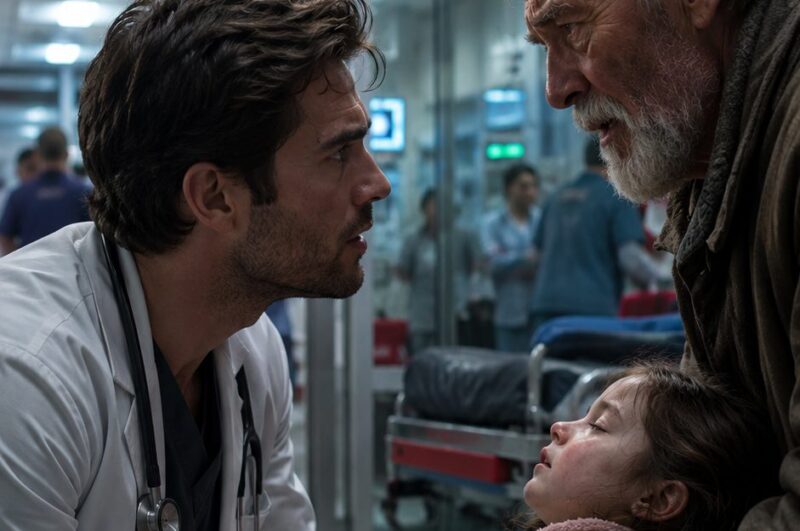
The elderly man’s voice trembled across the crowded hospital lobby. In his arms lay a little girl burning with fever, her tiny face pale from exhaustion and illness.
I was the Chief of Trauma at St. Jude’s Medical Center. For ten years, I had trained myself to keep emotions at a distance.
Patients were diagnoses, emergencies, and procedures—not personal stories. Caring too much felt like a liability in a profession where hesitation could cost lives.
One freezing evening in January, as I reviewed scans in the emergency department, a desperate plea echoed through the hallway.

“Please… save her.”
I looked up and saw an elderly man standing at the admissions desk, clutching a frail child who couldn’t have been older than six. Her skin was ashen, her body limp with fever.
The receptionist calmly explained that hospital policy required financial authorization before admission.
The old man pleaded.
“I’ll find the money. Please help her first.”
Then the little girl lifted her head slightly and whispered,
“Grandpa… please don’t let me go.”
Something inside me cracked.
Ignoring procedure, I stepped forward.
“Get her to Trauma Bay Four. Now.”
The staff immediately rushed into action.
As I began examining the child, I glanced at the man standing beside her.
My breath caught.
It was my father.
Ten years earlier, our relationship had collapsed beyond repair. I had walked away believing there was nothing left between us worth saving.
“Dad?” I whispered.
But there was no time for explanations.
The little girl’s condition was deteriorating rapidly. Her name was Lily. Her fever was over 104 degrees, her oxygen levels were dropping, and her blood pressure had reached dangerous levels.
While my team worked frantically around her, I questioned my father.
He explained that Lily had been ill for days. Without money or insurance, they had been turned away repeatedly by clinics and urgent care centers.
Anger simmered inside me.
Then Lily suddenly began seizing.
The room erupted into motion as we fought to stabilize her.
My father grabbed my arm.
“You can’t let her die.”
“I’m doing everything possible,” I replied.
Tears filled his eyes.
“No,” he said quietly. “You don’t understand.”
His voice trembled.
“Lily isn’t just my granddaughter.”
My heart skipped.
“What are you talking about?”
He closed his eyes.
“She’s your daughter.”
For a moment, the world seemed to stop.
The sounds of monitors, voices, and alarms faded into silence.
Then my father revealed a secret he had carried for a decade.
Ten years ago, I had been deeply in love with a woman named Elena. We planned to build a life together until she disappeared without warning, leaving behind a letter saying she no longer wanted the future we had dreamed about.
Her disappearance shattered me.
It transformed me into the emotionally distant man I had become.
Now my father confessed the truth.
Elena had been pregnant.
Believing a family would distract me from my medical career, he had paid her to leave and convinced her to disappear. The heartbreaking letter that ended our relationship had been part of his plan.
I could barely breathe.
But an even crueler truth followed.
Elena had died from cancer four years earlier.
Before her death, she entrusted Lily to my father and asked him to protect her.
I turned toward the unconscious child lying in the hospital bed.
For the first time, I truly saw her.
The shape of her face.
The curve of her smile.
The familiar eyes.
My daughter.
Just then, new test results arrived.
Lily wasn’t suffering from a simple infection.
She had HLH—a rare and devastating genetic disorder causing her immune system to attack her own body. Multiple organs were already beginning to fail.
She needed immediate treatment.
Then disaster struck.
Lily’s heart stopped.
The trauma room exploded into chaos.
My team started CPR while I administered medications and prepared defibrillation shocks.
“Come on, Lily,” I whispered. “Stay with me.”
The seconds felt endless.
Finally, her heartbeat returned.
Relief washed through the room, but the battle wasn’t over.
The hospital lacked enough compatible resources for the specialized transfusion she desperately needed.
There was only one option.
“I’m her father,” I said. “Use my blood.”
Hospital policies didn’t matter anymore.
Only Lily mattered.
Hours later, I remained beside her as my blood flowed through the transfusion lines into her small body.
The procedure left me weak and exhausted, but I refused to stop.
“She’s my daughter,” I told the surgical team. “Give her whatever she needs.”
Slowly, the treatment began working.
Two days later, I woke up in a recovery room.
My father sat beside my bed holding Lily in his arms.
Color had returned to her cheeks.
She was getting better.
For the first time in years, my father openly admitted everything.
He confessed that he had lost his fortune, reputation, and influence because of the choices he made. Raising Lily had become his attempt to atone for the damage he had caused.
I looked at him and spoke honestly.
“You destroyed my life.”
He nodded quietly.
“I know.”
Yet as I watched him caring for my daughter, I realized that holding onto hatred would only destroy what remained of our future.
A few days later, Lily was discharged from intensive care.
When I entered her room, she smiled at me.
“Grandpa said you gave me your blood.”
“I did,” I answered.
She studied me carefully.
“He also said you’re my daddy.”
My eyes filled with tears.
“Yes,” I whispered. “I am.”
She wrapped her arms around me, and in that moment, the emptiness I had carried for years finally disappeared.
I officially became Lily’s father.
My own father moved closer so he could help raise her and spend the rest of his life repairing the wounds he had created.
I continued leading the trauma department, but I was no longer the cold doctor who viewed patients as medical cases.
That night changed everything.
I learned that medicine can save lives, but forgiveness can heal hearts.
And sometimes, the family you believe is gone forever is simply waiting on the other side of pain.